


Differences in the expression of endogenous efflux transporters in MDR1-transfected versus wildtype cell lines affect P-glycoprotein mediated drug transport
- PMID: 20590635
- PMCID: PMC2938816
- DOI: 10.1111/j.1476-5381.2010.00801.x
Differences in the expression of endogenous efflux transporters in MDR1-transfected versus wildtype cell lines affect P-glycoprotein mediated drug transport
Abstract
Background and purpose: P-glycoprotein (Pgp) efflux assays are widely used to identify Pgp substrates. The kidney cell lines Madin-Darby canine kidney (MDCK)-II and LLC-PK1, transfected with human MDR1 (ABCB1) are used to provide recombinant models of drug transport. Endogenous transporters in these cells may contribute to the activities of recombinant transporters, so that drug transport in MDR1-transfected cells is often corrected for the transport obtained in parental (wildtype) cells. However, expression of endogenous transporters may vary between transfected and wildtype cells, so that this correction may cause erroneous data. Here, we have measured the expression of endogenous efflux transporters in transfected and wildtype MDCK-II or LLC cells and the consequences for Pgp-mediated drug transport.
Experimental approach: Using quantitative real-time RT-PCR, we determined the expression of endogenous Mdr1 mRNA and other efflux transporters in wildtype and MDR1-transfected MDCK-II and LLC cells. Transcellular transport was measured with the test substrate vinblastine.
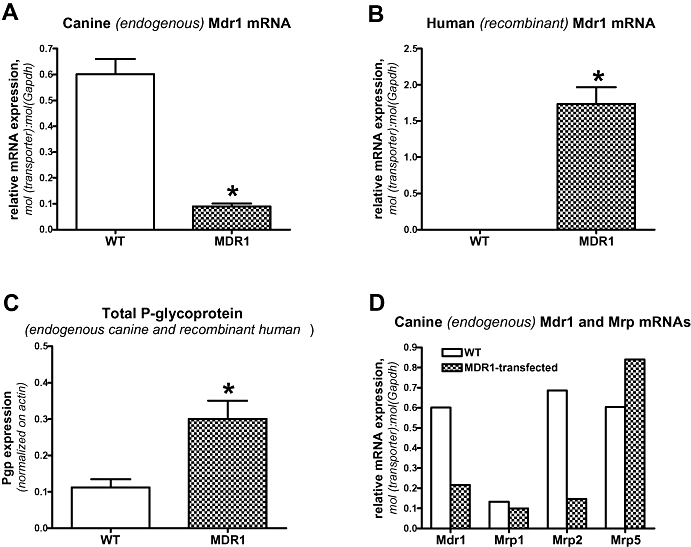
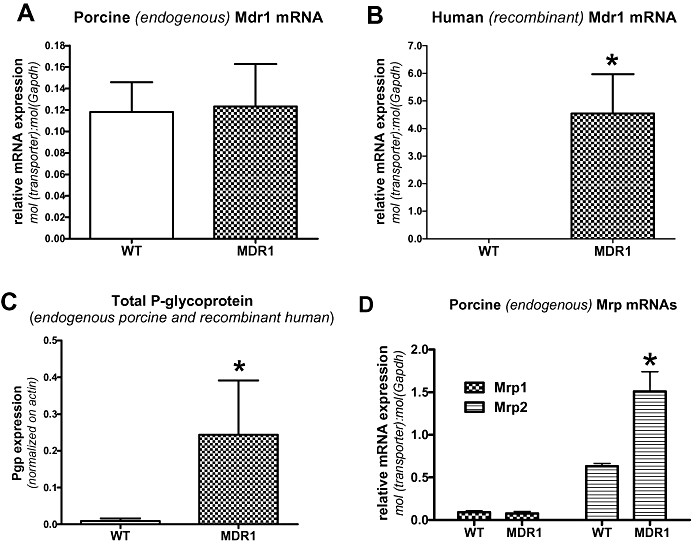
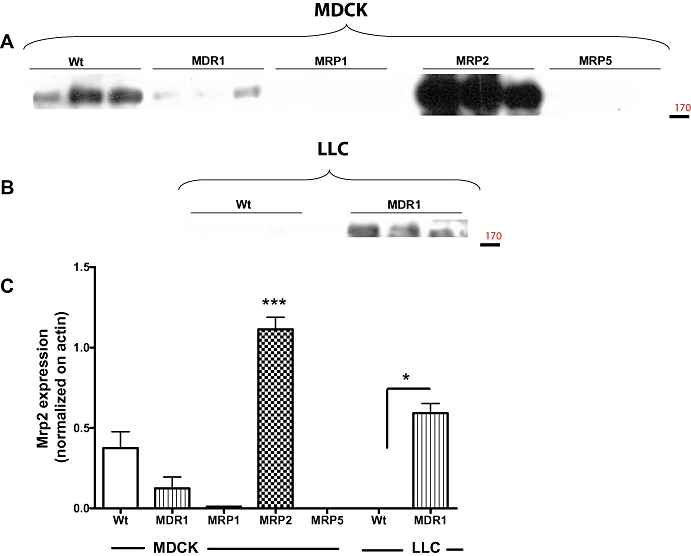
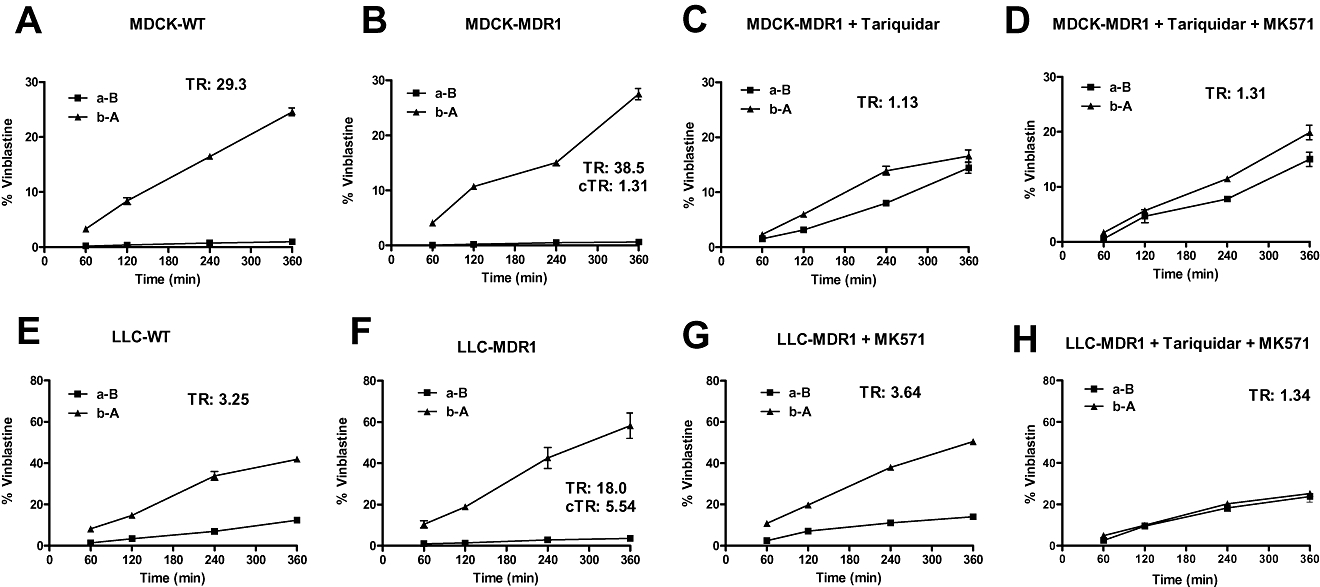
Key results: In MDR1-transfected MDCK cells, expression of endogenous (canine) Mdr1 and Mrp2 (Abcc2) mRNA was markedly lower than in wildtype cells, whereas MDR1-transfected LLC cells exhibited comparable Mdr1 but strikingly higher Mrp2 mRNA levels than wildtype cells. As a consequence, transport of vinblastine by human Pgp in efflux experiments was markedly underestimated when transport in MDR1-transfected MDCK cells was corrected for transport obtained in wildtype cells. This problem did not occur in LLC cells.
Conclusions and implications: Differences in the expression of endogenous efflux transporters between transfected and wildtype MDCK cells provide a potential bias for in vitro studies on Pgp-mediated drug transport.
Figures
References
-
- Allen JD, van Loevezijn A, Lakhai JM, van der Valk M, van Tellingen O, Reid G, et al. Potent and specific inhibition of the breast cancer resistance protein multidrug transporter in vitro and in mouse intestine by a novel analogue of fumitremorgin C. Mol Cancer Ther. 2002;1:417–425. - PubMed
-
- Artursson P. Epithelial transport of drugs in cell culture. I: a model for studying the passive diffusion of drugs over intestinal absorptive (Caco-2) cells. J Pharm Sci. 1990;79:476–482. - PubMed
-
- Baltes S, Gastens AM, Fedrowitz M, Potschka H, Kaever V, Löscher W. Differences in the transport of the antiepileptic drugs phenytoin, levetiracetam and carbamazepine by human and mouse P-glycoprotein. Neuropharmacology. 2007a;52:333–346. - PubMed
-
- Baltes S, Fedrowitz M, Luna-Tortós C, Potschka H, Löscher W. Valproic acid is not a substrate for P-glycoprotein or multidrug resistance proteins 1 and 2 in a number of in vitro and in vivo transport assays. J Pharmacol Exp Ther. 2007b;320:331–343. - PubMed
Publication types
MeSH terms
Substances
LinkOut - more resources
Full Text Sources
Research Materials
Miscellaneous
