


Openers of small conductance calcium-activated potassium channels selectively enhance NO-mediated bradykinin vasodilatation in porcine retinal arterioles
- PMID: 20590639
- PMCID: PMC2938820
- DOI: 10.1111/j.1476-5381.2010.00803.x
Openers of small conductance calcium-activated potassium channels selectively enhance NO-mediated bradykinin vasodilatation in porcine retinal arterioles
Abstract
Background and purpose: Small (SK(Ca) or K(Ca)2) and intermediate (IK(Ca) or K(Ca)3.1) conductance calcium-activated potassium channels are involved in regulation of vascular tone and blood pressure. The present study investigated whether NS309 (6,7-dichloro-1H-indole-2,3-dione 3-oxime) and CyPPA (cyclohexyl-[2-(3,5-dimethyl-pyrazol-1-yl)-6-methyl-pyrimidin-4-yl]-amine), which are selective openers of SK(Ca) and IK(Ca) channels and of SK(Ca)2 and SK(Ca)3 channels, respectively, enhance endothelium-dependent vasodilatation in porcine retinal arterioles.
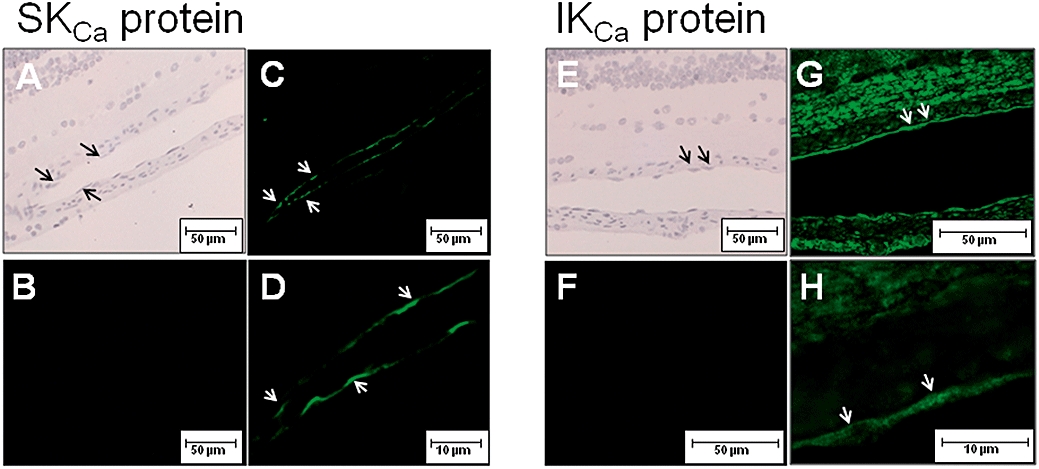
Experimental approach: In porcine retinal arterioles, SK(Ca)3 and IK(Ca) protein localization was examined by immunolabelling. Endothelial cell calcium was measured by fluorescence imaging. For functional studies, arterioles with internal diameters of 116 +/- 2 microm (n = 276) were mounted in microvascular myographs for isometric tension recordings.
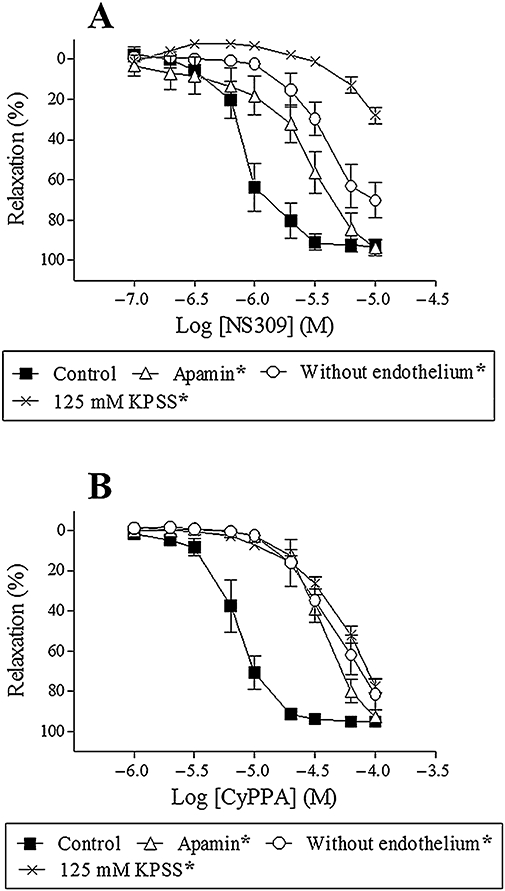
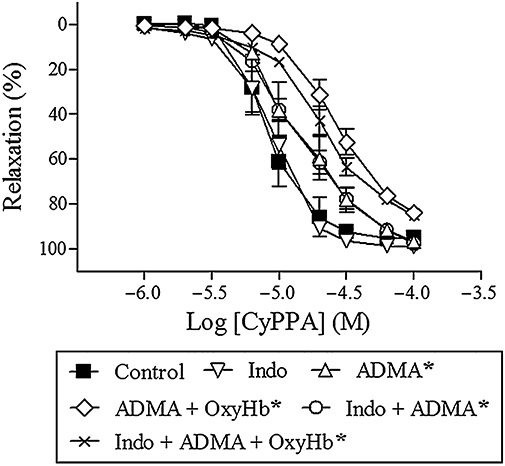
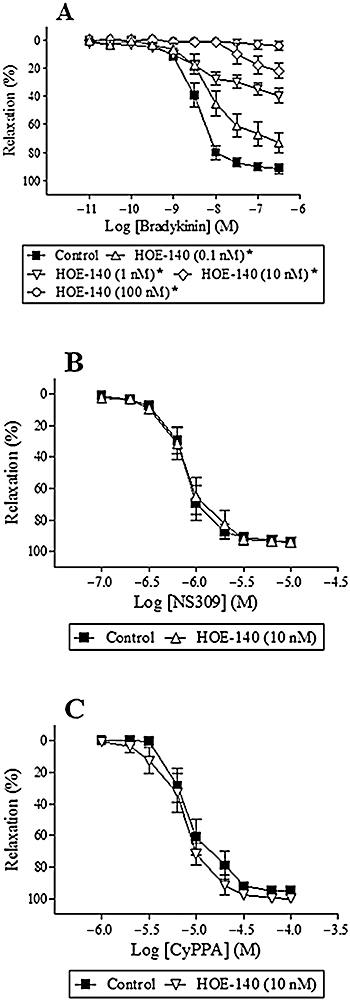
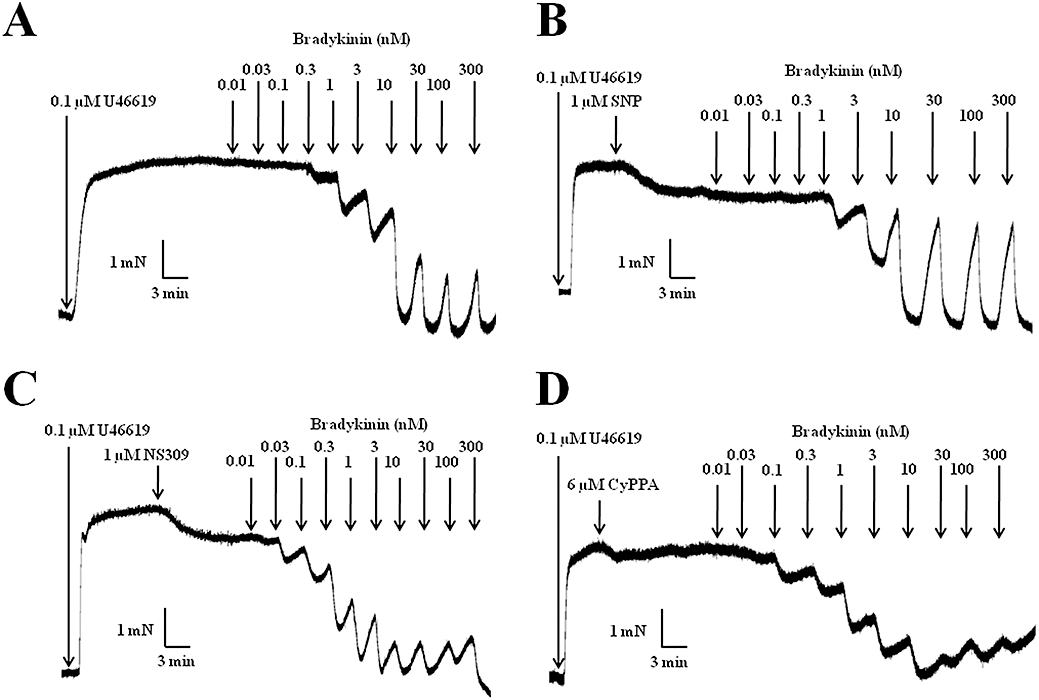
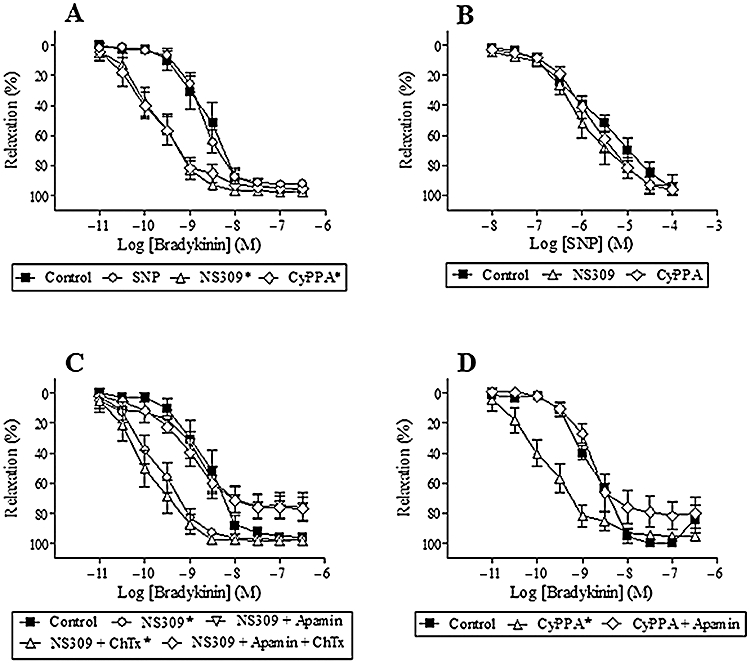
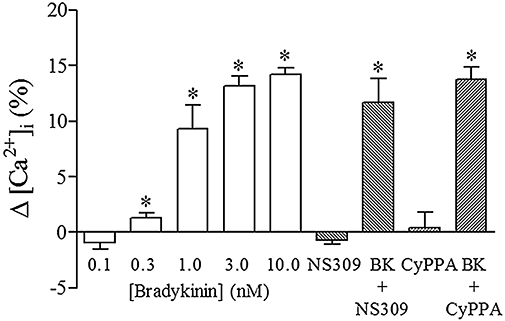
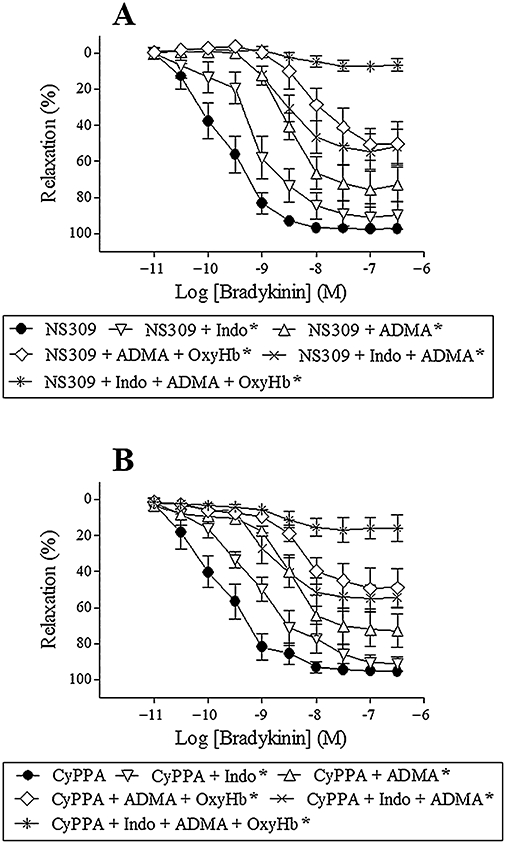
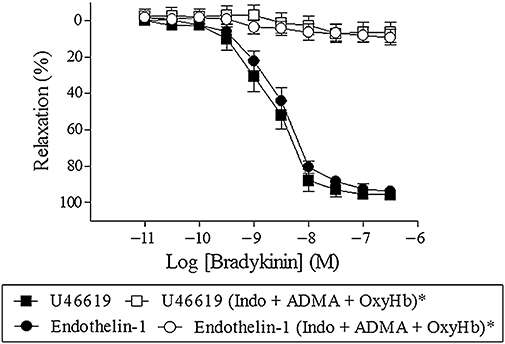
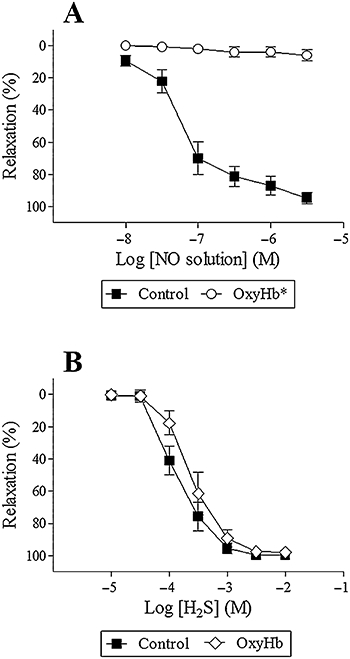
Key results: SK(Ca)3 and IK(Ca) protein was localized in the endothelium. Bradykinin, but not NS309 or CyPPA increased endothelial cell calcium. Pre-incubation with NS309 or CyPPA enhanced bradykinin relaxation without changing endothelial cell calcium. This enhanced relaxation was abolished by blocking SK(Ca) channels with apamin. In the presence of NS309 or CyPPA, mainly inhibition of NO synthase with asymmetric dimethylarginine, but also inhibition of cyclooxygenase with indomethacin, reduced bradykinin relaxation. Bradykinin relaxation was completely abolished by NO synthase and cyclooxygenase inhibition together with a NO scavenger, oxyhaemoglobin.
Conclusions and implications: In porcine retinal arterioles, bradykinin increases endothelial cell calcium leading to activation of SK(Ca) and IK(Ca) channels. Without altering endothelial cell calcium, NS309 and CyPPA open SK(Ca) channels that enhance NO-mediated bradykinin relaxations. These results imply that opening SK(Ca) channels improves endothelium-dependent relaxation and makes this channel a potential target for treatments aimed at restoring retinal blood flow.
Figures
References
-
- Adams DJ, Barakeh J, Laskey R, Van Breemen C. Ion channels and regulation of intracellular calcium in vascular endothelial cells. FASEB J. 1989;3:2389–2400. - PubMed
-
- Beauchamp RO, Jr, Bus JS, Popp JA, Boreiko CJ, Andjelkovich DA. A critical review of the literature on hydrogen sulfide toxicity. Crit Rev Toxicol. 1984;13:25–97. - PubMed
-
- Brahler S, Kaistha A, Schmidt VJ, Wolfle SE, Busch C, Kaistha BP, et al. Genetic deficit of SK3 and IK1 channels disrupts the endothelium-derived hyperpolarizing factor vasodilator pathway and causes hypertension. Circulation. 2009;119:2323–2332. - PubMed
Publication types
MeSH terms
Substances
LinkOut - more resources
Full Text Sources
