


Open liver resection for colorectal metastases: better short- and long-term outcomes in patients potentially suitable for laparoscopic liver resection
- PMID: 20590886
- PMCID: PMC2889271
- DOI: 10.1111/j.1477-2574.2009.00143.x
Open liver resection for colorectal metastases: better short- and long-term outcomes in patients potentially suitable for laparoscopic liver resection
Abstract
Background: There is no prospective randomized data comparing laparoscopic to open hepatectomy. This study compared short- and long-term outcomes in patients undergoing hepatectomy for colorectal metastases (CRM), who were suitable for either laparoscopic or open surgery.
Methods: Data were prospectively collected from consecutive patients undergoing hepatic resection of CRM at a single centre (1987-2007). Patients who were suitable for laparoscopic resection (Group 1) were compared with patients whose tumour characteristics would best be considered for open resection (Group 2).
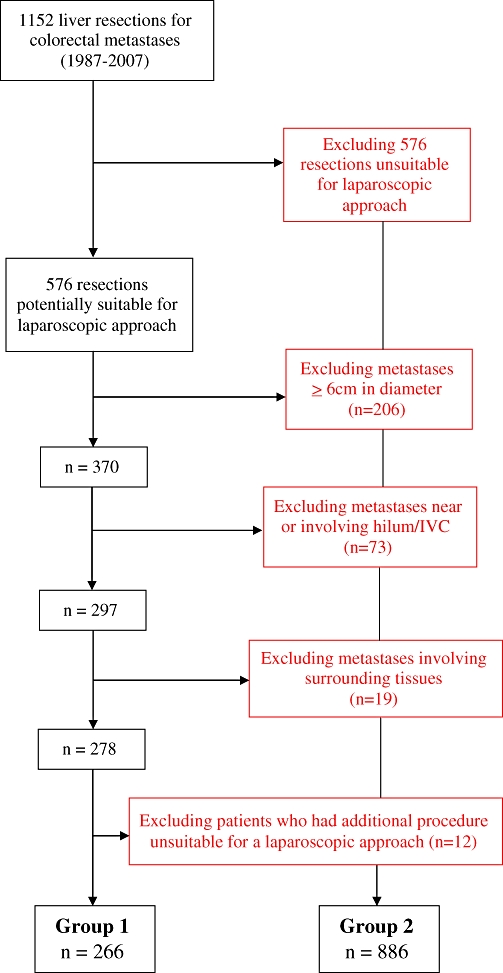
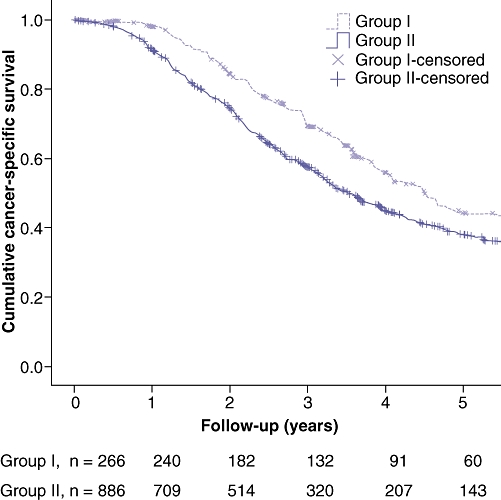
Results: Out of 1152 hepatectomies, 266 (23.1%) were deemed suitable for a laparoscopic approach. The median (IQR) number of metastases was greater in Group 2 [2(1-20) vs. 1(1-10), P < 0.001], as was the mean (SD) tumour size [5.3(3.6) cm vs. 3.3(1.2) cm, P < 0.001]. The median (IQR) operation time [210 (70) min vs. 240 (90) min, P < 0.001] and blood loss [270 (265) ml vs. 355 (320) ml, P < 0.001] were less in Group 1. There was no difference in length of stay, morbidity or mortality. Patients in Group 2 had a higher R1 resection rate (14.9%) compared with Group 1 (4.5%, P < 0.001) and lower 5-year survival (37.8% vs. 44.2%, P= 0.005).
Discussion: Current criteria for laparoscopic hepatectomy selects patients who have more straight-forward surgery, with less risk of an involved resection margin and better long-term survival, compared with patients unsuited to a laparoscopic approach. Clearly defined criteria for laparoscopic hepatectomy are essential to allow meaningful analysis of outcomes and the results of unrandomized series of laparoscopic hepatectomies must be interpreted with caution.
Figures
Comment in
-
Laparoscopic and open liver resection for colorectal metastases: different indications?HPB (Oxford). 2010 Aug;12(6):434; author reply 435. doi: 10.1111/j.1477-2574.2010.00195.x. HPB (Oxford). 2010. PMID: 20662795 Free PMC article. No abstract available.
References
-
- Stangl R, Altendorf-Hofmann A, Charnley RM, Scheele J. Factors influencing the natural history of colorectal liver metastases. Lancet. 1994;343:1405–1410. - PubMed
-
- Scheele J, Stangl R, Altendorf-Hofmann A. Hepatic metastases from colorectal cancer: impact of surgical resection on the natural history. Br J Surg. 1990;77:1241–1246. - PubMed
-
- Adam R, Huguet E, Azoulay D, Castaing D, Kunstlinger F, Levi F, et al. Hepatic resection after down-staging of unresectable hepatic colorectal metastases. Surg Oncol Clin N Am. 2003;12:211–220. - PubMed
-
- Rees M, Tekkis PP, Welsh FKS, O’Rourke TR, John TG. Evaluation of long-term survival after hepatic resection for metastatic colorectal cancer: a multifactorial model of 929 patients. Ann Surg. 2008;247:125–135. - PubMed
Publication types
MeSH terms
LinkOut - more resources
Full Text Sources
Medical
