


Environmental and biological monitoring of exposures to PAHs and ETS in the general population
- PMID: 20591483
- PMCID: PMC3148021
- DOI: 10.1016/j.envint.2010.05.015
Environmental and biological monitoring of exposures to PAHs and ETS in the general population
Abstract
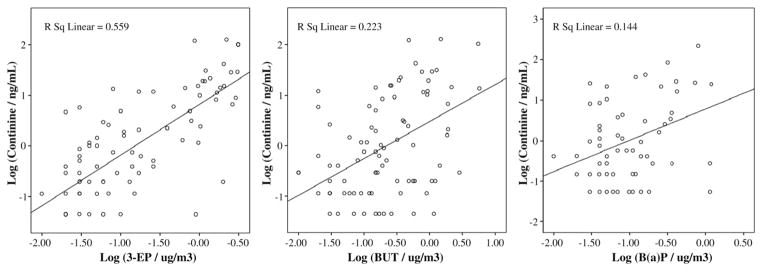
The objective of this study was to analyse environmental tobacco smoke (ETS) and PAH metabolites in urine samples of non-occupationally exposed non-smoker adult subjects and to establish relationships between airborne exposures and urinary concentrations in order to (a) assess the suitability of the studied metabolites as biomarkers of PAH and ETS, (b) study the use of 3-ethenypyridine as ETS tracer and (c) link ETS scenarios with exposures to carcinogenic PAH and VOC. Urine samples from 100 subjects were collected and concentrations of monophenolic metabolites of naphthalene, fluorene, phenanthrene, and pyrene and the nicotine metabolites cotinine and trans-3'-hydroxycotinine were measured using liquid chromatography-tandem mass spectrometry (LC-MS/MS) to assess PAH and ETS exposures. Airborne exposures were measured using personal exposure samplers and analysed using GC-MS. These included 1,3-butadiene (BUT), 3-ethenylpyridine (3-EP) (a tobacco-specific tracer derived from nicotine pyrolysis) and PAHs. ETS was reported by the subjects in 30-min time-activity questionnaires and specific comments were collected in an ETS questionnaire each time ETS exposure occurred. The values of 3-EP (>0.25 microg/m(3) for ETS) were used to confirm the ETS exposure status of the subject. Concentrations as geometric mean, GM, and standard deviation (GSD) of personal exposures were 0.16 (5.50)microg/m(3) for 3-EP, 0.22 (4.28)microg/m(3) for BUT and 0.09 (3.03)ng/m(3) for benzo(a)pyrene. Concentrations of urinary metabolites were 0.44 (1.70)ng/mL for 1-hydroxypyrene and 0.88 (5.28)ng/mL for cotinine. Concentrations of urinary metabolites of nicotine were lower than in most previous studies, suggesting very low exposures in the ETS-exposed group. Nonetheless, concentrations were higher in the ETS population for cotinine, trans-3'hydroxycotinine, 3-EP, BUT and most high molecular weight PAH, whilst 2-hydroxyphenanthrene, 3+4-hydroxyphenanthrene and 1-hydroxyphenanthrene were only higher in the high-ETS subpopulation. There were not many significant correlations between either personal exposures to PAH and their urinary metabolites, or of the latter with ETS markers. However, it was found that the urinary log cotinine concentration showed significant correlation with log concentrations of 3-EP (R=0.75), BUT (R=0.47), and high molecular weight PAHs (MW>200), especially chrysene (R=0.55) at the p=0.01 level. On the other hand, low correlation was observed between the PAH metabolite 2-naphthol and the parent PAH, gas-phase naphthalene. These results suggest that (1) ETS is a significant source of inhalation exposure to the carcinogen 1,3-butadiene and high molecular weight PAHs, many of which are carcinogenic, and (2) that for lower molecular weight PAHs such as naphthalene, exposure by routes other than inhalation predominate, since metabolite levels correlated poorly with personal exposure air sampling.
Copyright 2010 Elsevier Ltd. All rights reserved.
Figures

References
-
- Benowitz NL, Jacob P. Metabolism of nicotine to cotinine studied by a dual stable-isotope method. Clin Pharmacol Ther. 1994;56(5):483–93. - PubMed
-
- Bernert JT, Turner WE, Pirkle JL, Sosnoff CS, Akins JR, Waldrep MK, et al. Development and validation of sensitive method for determination of serum cotinine in smokers and nonsmokers by liquid chromatography atmospheric pressure ionization tandem mass spectrometry. Clin Chem. 1997;43(12):2281–91. - PubMed
-
- Boeniger MF, Lowry LK, Rosenberg J. Interpretation of urine results used to assess chemical-exposure with emphasis on creatinine adjustments — a review. Am Ind Hyg Assoc J. 1993;54(10):615–27. - PubMed
-
- Bouchard M, Krishnan K, Viau C. Kinetics of tissue distribution and elimination of pyrene and 1-hydroxypyrene following intravenous administration of [c-14] pyrene in rats. Toxicol Sci. 1998;46(1):11–20. - PubMed
Publication types
MeSH terms
Substances
Grants and funding
LinkOut - more resources
Full Text Sources
Medical
Miscellaneous
