BRCA1 loss preexisting in small subpopulations of prostate cancer is associated with advanced disease and metastatic spread to lymph nodes and peripheral blood
- PMID: 20592016
- PMCID: PMC3042432
- DOI: 10.1158/1078-0432.CCR-10-0150
BRCA1 loss preexisting in small subpopulations of prostate cancer is associated with advanced disease and metastatic spread to lymph nodes and peripheral blood
Abstract
Purpose: A preliminary study performed on a small cohort of multifocal prostate cancer (PCa) detected BRCA1 allelic imbalances among circulating tumor cells (CTC). The present analysis was aimed to elucidate the biological and clinical roles of BRCA1 losses in metastatic spread and tumor progression in PCa patients.
Experimental design: To map molecular progression in PCa outgrowth, we used fluorescence in situ hybridization analysis of primary tumors and lymph node sections, and CTCs from peripheral blood.
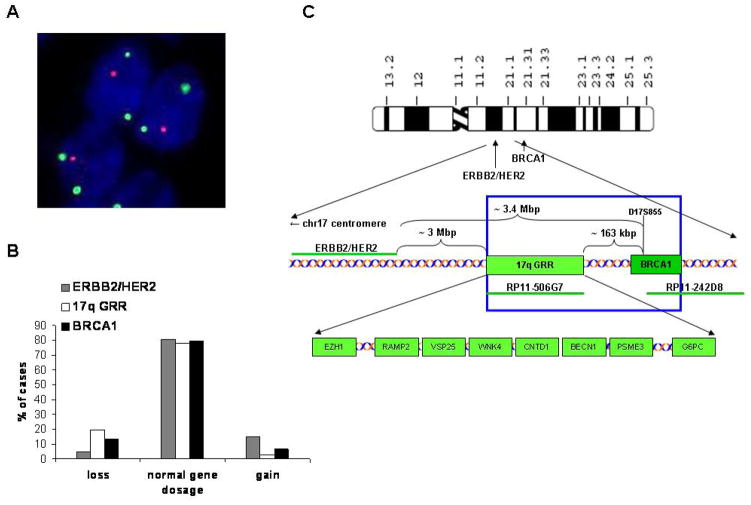
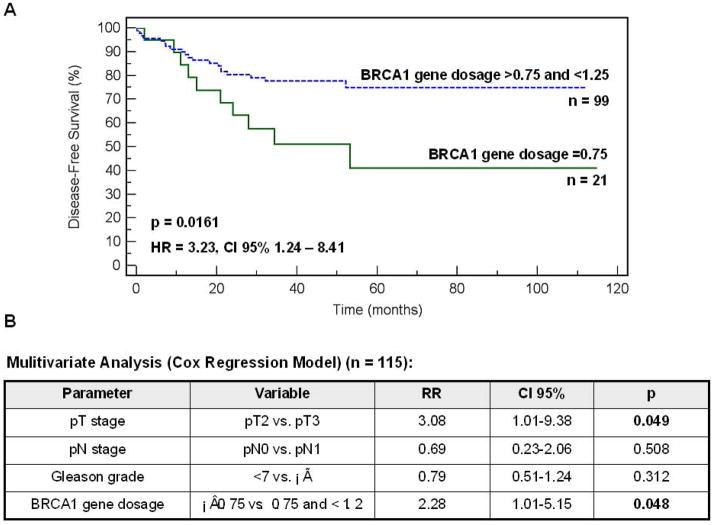
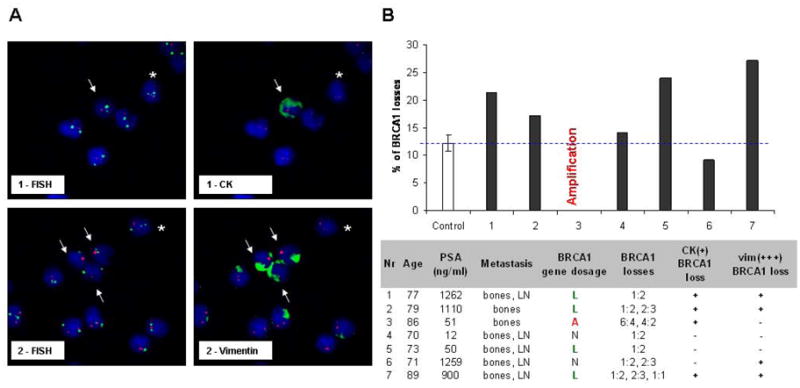
Results: We found that 14% of 133 tested patients carried monoallelic BRCA1 loss in at least one tumor focus. Extended molecular analysis of chr17q revealed that this aberration was often a part of larger cytogenetic rearrangement involving chr17q21 accompanied by allelic imbalance of the tumor suppressor gene PTEN and lack of BRCA1 promoter methylation. The BRCA1 losses correlated with advanced T stage (P < 0.05), invasion to pelvic lymph nodes (P < 0.05), as well as biochemical recurrence (P < 0.01). Their prevalence was twice as high within 62 lymph node metastases (LNM) as in primary tumors (27%, P < 0.01). The analysis of 11 matched primary PCa-LNM pairs confirmed the suspected transmission of genetic abnormalities between these two sites. In four of seven patients with metastatic disease, BRCA1 losses appeared in a minute fraction of cytokeratin- and vimentin-positive CTCs.
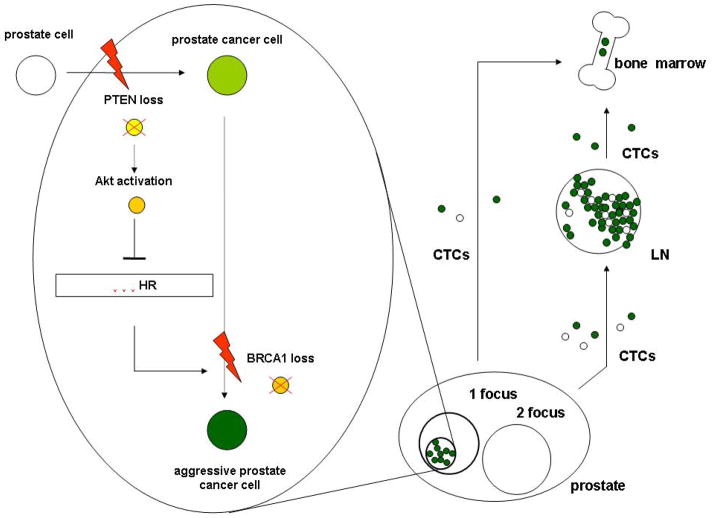
Conclusions: Small subpopulations of PCa cells bearing BRCA1 losses might be one confounding factor initiating tumor dissemination and might provide an early indicator of shortened disease-free survival.
Figures
References
-
- Schröder FH, Hugosson J, Roobol MJ, et al. Screening and prostate-cancer mortality in a randomized European study. N Engl J Med. 2009;360:1320–8. - PubMed
-
- de Bono JS, Scher HI, Montgomery RB, et al. Circulating tumor cells predict survival benefit from treatment in metastatic castration-resistant prostate cancer. Clin Cancer Res. 2008;14:6302–9. - PubMed
-
- Schmidt H, DeAngelis G, Eltze E, Grockel I, Semjonow A, Brandt B. Asynchronous growth of prostate cancer is reflected by circulating tumor cells delivered from distinct, even small foci, harboring loss of heterozygosity of the PTEN gene. Cancer Res. 2006;66:8959–65. - PubMed
-
- Boulton S. Cellular functions of the BRCA tumour-suppressor proteins. Biochem Soc Trans. 2006;34:633–45. - PubMed
-
- Turner N, Tutt A, Ashworth A. Hallmarks of ‘BRCAness’ in sporadic cancers. Nat Rev Cancer. 2004;4:814–9. - PubMed
Publication types
MeSH terms
Grants and funding
LinkOut - more resources
Full Text Sources
Other Literature Sources
Medical
Research Materials
Miscellaneous