


Accuracy and cost-effectiveness of cervical cancer screening by high-risk human papillomavirus DNA testing of self-collected vaginal samples
- PMID: 20592553
- PMCID: PMC2898894
- DOI: 10.1097/LGT.0b013e3181cd6d36
Accuracy and cost-effectiveness of cervical cancer screening by high-risk human papillomavirus DNA testing of self-collected vaginal samples
Abstract
Objective: Estimate the accuracy and cost-effectiveness of cervical cancer screening strategies based on high-risk human papillomavirus (HPV) DNA testing of self-collected vaginal samples.
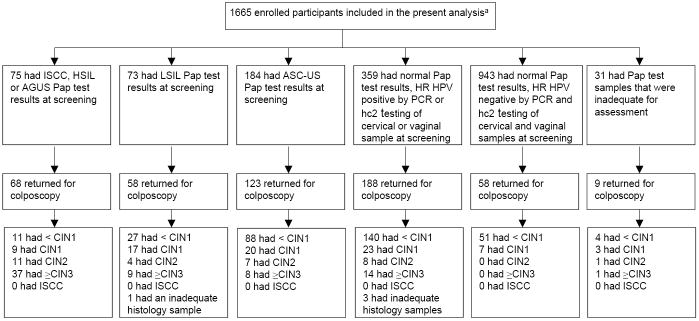
Materials and methods: A subset of 1,665 women (age range, 18-50 y) participating in a cervical cancer screening study were screened by liquid-based cytology and by high-risk HPV DNA testing of both self-collected vaginal swab samples and clinician-collected cervical samples. Women with positive/abnormal screening test results and a subset of women with negative screening test results were triaged to colposcopy. On the basis of individual and combined test results, 5 screening strategies were defined. Estimates of sensitivity and specificity for cervical intraepithelial neoplasia grade 2 or worse were calculated, and a Markov model was used to estimate the incremental cost-effectiveness ratios for each strategy.
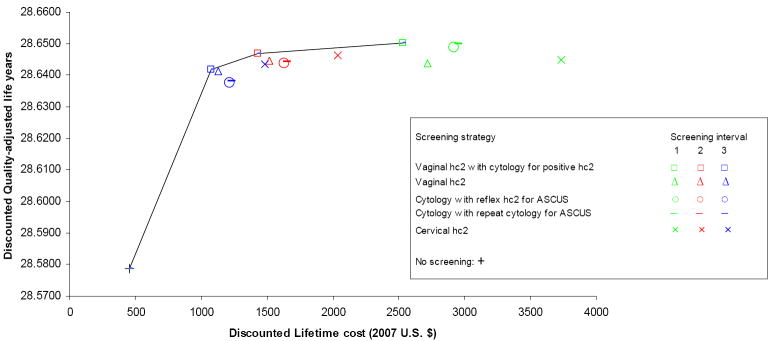
Results: Compared with cytology-based screening, high-risk HPV DNA testing of self-collected vaginal samples was more sensitive (68%, 95% CI = 58%-78% vs 85%, 95% CI = 76%-94%) but less specific (89%, 95% CI = 86%-91% vs 73%, 95% CI = 67%-79%). A strategy of high-risk HPV DNA testing of self-collected vaginal samples followed by cytology triage of HPV-positive women was comparably sensitive (75%, 95% CI = 64%-86%) and specific (88%, 95% CI = 85%-92%) to cytology-based screening. In-home self-collection for high-risk HPV DNA detection followed by in-clinic cytology triage had a slightly lower lifetime cost and a slightly higher quality-adjusted life year (QALY) expectancy than did cytology-based screening (incremental cost-effectiveness ratio of triennial screening compared with no screening was $9,871/QALY and $12,878/QALY, respectively).
Conclusions: Triennial screening by high-risk HPV DNA testing of in-home, self-collected vaginal samples followed by in-clinic cytology triage was cost-effective.
Figures
References
-
- Stoler MH, Schiffman M. Interobserver reproducibility of cervical cytologic and histologic interpretations: realistic estimates from the ASCUS-LSIL Triage Study. J Natl Cancer Inst. 2001;285:1500–5. - PubMed
-
- Cuzick J. Screening for cervical cancer. In: Rohan TE, Shah KV, editors. Cervical Cancer: From Etiology to Prevention. Norwell: Kluwer Academic Publishers; 2004. pp. 261–93.
-
- Nanda K, McCrory DC, Myers ER, Bastian LA, Hasselblad V, Hickey JD, et al. Accuracy of the Papanicolaou test in screening for and follow-up of cervical cytologic abnormalities: a systematic review. Ann Intern Med. 2000;132:810–19. - PubMed
-
- Wright TC, Jr, Massad LS, Dunton CJ, Spitzer M, Wilkinson EJ, Solomon D. 2006 consensus guidelines for the management of women with abnormal cervical cancer screening tests. Am J Obstet Gynecol. 2007;197:346–55. - PubMed
