


Application of MS-based proteomics to study serum protein adsorption/absorption and complement C3 activation on poly(ethylene glycol) hydrogels
- PMID: 20594411
- PMCID: PMC3855078
- DOI: 10.1163/092050610X508400
Application of MS-based proteomics to study serum protein adsorption/absorption and complement C3 activation on poly(ethylene glycol) hydrogels
Abstract
Although the interaction between cells and poly(ethylene glycol) (PEG) hydrogels is well documented, there lacks a thorough investigation into the adsorption of blood proteins on these surfaces which dictates the observed cellular and in vivo host response. Thus, a clear understanding of how surface-bound proteins mediate the unique biological property of PEG hydrogels is fundamentally important. The information obtained will also provide insights into future biomaterial design. In this study, several mass-spectrometrybased proteomic tools coupled with complementary immunoassays were employed to survey the complex surface-bound serum proteome. The adsorption of vitronectin, thrombin, fibrinogen and complement component C3 was significantly lower on PEG hydrogels than on tissue culture polystyrene (TCPS). Although PEG hydrogels mediated lower C3 adsorption than TCPS, the extent of C3 activation between the two surfaces was comparable. Adherent monocyte density was also significantly lower on PEG hydrogels as compared to TCPS. Taken together, these results support the critical role of the complement C3 in mediating monocyte adhesion on biomaterials. Thus we conclude that the biocompatibility of PEG hydrogels both in vitro and in vivo can be partly contributed to their limited C3 interaction and monocyte activity.
Keywords: COMPLEMENT C3; FIBRINOGEN; MASS SPECTROMETRY; POLY(ETHYLENE GLYCOL) HYDROGEL; THROMBIN; VITRONECTIN.
Figures
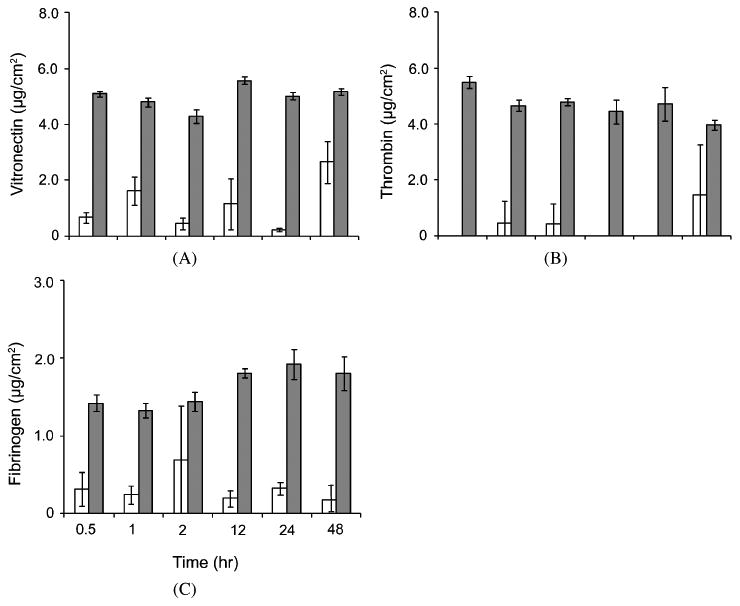
 ) from DMEM supplemented with whole human serum at 0.5, 1, 2, 12, 24 and 48 h. All data presented as average ± SD (n = 3).
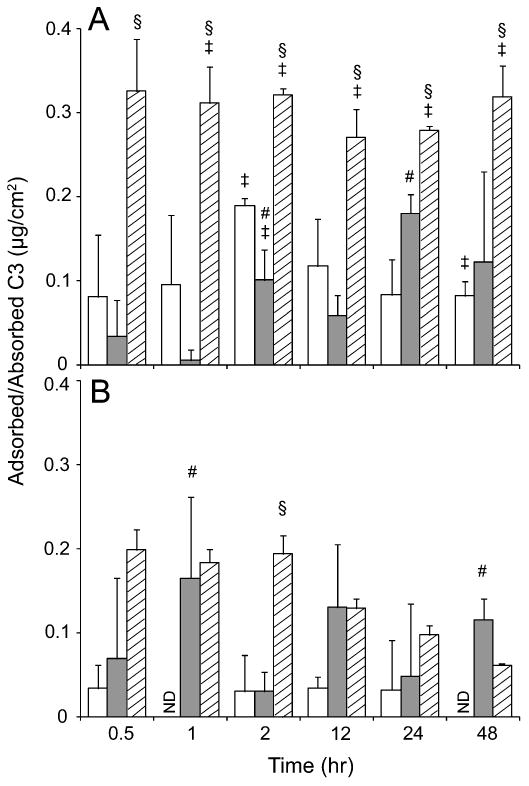 )) and TCPS (▨) from RPMI 1640 supplemented with pooled human sera (A) or C3-inactivated serum (B) at 0.5, 1, 2, 12, 24 and 48 h. All data presented as average ± SD (n = 3). § Significantly different compared to PEG hydrogels (575 and 3400 Da), P < 0.05; ‡significantly different compared to C3-inactivated serum, P < 0.05; #significantly different compared to PEG hydrogel (575 Da), P < 0.05. ND, below detection limit.
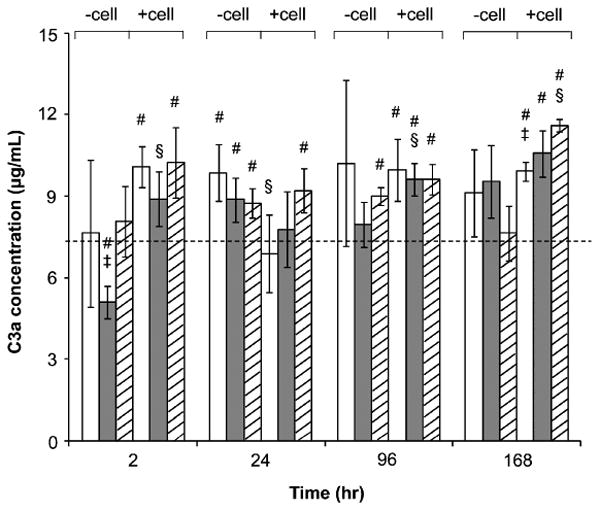 )) and TCPS (▨). Human primary monocytes were seeded on these substrates in RPMI 1640 supplemented with 10% pooled human sera. Culture supernatants with and without cells were collected at 2, 24, 96 and 168 h. The C3a concentrations in supernatants were analyzed by ELISA. The dashed line represents the C3a concentration in 10% pooled human sera without incubation with any substrate. All data presented as average ± SD (n = 3). § Significantly different compared to the same substrate without cells, P < 0.05; ‡significantly different compared to TCPS, P < 0.05; #significantly different compared to pooled human sera, P < 0.05.
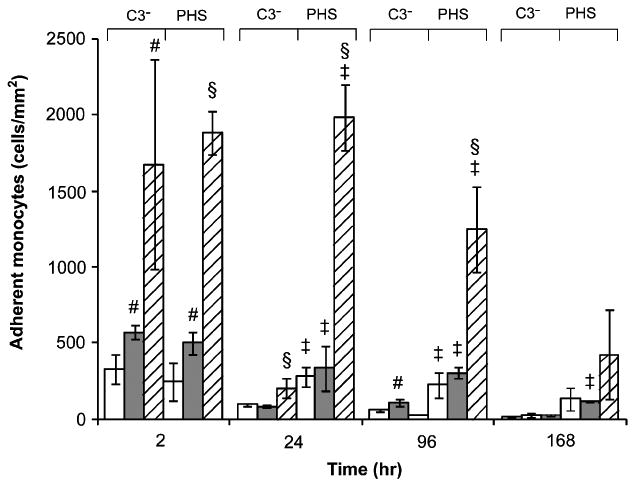 ) and TCPS (▨) with RPMI 1640 supplemented with C3-inactivated (C3−) or pooled human sera (PHS) at 2, 24, 96 and 168 h. Cell seeding density was 0.5 ml at 5 × 10 cells/ml. All data presented as average ± SD (n = 3). §Significantly different compared to PEG hydrogels (575 and 3400 Da), P < 0.05; ‡significantly different compared to C3-inactivated serum, P < 0.05; #significantly different compared to PEG hydrogel (575 Da), P < 0.05.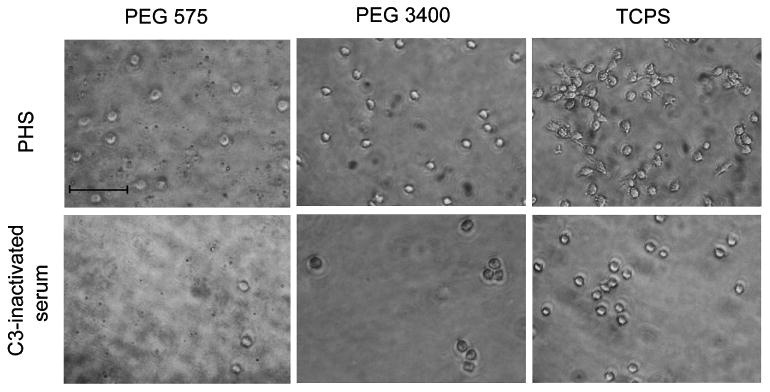
References
-
- Nakanishi K, Sakiyama T, Imamura K. J Biosci Bioeng. 2001;91:233. - PubMed
-
- Welle A, Grunze M, Tur D. J Colloid Interface Sci. 1998;197:263. - PubMed
-
- Sun S, Yue Y, Huang X, Meng D. J Membr Sci. 2003;222:3.
-
- Chen H, Yuan L, Song W, Wu Z, Li D. Prog Polym Sci. 2008;33:1059.
-
- Higuchi A, Sugiyama K, Yoon BO, Sakurai M, Hara M, Sumita M, Sugawara S, Shirai T. Biomaterials. 2003;24:3235. - PubMed
Publication types
MeSH terms
Substances
Grants and funding
LinkOut - more resources
Full Text Sources
Miscellaneous