Adolescent women can perform a point-of-care test for trichomoniasis as accurately as clinicians
- PMID: 20595142
- PMCID: PMC3221308
- DOI: 10.1136/sti.2009.042168
Adolescent women can perform a point-of-care test for trichomoniasis as accurately as clinicians
Abstract
Objectives: To compare the accuracy (ie, correlation, sensitivity, specificity) of self-performed point-of-care (POC) tests with clinician-performed tests for trichomoniasis in adolescent women.
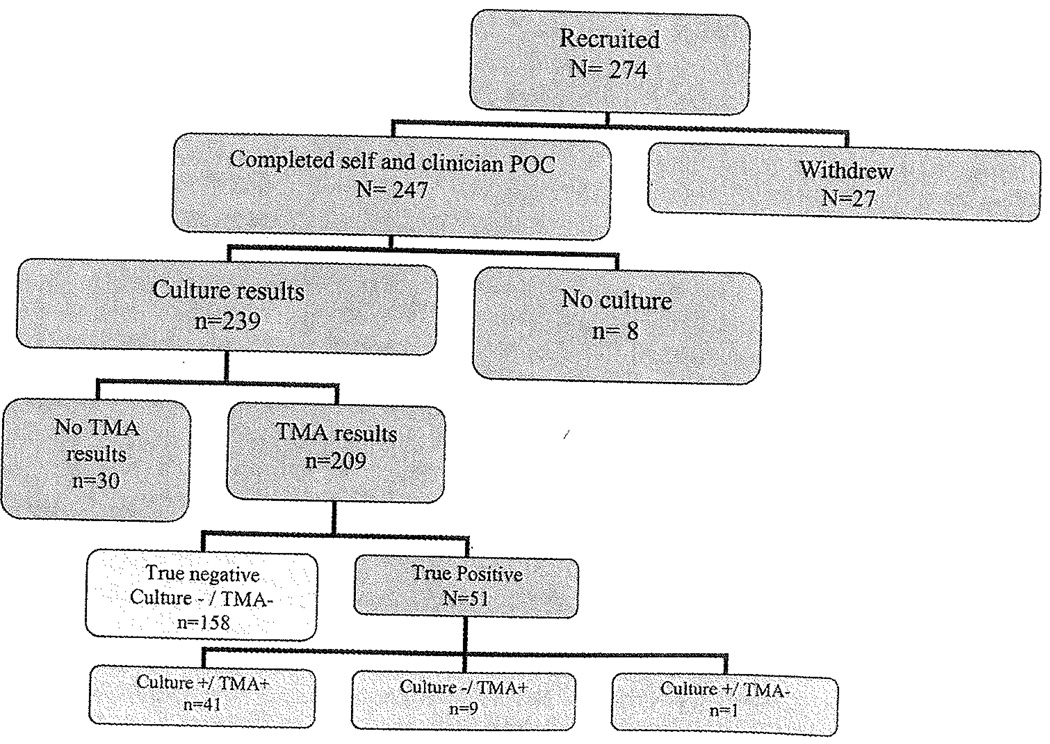
Methods: Sexually experienced women aged 14-22 years (n=209) collected a vaginal swab and performed a POC test for trichomoniasis. Using a speculum, the clinician obtained vaginal swabs that were tested for trichomoniasis using the POC test, wet mount, culture and transcription-mediated amplification (TMA) using standard and alternative primers. Self and clinician results were compared with true positives, defined as either culture-positive or TMA-positive with both sets of primers.
Results: Participants' mean age was 17.8 years; 87% were African-American; 74% reported vaginal itching or discharge and 51 (24%) had trichomoniasis. Over 99% correctly performed and interpreted her self-test. Self and clinician POC tests were highly correlated (95.7% agreement, κ 0.87). Compared with true positives, the sensitivity of the self-POC test was 78% (CI 65% to 89%), similar to that of the clinician-POC test (84%, CI 71% to 93%) and culture (82%, CI 69% to 92%), and significantly better than wet mount (39%, CI 26% to 54%). The specificity of the self-POC test was 99% (CI 96% to 100%), similar to that of the clinician-POC test (100%, CI 98% to 100%). The sensitivity of the self-POC test was not affected by vaginal symptoms or other variables.
Conclusions: Young women performing a self-POC test detected as many trichomoniasis infections as clinician-POC tests or culture, twice as many as wet mount and slightly fewer than an amplified test. Incorporating self-obtained or self-performed POC tests into routine practice could effectively increase the identification and treatment of trichomoniasis in this vulnerable population.
Figures
References
-
- Weinstock H, Berman S, Cates W., Jr Sexually transmitted diseases among american youth: incidence and prevalence estimates, 2000. Perspect Sex Reprod Health. 2004;36:6–10. - PubMed
-
- Sutton M, Sternberg M, Koumans EH, et al. The prevalence of Trichomonas vaginalis infection among reproductive-age women in the United States, 2001–2004. Clin Infect Dis. 2007;45:1319–1326. - PubMed
-
- Miller WC, Swygard H, Hobbs MM, et al. The prevalence of trichomoniasis in young adults in the United States. Sex Transm Dis. 2005;32:593–598. - PubMed
-
- Miller WC, Ford CA, Morris M, et al. Prevalence of chlamydial and gonococcal infections among young adults in the United States. JAMA. 2004;291:2229–2236. - PubMed
-
- Datta SD, Sternberg M, Johnson RE, et al. Gonorrhea and chlamydia in the United States among persons 14 to 39 years of age, 1999 to 2002. Ann Intern Med. 2007;147:89–96. - PubMed
Publication types
MeSH terms
Grants and funding
LinkOut - more resources
Full Text Sources