Phylogeny and function of the invertebrate p53 superfamily
- PMID: 20595397
- PMCID: PMC2890203
- DOI: 10.1101/cshperspect.a001131
Phylogeny and function of the invertebrate p53 superfamily
Abstract
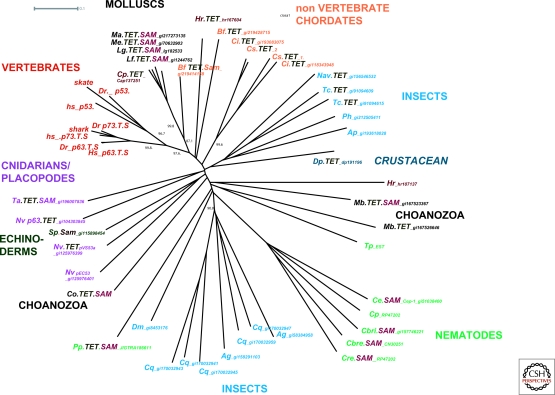
The origin of the p53 superfamily predates animal evolution and first appears in unicellular Flagellates. Invertebrate p53 superfamily members appear to have a p63-like domain structure, which seems to be evolutionarily ancient. The radiation into p53, p63, and p73 proteins is a vertebrate invention. In invertebrate models amenable to genetic analysis p53 superfamily members mainly act in apoptosis regulation in response to genotoxic agents and do not have overt developmental functions. We summarize the literature on cnidarian and mollusc p53 superfamily members and focus on the function and regulation of Drosophila melanogaster and Caenorhabditis elegans p53 superfamily members in triggering apoptosis. Furthermore, we examine the emerging evidence showing that invertebrate p53 superfamily proteins also have functions unrelated to apoptosis, such as DNA repair, cell cycle checkpoint responses, compensatory proliferation, aging, autophagy, and innate immunity.
Figures
References
-
- Akdemir F, Christich A, Sogame N, Chapo J, Abrams JM 2007. p53 directs focused genomic responses in Drosophila. Oncogene 26:5184–5193 - PubMed
-
- Allison SJ, Milner J 2003. Loss of p53 has site-specific effects on histone H3 modification, including serine 10 phosphorylation important for maintenance of ploidy. Cancer Res 63:6674–6679 - PubMed
-
- Arum O, Johnson TE 2007. Reduced expression of the Caenorhabditis elegans p53 ortholog cep-1 results in increased longevity. J Gerontol A Biol Sci Med Sci 62:951–959 - PubMed
-
- Baldauf SL 2003. The deep roots of eukaryotes. Science 300:1703–1706 - PubMed
Publication types
MeSH terms
Substances
Grants and funding
LinkOut - more resources
Full Text Sources
Molecular Biology Databases
Research Materials
Miscellaneous