Emergence of gentamicin-resistant bacteremia in hemodialysis patients receiving gentamicin lock catheter prophylaxis
- PMID: 20595689
- PMCID: PMC2974380
- DOI: 10.2215/CJN.01270210
Emergence of gentamicin-resistant bacteremia in hemodialysis patients receiving gentamicin lock catheter prophylaxis
Abstract
Background and objectives: Antibiotic locks in catheter-dependent chronic hemodialysis patients reduce the rate of catheter-related blood stream infections (CRIs), but there are no data regarding the long-term consequences of this practice.
Design, setting, participants, & measurements: Over a 4-year period, from October 1, 2002, to September 30, 2006, we initiated a gentamicin and heparin lock (GHL) protocol in 1410 chronic hemodialysis patients receiving dialysis through a tunneled catheter in eight outpatient units.
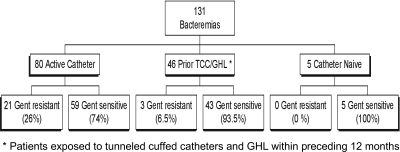
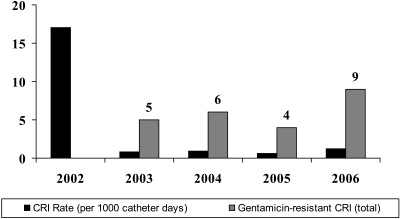
Results: Within the first year of the GHL protocol, our CRI rate decreased from 17 to 0.83 events per 1000 catheter-days. Beginning 6 months after initiation of the GHL protocol, febrile episodes occurred in 13 patients with coagulase-negative Staphylococcus bacteremia resistant to gentamicin. Over the 4 years of GHL use, an additional 10 patients developed 11 episodes of gentamicin-resistant CRI (including 7 with Enterococcus faecalis), in which there were 4 deaths, 2 cases of septic shock requiring intensive care unit admission, and 4 cases of endocarditis. Because of these events, the GHL protocol was discontinued at the end of 2006.
Conclusions: Although the use of GHL effectively lowered the CRI rate in our dialysis population, gentamicin-resistant CRIs emerged within 6 months. Gentamicin-resistant infections are a serious complication of the long-term use of GHLs. Alternative nonantibiotic catheter locks may be preferable to decrease the incidence of CRIs without inducing resistant pathogens.
Figures
Similar articles
-
Comparative effectiveness of two catheter locking solutions to reduce catheter-related bloodstream infection in hemodialysis patients.Clin J Am Soc Nephrol. 2014 Jul;9(7):1232-9. doi: 10.2215/CJN.11291113. Epub 2014 Jun 26. Clin J Am Soc Nephrol. 2014. PMID: 24970874 Free PMC article.
-
The incidence and costs of bacteremia due to lack of gentamicin lock solutions for dialysis catheters.Nephrology (Carlton). 2017 Jun;22(6):485-489. doi: 10.1111/nep.12960. Nephrology (Carlton). 2017. PMID: 28429519
-
Successful prevention of tunneled central catheter infection by antibiotic lock therapy using cefazolin and gentamicin.Int Urol Nephrol. 2013 Oct;45(5):1405-13. doi: 10.1007/s11255-012-0339-1. Epub 2012 Dec 27. Int Urol Nephrol. 2013. PMID: 23269457
-
Prevention of hemodialysis catheter infections: Ointments, dressings, locks, and catheter hub devices.Hemodial Int. 2018 Oct;22(S2):S75-S82. doi: 10.1111/hdi.12703. Epub 2018 Nov 8. Hemodial Int. 2018. PMID: 30411464 Review.
-
Prevention and treatment of hemodialysis-related bloodstream infections.Semin Dial. 2013 Jul-Aug;26(4):476-81. doi: 10.1111/sdi.12117. Semin Dial. 2013. PMID: 23859190 Review.
Cited by
-
Antibiotic lock therapy: review of technique and logistical challenges.Infect Drug Resist. 2014 Dec 12;7:343-63. doi: 10.2147/IDR.S51388. eCollection 2014. Infect Drug Resist. 2014. PMID: 25548523 Free PMC article. Review.
-
Reducing catheter-related infections in hemodialysis patients.Clin J Am Soc Nephrol. 2014 Jul;9(7):1156-9. doi: 10.2215/CJN.04700514. Epub 2014 Jun 26. Clin J Am Soc Nephrol. 2014. PMID: 24970878 Free PMC article. No abstract available.
-
Anticoagulant properties of enoxaparin 400 IU/mL-40 % ethanol catheter lock solution.Springerplus. 2015 Dec 1;4:746. doi: 10.1186/s40064-015-1533-2. eCollection 2015. Springerplus. 2015. PMID: 26693105 Free PMC article.
-
Clinical application of 4% sodium citrate and heparin in the locking of central venous catheters (excluding dialysis catheters) in intensive care unit patients: A pragmatic randomized controlled trial.PLoS One. 2023 Jul 3;18(7):e0288117. doi: 10.1371/journal.pone.0288117. eCollection 2023. PLoS One. 2023. PMID: 37399185 Free PMC article. Clinical Trial.
-
In Vitro Assessment of the Antimicrobial Efficacy of Optimized Nitroglycerin-Citrate-Ethanol as a Nonantibiotic, Antimicrobial Catheter Lock Solution for Prevention of Central Line-Associated Bloodstream Infections.Antimicrob Agents Chemother. 2016 Aug 22;60(9):5175-81. doi: 10.1128/AAC.00254-16. Print 2016 Sep. Antimicrob Agents Chemother. 2016. PMID: 27297475 Free PMC article.
References
-
- Centers for Medicare and Medicaid Services: 2004 Annual report: End-stage renal disease clinical performance measures project. Am J Kidney Dis 46: 1–100, 2005 - PubMed
-
- Vascular Access Working Group: Clinical practice guidelines for vascular access. Am J Kidney Dis 48[Suppl 1]: S248–S273, 2006 - PubMed
-
- Allon M: Dialysis catheter-related bacteremia: Treatment and prophylaxis. Am J Kidney Dis 44: 779–791, 2004 - PubMed
-
- Allon M, Depner TA, Radeva M, Bailey J, Beddhu S, Butterly D, Coyne DW, Gassman JJ, Kaufman AM, Kaysen GA, Lewis JA, Schwab SJ: Impact of dialysis dose and membrane on infection-related hospitalization and death: Results of the HEMO study. J Am Soc Nephrol 14: 1863–1870, 2003 - PubMed
-
- Dogra GK, Herson H, Hutchison B, Irish AB, Heath CH, Golledge C, Luxton G, Moody H: Prevention of tunneled haemodialysis catheter-related infections using catheter-restricted gentamicin and citrate: A randomized controlled study. J Am Soc Nephrol 12: 2133–2139, 2002 - PubMed
MeSH terms
Substances
LinkOut - more resources
Full Text Sources
Medical