


Increased TLR4 expression and downstream cytokine production in immunosuppressed adults compared to non-immunosuppressed adults
- PMID: 20596538
- PMCID: PMC2893205
- DOI: 10.1371/journal.pone.0011343
Increased TLR4 expression and downstream cytokine production in immunosuppressed adults compared to non-immunosuppressed adults
Abstract
Background: An increasing number of patients have medical conditions with altered host immunity or that require immunosuppressive medications. While immunosuppression is associated with increased risk of infection, the precise effect of immunosuppression on innate immunity is not well understood. We studied monocyte Toll-like receptor (TLR) expression and cytokine production in 137 patients with autoimmune diseases who were maintained on immunosuppressive medications and 419 non-immunosuppressed individuals.
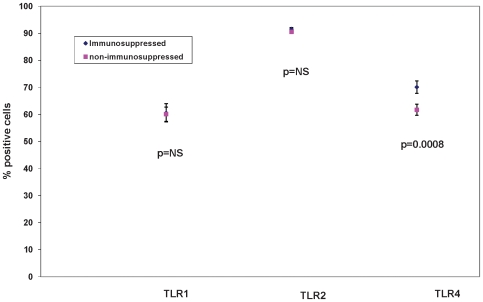
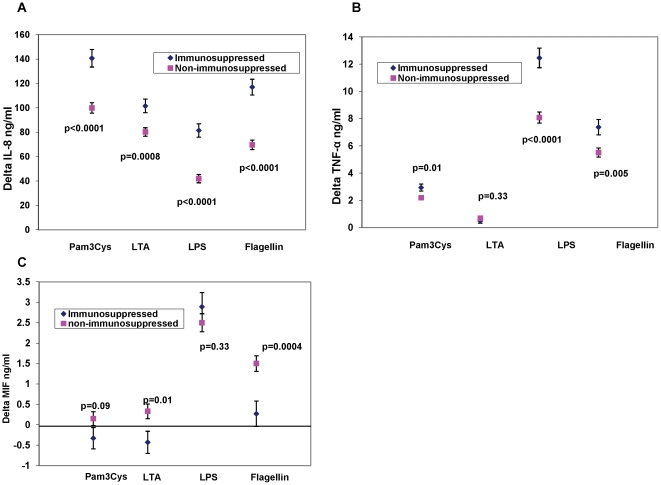
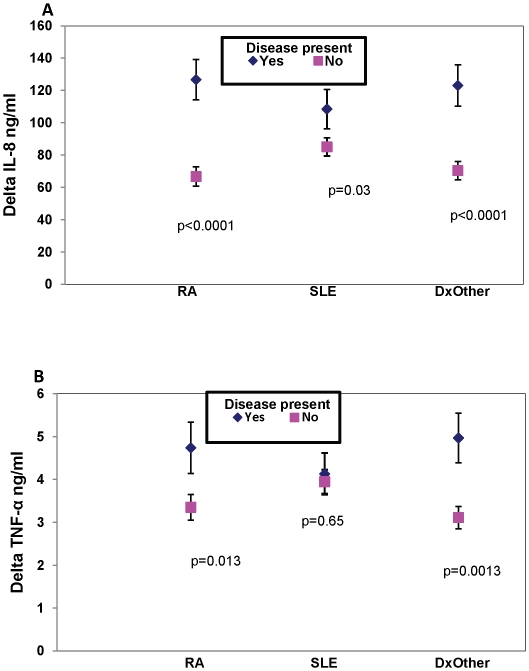
Methodology/principal findings: Human peripheral blood monocytes were assessed for surface expression of TLRs 1, 2, and 4. After incubation with TLR agonists, in vitro production of the cytokines IL-8, TNFalpha, and MIF were measured by ELISA as a measure of TLR signaling efficiency and downstream effector responsiveness. Immunosuppressed patients had significantly higher TLR4 surface expression when compared to non-immunosuppressed adults (TLR4 %-positive 70.12+/-2.28 vs. 61.72+/-2.05, p = 0.0008). IL-8 and TNF-alpha baseline levels did not differ, but were significantly higher in the autoimmune disease group following TLR stimulation. By contrast, baseline MIF levels were elevated in monocytes from immunosuppressed individuals. By multivariable analyses, IL-8 and TNFalpha, but not MIF levels, were associated with the diagnosis of an underlying autoimmune disease. However, only MIF levels were significantly associated with the use of immunosuppressive medications.
Conclusions/significance: Our results reveal that an enhanced innate immune response is a feature of patients with autoimmune diseases treated with immunosuppressive agents. The increased risk for infection evident in this patient group may reflect a dysregulation rather than a simple suppression of innate immunity.
Conflict of interest statement
Figures
References
-
- Medzhitov R, Preston-Hurlburt P, Janeway CA., Jr A human homologue of the Drosophila Toll protein signals activation of adaptive immunity. Nature. 1997;388(6640):394–7. - PubMed
-
- Poltorak A, He X, Smirnova I, Liu MY, Van Huffel C, et al. Defective LPS signaling in C3H/HeJ and C57BL/10ScCr mice: mutations in Tlr4 gene. Science. 1998;282(5396):2085–8. - PubMed
-
- Akira S, Uematsu S, Takeuchi O. Pathogen recognition and innate immunity. Cell. 2006;124(4):783–801. - PubMed
-
- Iwasaki A, Medzhitov R. Toll-like receptor control of the adaptive immune responses. Nat Immunol. 2004;5(10):987–95. - PubMed
-
- Medzhitov R. Recognition of microorganisms and activation of the immune response. Nature. 2007;449(7164):819–26. - PubMed
Publication types
MeSH terms
Substances
Grants and funding
- R01 AR050498/AR/NIAMS NIH HHS/United States
- M01-RR00125/RR/NCRR NIH HHS/United States
- R01 AR049610/AR/NIAMS NIH HHS/United States
- P30 AG021342/AG/NIA NIH HHS/United States
- AR050498/AR/NIAMS NIH HHS/United States
- R37-AI-049200-09S1/AI/NIAID NIH HHS/United States
- AR049610/AR/NIAMS NIH HHS/United States
- M01 RR000125/RR/NCRR NIH HHS/United States
- P30AG21342/AG/NIA NIH HHS/United States
- N01-AI-50031/AI/NIAID NIH HHS/United States
- N01 AI050031/AI/NIAID NIH HHS/United States
- R37 AI049200/AI/NIAID NIH HHS/United States
LinkOut - more resources
Full Text Sources
Other Literature Sources
Miscellaneous
