


The number of elevated cytokines and chemokines in preclinical seropositive rheumatoid arthritis predicts time to diagnosis in an age-dependent manner
- PMID: 20597112
- PMCID: PMC2980824
- DOI: 10.1002/art.27638
The number of elevated cytokines and chemokines in preclinical seropositive rheumatoid arthritis predicts time to diagnosis in an age-dependent manner
Abstract
Objective: To evaluate levels of biomarkers in preclinical rheumatoid arthritis (RA) and to use elevated biomarkers to develop a model for the prediction of time to future diagnosis of seropositive RA.
Methods: Stored samples obtained from 73 military cases with seropositive RA prior to RA diagnosis and from controls (mean 2.9 samples per case; samples collected a mean of 6.6 years prior to diagnosis) were tested for rheumatoid factor (RF) isotypes, anti-cyclic citrullinated peptide (anti-CCP) antibodies, 14 cytokines and chemokines (by bead-based assay), and C-reactive protein (CRP).
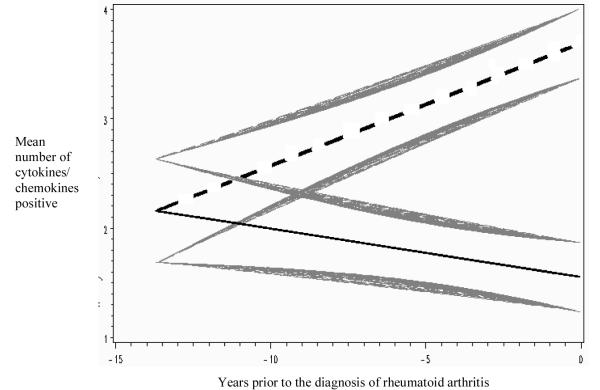
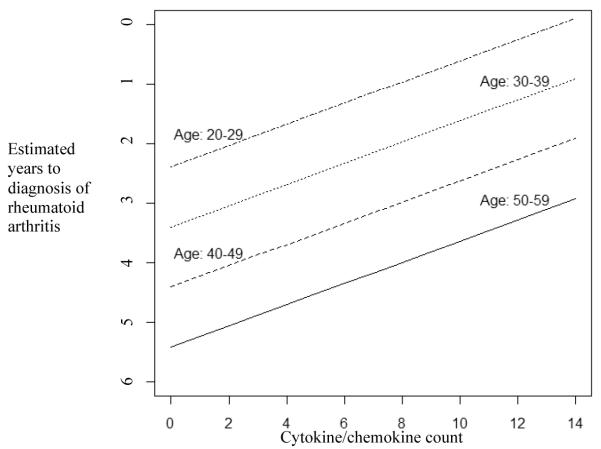
Results: Preclinical positivity for anti-CCP and/or ≥2 RF isotypes was >96% specific for future RA. In preclinical RA, levels of the following were positive in a significantly greater proportion of RA cases versus controls: interleukin-1α (IL-1α), IL-1β, IL-6, IL-10, IL-12p40, IL-12p70, IL-15, fibroblast growth factor 2, flt-3 ligand, tumor necrosis factor α, interferon-γ-inducible 10-kd protein, granulocyte-macrophage colony-stimulating factor, and CRP. Also, increasing numbers of elevated cytokines/chemokines were present in cases nearer to the time of diagnosis. RA patients who were ≥40 years old at diagnosis had a higher proportion of samples positive for cytokines/chemokines 5-10 years prior to diagnosis than did patients who were <40 years old at diagnosis (P < 0.01). In regression modeling using only case samples positive for autoantibodies highly specific for future RA, increasing numbers of cytokines/chemokines were predictive of decreased time to diagnosis, and the predicted time to diagnosis based on cytokines/chemokines was longer in older compared with younger cases.
Conclusion: Levels of autoantibodies, cytokines/chemokines, and CRP are elevated in the preclinical period of RA development. In preclinical autoantibody-positive cases, the number of elevated cytokines/chemokines is predictive of the time of diagnosis of future RA in an age-dependent manner.
Copyright © 2010 by the American College of Rheumatology.
Figures
References
-
- del Puente A, Knowler WC, Pettitt DJ, Bennett PH. The incidence of rheumatoid arthritis is predicted by rheumatoid factor titer in a longitudinal population study. Arthritis Rheum. 1988 Oct;31(10):1239–44. - PubMed
-
- Aho K, Heliovaara M, Maatela J, Tuomi T, Palosuo T. Rheumatoid factors antedating clinical rheumatoid arthritis. J Rheumatol. 1991 Sep;18(9):1282–4. - PubMed
-
- Kurki P, Aho K, Palosuo T, Heliovaara M. Immunopathology of rheumatoid arthritis. Antikeratin antibodies precede the clinical disease. Arthritis Rheum. 1992 Aug;35(8):914–7. - PubMed
-
- Aho K, von Essen R, Kurki P, Palosuo T, Heliovaara M. Antikeratin antibody and antiperinuclear factor as markers for subclinical rheumatoid disease process. J Rheumatol. 1993 Aug;20(8):1278–81. - PubMed
Publication types
MeSH terms
Substances
Grants and funding
- AI-50864/AI/NIAID NIH HHS/United States
- P30-DE-020752/DE/NIDCR NIH HHS/United States
- T32 CA009337/CA/NCI NIH HHS/United States
- AR-054822/AR/NIAMS NIH HHS/United States
- K23 AR051461/AR/NIAMS NIH HHS/United States
- R01 AR054822/AR/NIAMS NIH HHS/United States
- AR-058713/AR/NIAMS NIH HHS/United States
- U19 AI050864/AI/NIAID NIH HHS/United States
- R01 AR051394/AR/NIAMS NIH HHS/United States
- AR-51394/AR/NIAMS NIH HHS/United States
- AR-051461/AR/NIAMS NIH HHS/United States
- T32-CA-09337/CA/NCI NIH HHS/United States
- RC1 AR058713/AR/NIAMS NIH HHS/United States
LinkOut - more resources
Full Text Sources
Other Literature Sources
Medical
Research Materials
Miscellaneous
