


Rate-dependent impairments in repetitive finger movements in patients with Parkinson's disease are not due to peripheral fatigue
- PMID: 20599591
- PMCID: PMC2924741
- DOI: 10.1016/j.neulet.2010.06.054
Rate-dependent impairments in repetitive finger movements in patients with Parkinson's disease are not due to peripheral fatigue
Abstract
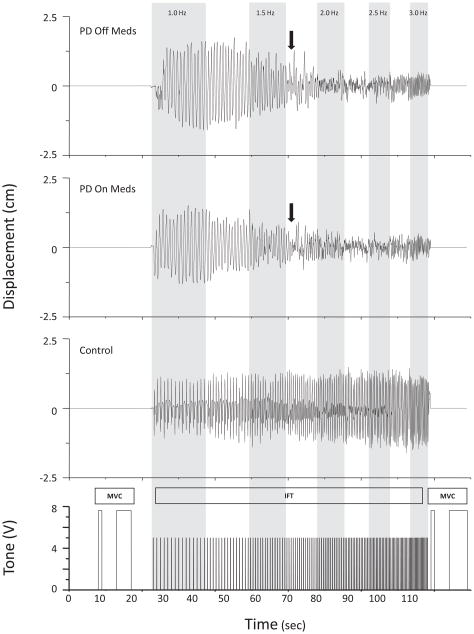
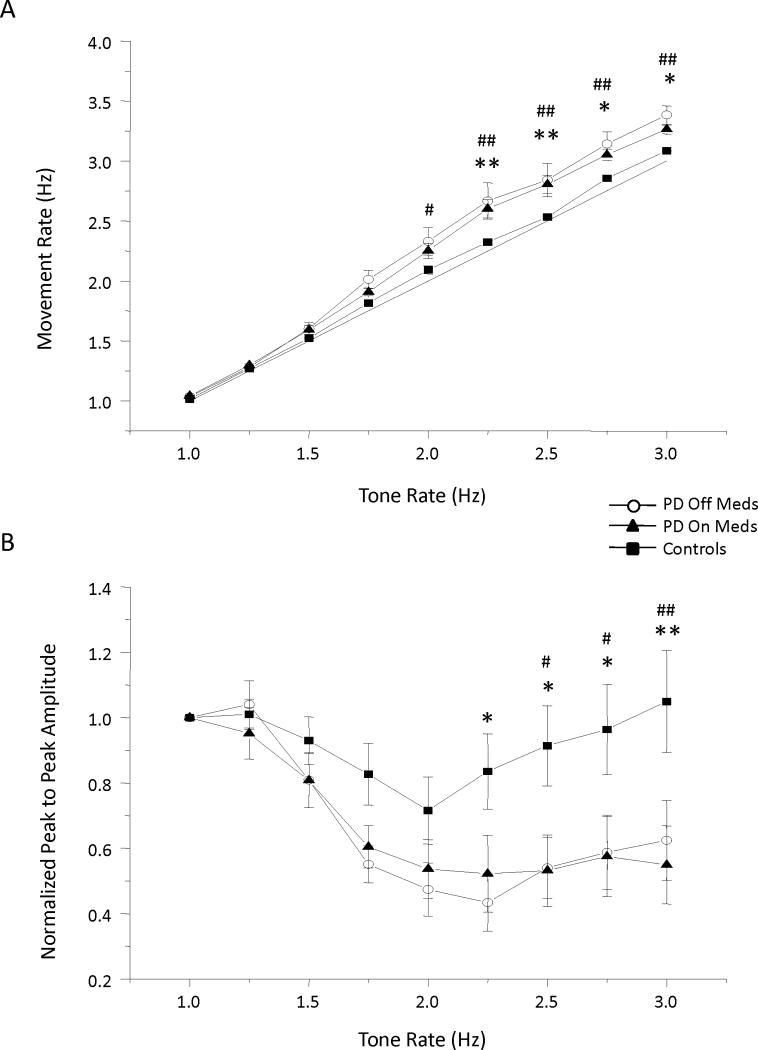
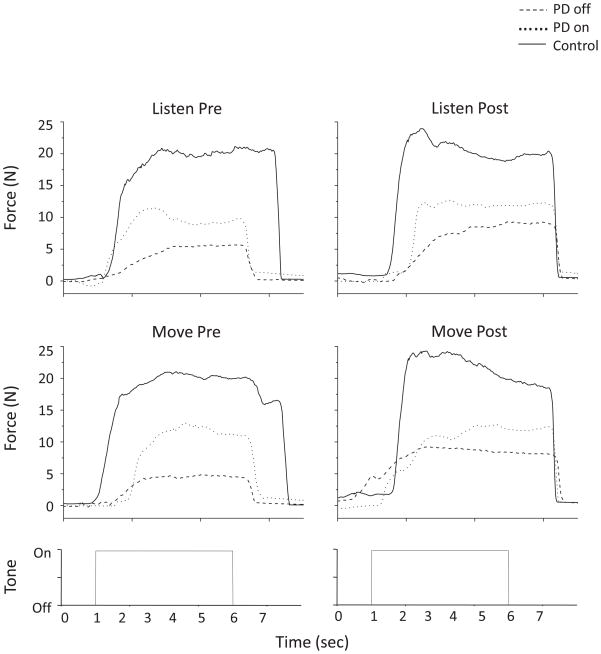
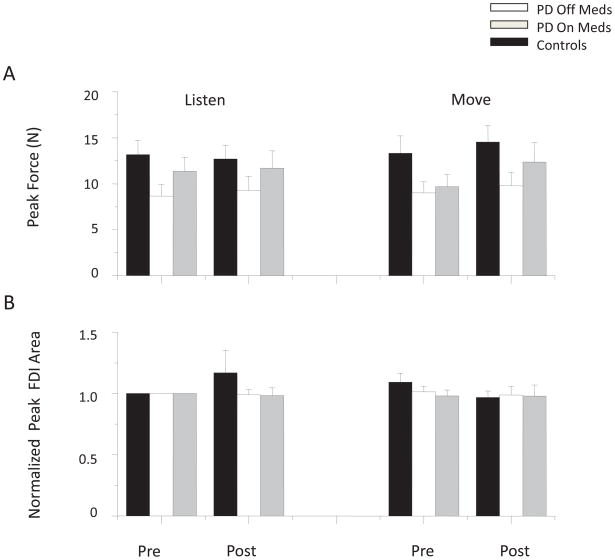
Performance of repetitive finger movements is an important clinical measure of disease severity in patients with Parkinson's disease (PD) and is associated with a dramatic deterioration in performance at movement rates near 2 Hz and above. The mechanisms contributing to this rate-dependent movement impairment are poorly understood. Since clinical and experimental testing of these movements involve prolonged repetition of movement, a loss of force-generating capacity due to peripheral fatigue may contribute to performance deterioration. This study examined the contribution of peripheral fatigue to the performance of unconstrained index finger flexion movements by measuring maximum voluntary contractions (MVC) immediately before and after repetitive finger movements in patients with PD (both off- and on-medication) and matched control subjects. Movement performance was quantified using finger kinematics, maximum force production, and electromyography (EMG). The principal finding was that peak force and EMG activity during the MVC did not significantly change from the pre- to post-movement task in patients with PD despite the marked deterioration in movement performance of repetitive finger movements. These findings show that the rate-dependent deterioration of repetitive finger movements in PD cannot be explained by a loss of force-generating capacity due to peripheral fatigue, and further suggest that mechanisms contributing to impaired isometric force production in PD are different from those that mediate impaired performance of high-rate repetitive movements.
Copyright 2010 Elsevier Ireland Ltd. All rights reserved.
Figures
References
-
- Brown P. Cortical drives to human muscle: the Piper and related rhythms. Prog Neurobiol. 2000;60:97–108. - PubMed
-
- Brown P, Corcos D, Rothwell JC. Does parkinsonian action tremor contribute to muscle weakness in Parkinson’s disease? Brain. 1997;120:401–408. - PubMed
-
- Corcos D, Chen CM, Quinn NP, McAuley J, Rothwell JC. Strength in Parkinson’s disease: relationship to rate of force generation and clinical status. Annals of Neurology. 1996;39:79–88. - PubMed
-
- Dick JPR, Rothwell JC, Day BL, Cantello R, Buruma O, Gioux M, Benecke R, Berardelli A, Thompson PD, Marsden CD. The bereitschafts potential is abnormal in Parkinson’s disease. Brain. 1989;112:233–244. - PubMed
-
- Diederich NJ, Moore CG, Leurgans SE, Chmura TA, Goetz CG. Parkinson disease with old-age onset - A comparative study with subjects with middle-age onset. Archives of Neurology. 2003;60:529–533. - PubMed
Publication types
MeSH terms
Grants and funding
LinkOut - more resources
Full Text Sources
Medical
