


Establishment of sandwich ELISA for soluble alpha-Klotho measurement: Age-dependent change of soluble alpha-Klotho levels in healthy subjects
- PMID: 20599764
- PMCID: PMC4130489
- DOI: 10.1016/j.bbrc.2010.06.110
Establishment of sandwich ELISA for soluble alpha-Klotho measurement: Age-dependent change of soluble alpha-Klotho levels in healthy subjects
Abstract
Background: Alpha-Klotho (alphaKl) regulates mineral metabolism such as calcium ion (Ca(2+)) and inorganic phosphate (Pi) in circulation. Defects in mice result in clinical features resembling disorders found in human aging. Although the importance of transmembrane-type alphaKl has been demonstrated, less is known regarding the physiological importance of soluble-type alphaKl (salphaKl) in circulation.
Objectives: The aims of this study were: (1) to establish a sandwich ELISA system enabling detection of circulating serum salphaKl, and (2) to determine reference values for salphaKl serum levels and relationship to indices of renal function, mineral metabolism, age and sex in healthy subjects.
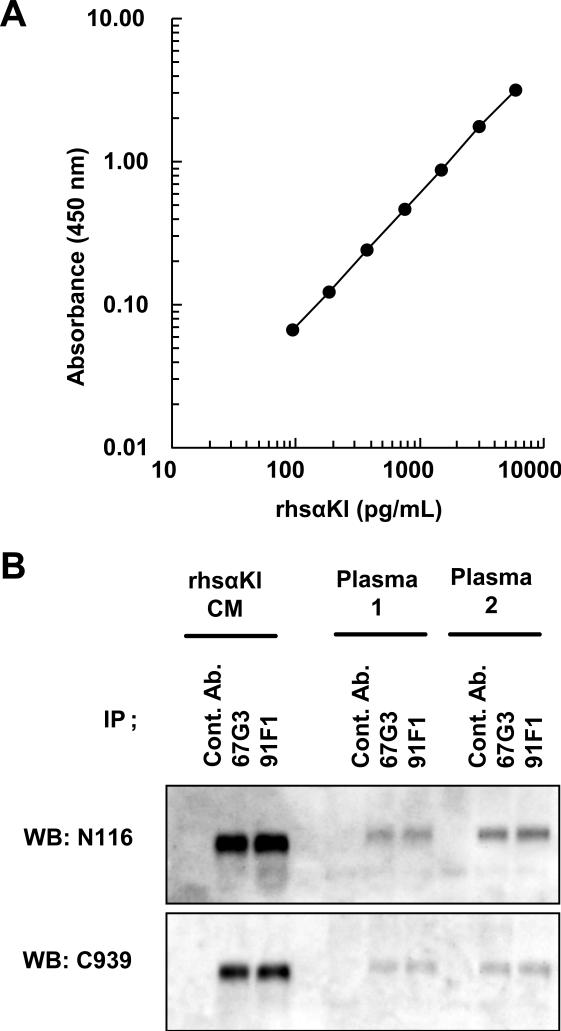
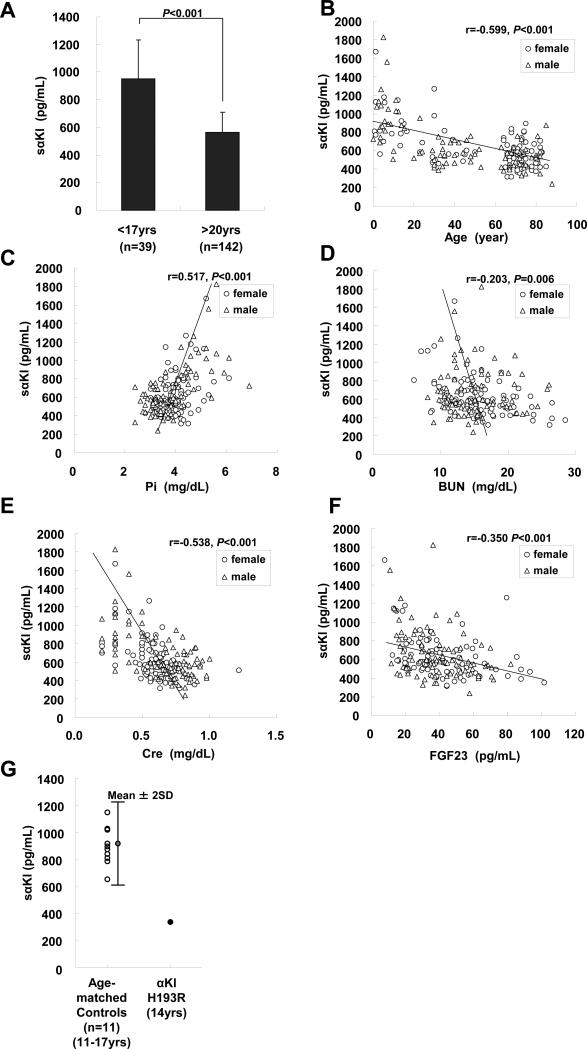
Results: We successively developed an ELISA to measure serum salphaKl in healthy volunteers (n=142, males 66) of ages (61.1+/-18.5year). The levels (mean+/-SD) in these healthy control adults were as follows: total calcium (Ca; 9.46+/-0.41mg/dL), Pi (3.63+/-0.51mg/dL), blood urea nitrogen (BUN; 15.7+/-4.3mg/dL), creatinine (Cre; 0.69+/-0.14mg/dL), 1,25 dihydroxyvitamin D (1,25(OH)(2)D; 54.8+/-17.7pg/mL), intact parathyroid hormone (iPTH; 49.2+/-20.6pg/mL), calcitonin (26.0+/-12.3pg/mL) and intact fibroblast growth factor (FGF23; 43.8+/-17.6pg/mL). Serum levels of salphaKl ranged from 239 to 1266pg/mL (mean+/-SD; 562+/-146pg/mL) in normal adults. Although salphaKl levels were not modified by gender or indices of mineral metabolism, salphaKl levels were inversely related to Cre and age. However, salphaKl levels in normal children (n=39, males 23, mean+/-SD; 7.1+/-4.8years) were significantly higher (mean+/-SD; 952+/-282pg/mL) than those in adults (mean+/-SD; 562+/-146, P<0.001). A multivariate linear regression analysis including children and adults in this study demonstrated that salphaKl correlated negatively with age and Ca, and positively with Pi. Finally, we measured a serum salphaKl from a patient with severe tumoral calcinosis derived from a homozygous missense mutation of alpha-klotho gene. In this patient, salphaKl level was notably lower than those of age-matched controls.
Conclusion: We established a detection system to measure human serum salphaKl for the first time. Age, Ca and Pi seem to influence serum salphaKl levels in a normal population. This detection system should be an excellent tool for investigating salphaKl functions in mineral metabolism.
Copyright 2010 Elsevier Inc. All rights reserved.
Figures
References
-
- Kuro-o M, Matsumura Y, Aizawa H. Mutation of the mouse klotho gene leads to a syndrome resembling ageing. Nature. 1997;390:45–51. - PubMed
-
- Kato Y, Arakawa E, Kinoshita S. Establishment of the anti-Klotho monoclonal antibodies and detection of Klotho protein in kidneys. Biochem. Biophys. Res. Commun. 2000;267:597–602. - PubMed
-
- Takeshita K, Fujimori T, Kurotaki Y. Sinoatrial node dysfunction and early unexpected death of mice with a defect of klotho gene expression. Circulation. 2004;109:1776–1782. - PubMed
-
- Li SA, Watanabe M, Yamada H. Immunohistochemical localization of Klotho protein in brain, kidney, and reproductive organs of mice. Cell Struct. Funct. 2004;29:91–99. - PubMed
-
- Imura A, Tsuji Y, Murata M. alpha-Klotho as a regulator of calcium homeostasis. Science. 2007;316:1615–1618. - PubMed
Publication types
MeSH terms
Substances
Grants and funding
LinkOut - more resources
Full Text Sources
Other Literature Sources
Medical
Molecular Biology Databases
Research Materials
Miscellaneous
