Review
. 2010 Dec;154(1-2):150-60.
doi: 10.1016/j.virusres.2010.06.017. Epub 2010 Jun 25.

Vectored vaccines to protect against PRRSV

Affiliations
Review

Vectored vaccines to protect against PRRSV

Jazmina L G Cruz et al. Virus Res. 2010 Dec.

Abstract

PRRSV is the causative agent of the most important infectious disease affecting swine herds worldwide, producing great economic losses. Commercially available vaccines are only partially effective in protection against PRRSV. Moreover, modified live vaccines may allow virus shedding, and could revert generating virulent phenotypes. Therefore, new efficient vaccines are required. Vaccines based on recombinant virus genomes (virus vectored vaccines) against PRRSV could represent a safe alternative for the generation of modified live vaccines. In this paper, current vectored vaccines to protect against PRRSV are revised, including those based on pseudorabies virus, poxvirus, adenovirus, and virus replicons. Special attention has been provided to the use of transmissible gastroenteritis virus (TGEV) as vector for the expression of PRRSV antigens. This vector has the capability of expressing high levels of heterologous genes, is a potent interferon-α inducer, and presents antigens in mucosal surfaces, eliciting both secretory and systemic immunity. A TGEV derived vector (rTGEV) was generated, expressing PRRSV wild type or modified GP5 and M proteins, described as the main inducers of neutralizing antibodies and cellular immune response, respectively. Protection experiments showed that vaccinated animals developed a faster and stronger humoral immune response than the non-vaccinated ones. Partial protection in challenged animals was observed, as vaccinated pigs showed decreased lung damage when compared with the non-vaccinated ones. Nevertheless, the level of neutralizing antibodies was low, what may explain the limited protection observed. Several strategies are proposed to improve current rTGEV vectors expressing PRRSV antigens.


Figures

Fig. 1
Fig. 1
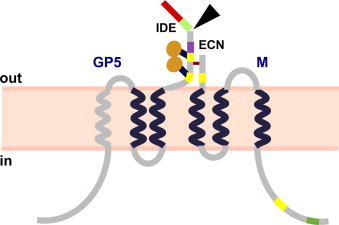
Predicted GP5-M heterodimer topology. The PRRSV GP5-M heterodimer may be anchored in membranes, with both proteins exposing to the surface a short N-terminal ectodomain. The GP5 protein ectodomain contains the protein motives relevant in antigenicity, such as the epitope critical in neutralization (ECN, purple) and the decoy immunodominant epitope (IDE, green). Signal peptide (red) cleavage is represented by a black arrowhead. Both GP5 and M proteins contain predicted glycosylation sites (yellow), although only GP5 protein is glycosylated (represented by orange circles). M protein contains in its C-terminal an endoplasmic reticulum retention signal (dark green).
Fig. 2
Fig. 2
Design of rTGEV expressing PRRSV antigens. Scheme of the TGEV infectious cDNA clone, cloned in a BAC (pBAC-TGEVFL). After transfection of cells, a full-length virus genome is generated (rTGEV). CMV, cytomegalovirus immediate-early promoter; polyA, tail of 24 A residues; HDV, hepatitis delta virus ribozyme; BGH, bovine growth hormone termination and polyadenylation sequences. The TGEV derived vectors are based on a TGEV genome in which non-essential 3ab genes were deleted (rTGEV-Δ3ab). Genes encoding PRRSV heterologous proteins were cloned in this position. Expression of the foreign genes was driven by transcription regulatory sequences (TRSs) from genes 3a and N.
Fig. 3
Fig. 3
Generation of rTGEV co-expressing GP5 and M proteins. (A) Schematic representation of PRRSVOlot91 GP5 domains. A detail of the domain containing the epitopes inducing non-neutralizing (IDE) and neutralizing (ECN) antibodies is shown. Two N-glycosylation sites, N46 (G1) and N53 (G2), are located within this domain. Three different mutants were generated, substituting Asn 46 and 53 by Ser, avoiding the glycosylation at these positions (N46S, N53S, and N46,53S). An additional mutant, lacking N46 glycosylation site and decoy epitope, was obtained (N46S-ΔIDE). In all cases, rTGEV viruses were recovered with high titers. (B) ST cells were infected with the rTGEVs and double immunofluorescence staining was performed. TGEV N protein specific monoclonal antibodies and a secondary antibody staining red were used to identify virus-infected cells. Expression of GP5 was detected with rabbit antiserum specific for a GP5 peptide coupled to a secondary antibody staining green (upper panels). Expression of M protein was detected with a rabbit antiserum specific for an M protein peptide, coupled to a secondary antibody staining green (lower panels). The percentage of infected cells expressing PRRSV antigens was estimated by the analysis 10 different microscopic fields.
Fig. 4
Fig. 4
Colocalization of GP5 and M proteins. To study if GP5 and M proteins expressed by rTGEVs also colocalize, confocal microscopy analysis was performed. MA-104 or ST cells were infected with PRRSV and the rTGEVs, respectively, and double immunofluorescence staining was performed. Expression of GP5 was detected with a monoclonal antibody specific for GP5, coupled to a secondary antibody staining red (upper panels). Expression of M protein was detected with a rabbit antiserum specific for an M protein peptide, coupled to a secondary antibody staining green (medium panels). As shown in the merge, colocalization of GP5 and M proteins was observed both in the PRRSV and rTGEV infected cells (lower panels). Mutant GP5 proteins (GP5-N46S and GP5-ΔIDE-N46S) expressed by rTGEVs also colocalized with M protein.
Fig. 5
Fig. 5
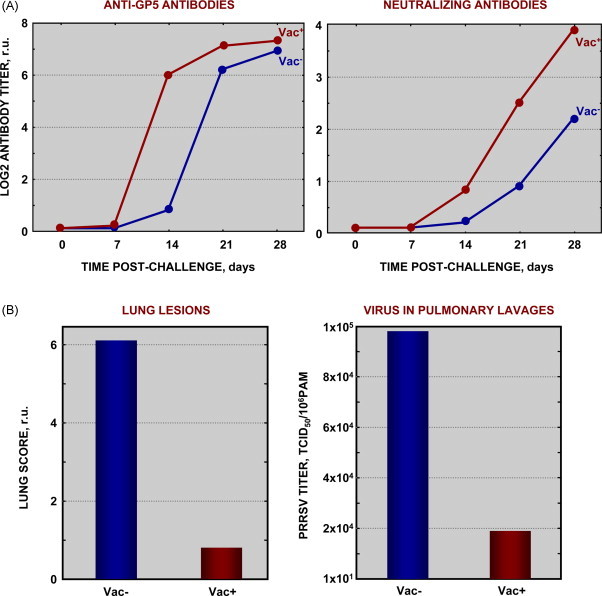
Protection conferred by rTGEV based inactivated vaccine expressing GP5 with altered glycosylation pattern. (A) Killed vaccine was formulated from rTGEVs expressing GP5 with altered glycosylation pattern. Protection was analyzed and blood samples of animals were collected at indicated times post-challenge. Samples were analyzed by immunoperoxidase monolayer assay (IPMA) specific to detect antibodies against GP5 (left panel). Cells expressing recombinant GP5 were used as antigens for the IPMA assay. Neutralizing antibodies titers were calculated from neutralization assays of PRRSV Olot91 strain infecting MA-104 cells (right panel). (B) Lung damage caused by PRRSV infection (left panel). The lungs from vaccinated and non-vaccinated animals were analyzed. Lung lesions observed in all the pigs, with different degree of severity, included a craneo-ventral consolidation of apical and medial lung lobes. Viremia was also analyzed (right panel) by PRRSV quantification in samples, using Q-RT-PCR. Results were expressed as PRRSV TCID50 per million of pulmonary lavages (PAM).
Fig. 6
Fig. 6
Protection conferred by rTGEV based live vaccine expressing GP5 with altered glycosylation pattern. (A) Humoral immune response elicited by live rTGEV based vaccine. Blood samples of animals we collected at indicated times post-inoculation. Samples were analyzed by enzyme-linked immunosorbent assays (ELISAs) specific to detect antibodies against TGEV, GP5 and M. To evaluate response against GP5, GP5 protein from PRRSV Olot91 strain was expressed and purified from insect cells and used as antigen for the ELISA. (B) Lung damage caused by PRRSV infection. The lungs from animals inoculated with empty rTGEV vector, or rTGEV expressing GP5-N46S and M proteins, were analyzed. Lung lesions observed in all the pigs, with different degree of severity, included a craneo-ventral consolidation of apical and medial lung lobes.

References

    1. Albina E., Carrat C., Charley B. Interferon-alpha response to swine arterivirus (PoAV), the porcine reproductive and respiratory syndrome virus. J. Interferon Cytokine Res. 1998;18:485–490. - PubMed
    1. Almazán F., González J.M., Pénzes Z., Izeta A., Calvo E., Plana-Durán J., Enjuanes L. Engineering the largest RNA virus genome as an infectious bacterial artificial chromosome. Proc. Natl. Acad. Sci. U.S.A. 2000;97:5516–5521. - PMC - PubMed
    1. Alonso S., Izeta A., Sola I., Enjuanes L. Transcription regulatory sequences and mRNA expression levels in the coronavirus transmissible gastroenteritis virus. J. Virol. 2002;76:1293–1308. - PMC - PubMed
    1. Ansari I.H., Kwon B., Osorio F.A., Pattnaik A.K. Influence of N-linked glycosylation of porcine reproductive and respiratory syndrome virus GP5 on virus infectivity, antigenicity, and ability to induce neutralizing antibodies. J. Virol. 2006;80:3994–4004. - PMC - PubMed
    1. Ballesteros M.L., Sanchez C.M., Enjuanes L. Two amino acid changes at the N-terminus of transmissible gastroenteritis coronavirus spike protein result in the loss of enteric tropism. Virology. 1997;227:378–388. - PMC - PubMed

Publication types

MeSH terms