


The CounterACT Research Network: basic mechanisms and practical applications
- PMID: 20601628
- PMCID: PMC3159080
- DOI: 10.1513/pats.201001-003SM
The CounterACT Research Network: basic mechanisms and practical applications
Abstract
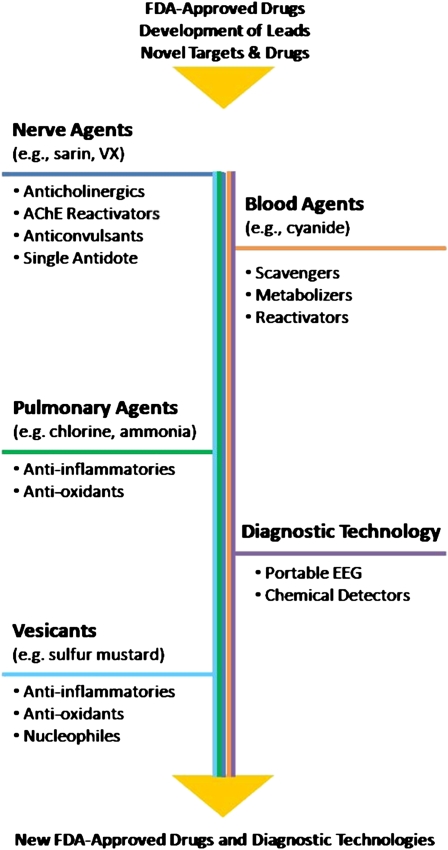
The National Institutes of Health has developed a comprehensive research program that includes research centers of excellence, individual research projects, small business projects, contracts, and interagency agreements to conduct basic, translational, and clinical research aimed at the discovery and/or identification of better medical countermeasures against chemical threat agents. Chemical threats include chemical warfare agents, toxic industrial and agricultural chemicals, and toxins and other chemicals that could be used intentionally as an act of terror or by large-scale accidents or natural disasters. The overarching goal of this research program is to enhance our medical response capabilities during an emergency. The program is named Countermeasures Against Chemical Threats (CounterACT). It supports translational research, applying ideas, insights, and discoveries generated through basic scientific inquiry to the treatment or prevention of mortality and morbidity caused by chemical threat agents. The categories of research supported under this program include creation and development of screening assays and animal models for therapy development, identification of candidate therapeutics, obtaining preliminary proof-of-principle data on the efficacy of candidate therapeutics, advanced efficacy and preclinical safety studies with appropriate animal models using Good Laboratory Practices (GLP), and clinical studies, including clinical trials with new drugs. Special consideration is given to research relevant to people who are particularly vulnerable, including the young, the elderly, and individuals with pre-existing medical conditions.
References
-
- Kortepeter MG, Cieslak TJ, Eitzen EM. Bioterrorism. J Environ Health 2001;63:21–24. - PubMed
-
- Morita H, Yanagisawa N, Nakajima T, Shimizu M, Hirabayashi H, Okudera H, Nohara M, Midorikawa Y, Mimura S. Sarin poisoning in Matsumoto, Japan. Lancet 1995;346:290–293. - PubMed
-
- Suzuki T, Morita H, Ono K, Maekawa K, Nagai R, Yazaki Y. Sarin poisoning in Tokyo subway. Lancet 1995;345:980. - PubMed
-
- United States Government Accounting Office. Homeland security. Voluntary initiatives are under way at chemical facilities, but the extent of security preparedness is unknown. Washington, DC: GAO-03-24R; 2003.
MeSH terms
Substances
LinkOut - more resources
Full Text Sources
Other Literature Sources
Medical