


The association between pre-pregnancy BMI and preterm delivery in a diverse southern California population of working women
- PMID: 20602159
- PMCID: PMC3131509
- DOI: 10.1007/s10995-010-0633-4
The association between pre-pregnancy BMI and preterm delivery in a diverse southern California population of working women
Abstract
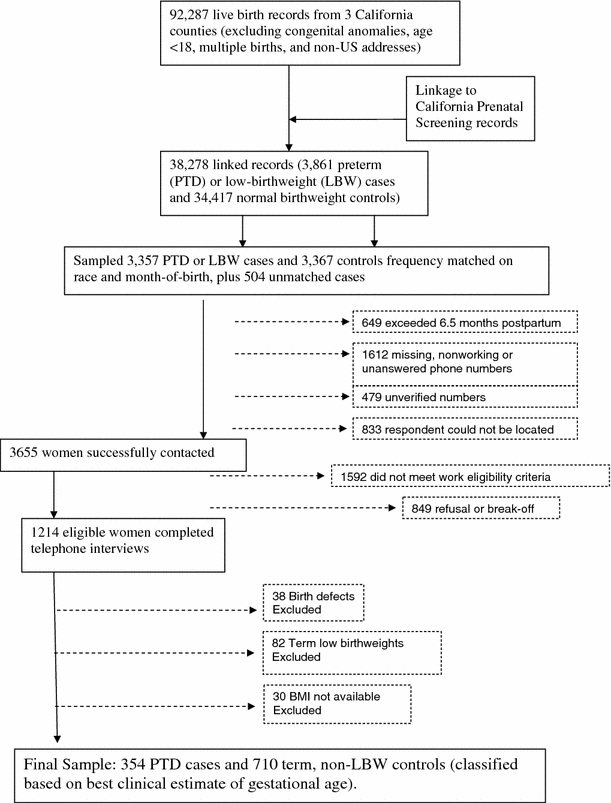
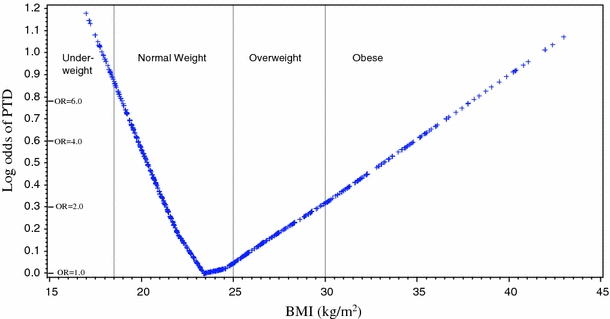
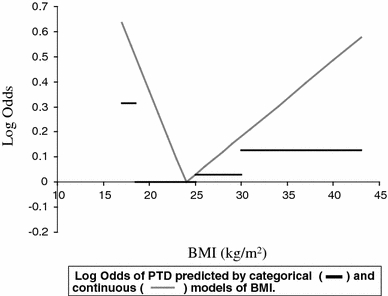
Whereas preterm birth has consistently been associated with low maternal pre-pregnancy weight, the relationship with high pre-pregnancy weight has been inconsistent. We quantified the pre-pregnancy BMI-preterm delivery (PTD) relationship using traditional BMI categories (underweight, normal weight, overweight and obese) as well as continuous BMI. Eligible women participated in California's statewide prenatal screening program, worked during pregnancy, and delivered a live singleton birth in Southern California in 2002-2003. The final analytic sample included 354 cases delivering at <37 weeks, as identified by clinical estimate of gestational age from screening records, and 710 term normal-birthweight controls. Multivariable logistic regression models using categorical BMI levels and continuous BMI were compared. In categorical analyses, PTD was significantly associated with pre-pregnancy underweight only. Nonparametric local regression revealed a V-shaped relationship between continuous BMI and PTD, with minimum risk at the high end of normal, around 24 kg/m2. The odds ratio (OR) for PTD associated with low BMI within the normal range (19 kg/m2) was 2.84 (95% CI = 1.61-5.01); ORs for higher BMI in the overweight (29 kg/m2) and obese (34 kg/m2) ranges were 1.42 (95% CI = 1.10-1.84) and 2.01 (95% CI = 1.20-3.39) respectively, relative to 24 kg/m2). BMI categories obscured the preterm delivery risk associated with low-normal, overweight, and obese BMI. We found that higher BMI up to around 24 kg/m2 is increasingly protective of preterm delivery, beyond which a higher body mass index becomes detrimental. Current NHLBI/WHO BMI categories may be inadequate for identifying women at higher risk for PTD.
Figures
References
-
- Hendler I, Goldenberg RL, Mercer BM, Iams JD, Meis PJ, Moawad AH, et al. The preterm prediction study: Association between maternal body mass index and spontaneous and indicated preterm birth. American Journal of Obstetrics and Gynecology. 2005;192(3):882–886. doi: 10.1016/j.ajog.2004.09.021. - DOI - PubMed
Publication types
MeSH terms
Grants and funding
LinkOut - more resources
Full Text Sources
Medical
