


Outcomes after an excisional procedure for cervical intraepithelial neoplasia in HIV-infected women
- PMID: 20605046
- PMCID: PMC3089021
- DOI: 10.1016/j.ygyno.2010.06.012
Outcomes after an excisional procedure for cervical intraepithelial neoplasia in HIV-infected women
Abstract
Objective: To determine predictors of treatment failure and recurrence after surgical excisional procedures for CIN in HIV-infected women.
Methods: A retrospective cohort study was conducted in which 136 eligible HIV-infected women treated for CIN between 1999 and 2005 were included. Data were abstracted from charts and computer databases. Treatment failures were defined as the presence of CIN 1+ at initial follow-up. Recurrences were defined as the presence of CIN 1+ subsequent to initial normal follow-up.
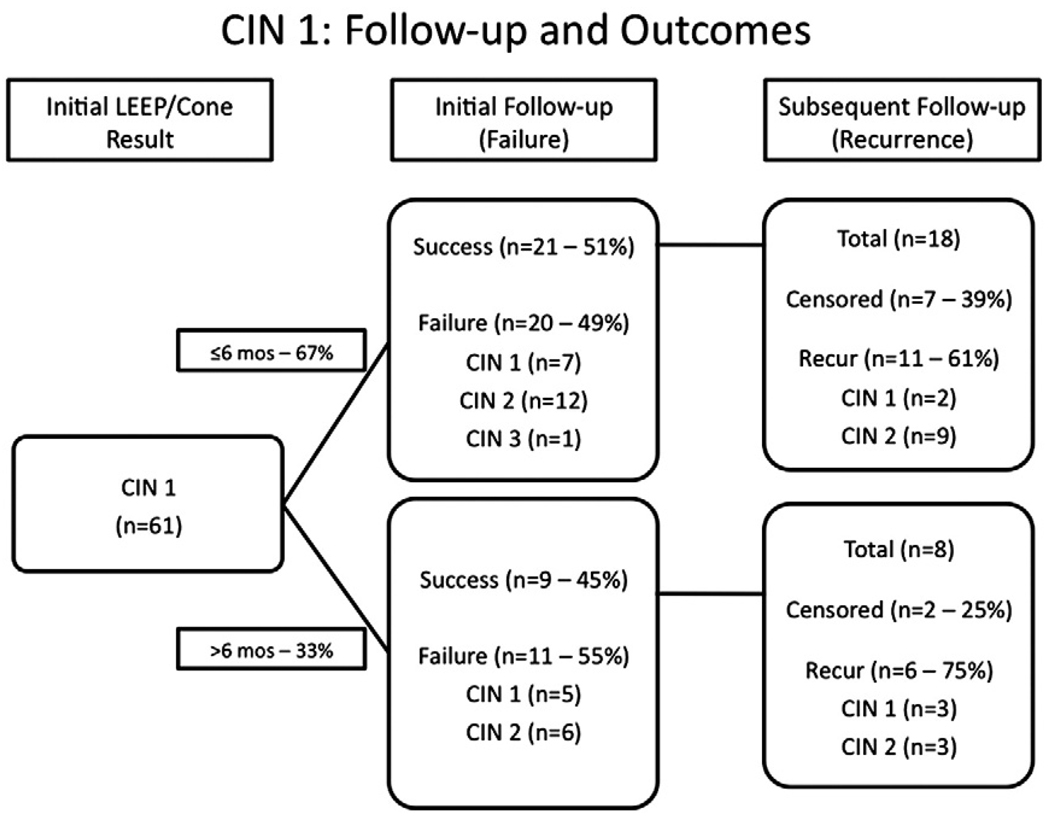
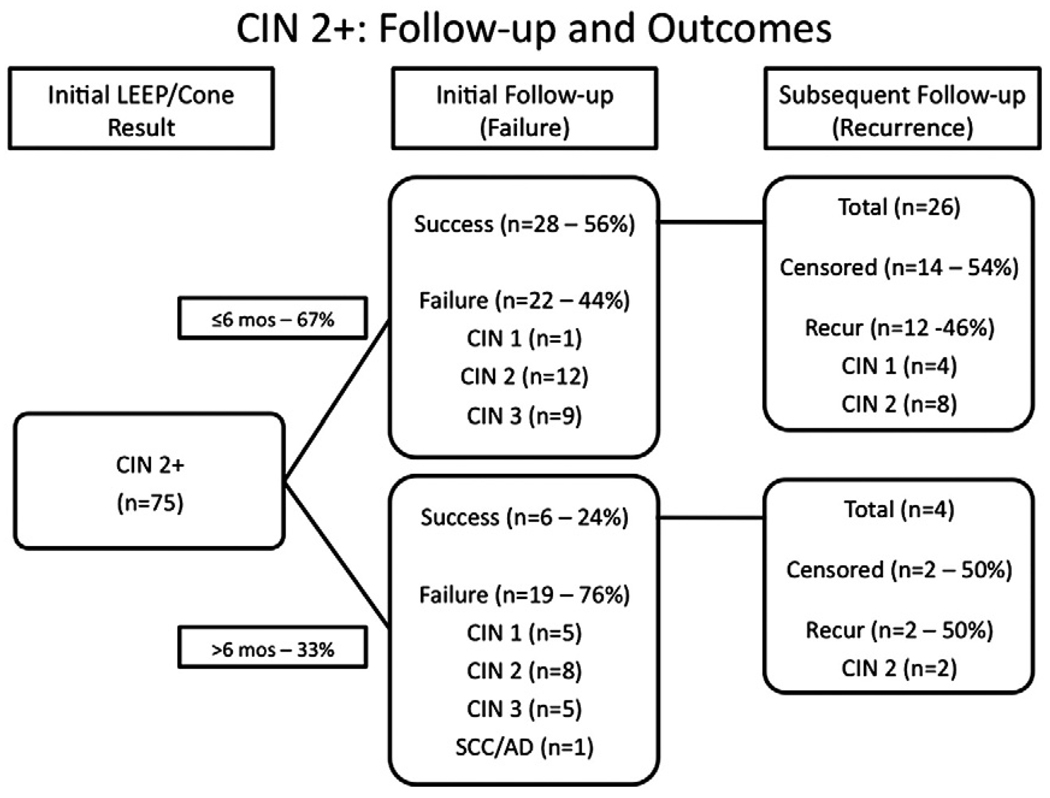
Results: Treatment failure at initial follow-up was common, occurring in 51% of CIN 1 and 55% of CIN 2+. Most lesions detected at treatment failure were high grade (>70%), regardless of the grade of initial lesion. Significant risk factors for treatment failure were loop electrosurgical excision procedure (LEEP) compared to cold knife conization (RR=1.76; 95% CI: 1.15-2.64), and low CD4+ count (p=0.04). Among those with an initial normal clinical evaluation, 55% eventually recurred. As with treatment failure, most lesions detected at recurrence were high grade. Risk factors for recurrence included use of LEEP (hazard ratio [HR]=3.38; 95% CI: 1.55-7.39), higher HIV RNA level, and the presence of positive margins at treatment (HR=6.12; 95% CI: 1.90-19.73).
Conclusions: Most CIN treatment of HIV-infected women studied either failed or resulted in recurrence. Of particular concern, many of these subsequent lesions were high grade. Conization, however, was associated with significantly less failure/recurrence than LEEP. Clinicians treating CIN in HIV-infected women should avoid raising expectations of cure and instead focus on the achievable goal of cancer prevention until there are better therapies for this patient population.
Copyright © 2010 Elsevier Inc. All rights reserved.
Conflict of interest statement
The authors declare that there are no conflicts of interest.
Figures
Comment in
-
Treatment failure and recurrence of cervical intraepithelial neoplasia in HIV-infected women.Womens Health (Lond). 2010 Nov;6(6):781-3. doi: 10.2217/whe.10.73. Womens Health (Lond). 2010. PMID: 21118036
References
-
- Hocke C, Leroy V, Morlat P, Rivel J, Duluc MC, Boulogne N, et al. Cervical dysplasia and human immunodeficiency virus infection in women: prevalence and associated factors. Groupe d'Epidemiologie Clinique du SIDA en Aquitaine (GESCA) Eur J Obstet Gynecol Reprod Biol. 1998;81:69–76. - PubMed
-
- Robinson WR, Hamilton CA, Michaels SH, Kissinger P. Effect of excisional therapy and highly active antiretroviral therapy on cervical intraepithelial neoplasia in women infected with human immunodeficiency virus. Am J Obstet Gynecol. 2001;184:538–543. - PubMed
-
- Boardman LA, Peipert JF, Hogan JW, Cooper AS. Positive cone biopsy specimen margins in women infected with the human immunodeficiency virus. Am J Obstet Gynecol. 1999;181:1395–1399. - PubMed
