. 2010 Aug;150(2):290-301.
doi: 10.1016/j.pain.2010.05.005.

Differential ATF3 expression in dorsal root ganglion neurons reveals the profile of primary afferents engaged by diverse noxious chemical stimuli

Affiliations

Differential ATF3 expression in dorsal root ganglion neurons reveals the profile of primary afferents engaged by diverse noxious chemical stimuli

João M Bráz et al. Pain. 2010 Aug.

Abstract

Although transgenic and knockout mice have helped delineate the mechanisms of action of diverse noxious compounds, it is still difficult to determine unequivocally the subpopulations of primary afferent nociceptor that these molecules engage. As most noxious stimuli lead to tissue and/or nerve injury, here we used induction of activating transcription factor 3 (ATF3), a reliable marker of nerve injury, to assess the populations of primary afferent fibers that are activated after peripheral administration of noxious chemical stimuli. In wild-type mice, hindpaw injections of capsaicin, formalin, mustard oil or menthol induce expression of ATF3 in distinct subpopulations of sensory neurons. Interestingly, even though these noxious chemicals are thought to act through subtypes of transient receptor potential (TRP) channels, all compounds also induced ATF3 in neurons that appear not to express the expected TRP channel subtypes. On the other hand, capsaicin failed to induce ATF3 in mice lacking TRPV1, indicating that TRPV1 is required for both the direct and indirect induction of ATF3 in sensory neurons. By contrast, only low doses of formalin or mustard oil failed to induce ATF3 in TRPA1 null mice, indicating that injections of high doses (>0.5%) of formalin or mustard oil recruit both TRPA1- and non-TRPA1 expressing primary afferent fibers. Finally, peripheral injection of menthol, a TRPM8 receptor agonist, induced ATF3 in a wide variety of sensory neurons, but in a TRPM8-independent manner. We conclude that purportedly selective agonists can activate a heterogeneous population of sensory neurons, which ultimately could contribute to the behavioral responses evoked.


Figures
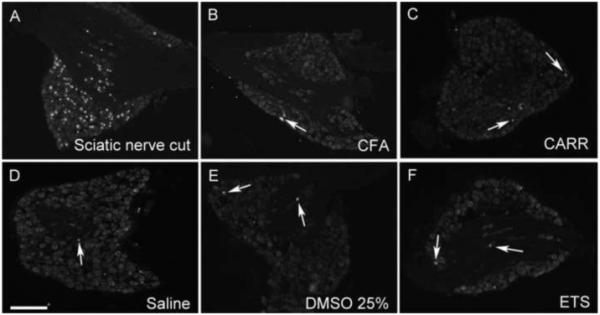
Figure 1
Figure 1. Nerve damage, not merely activation of peripheral afferents, is required for ATF3 induction in DRG neurons
(A) Nerve injury (axotomy) induces expression of ATF3 (red) in the nuclei of large numbers of DRG neurons. By contrast, neuronal activation associated with the inflammation induced by Complete Freund’s Adjuvant (CFA, 48h post-injection; B) does not. Carrageenan (CARR, 48h post-injection; C) induced a very small increase in the percentage of ATF3+ neurons compared to control animals. Neither saline (D), dimethyl sulfoxyde (DMSO 25%; E) nor the vehicle for capsaicin (ethanol/triton/saline; ETS, F) induces ATF3 expression above that produced by needle injection alone. Arrows point to ATF3+ neurons. Calibration bar 200μm.
Figure 2
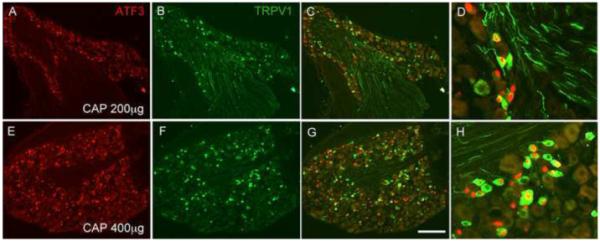
Figure 2. Capsaicin injures both TRPV1 and non-TRPV1 expressing DRG neurons
The effect of capsaicin (CAP) injection on ATF3 expression (red) is dose-dependent, in both TRPV1 (green) and non-TRPV1 expressing sensory neurons. Panels D and H show higher magnifications of C and G, respectively. Calibration bar 200μm.
Figure 3
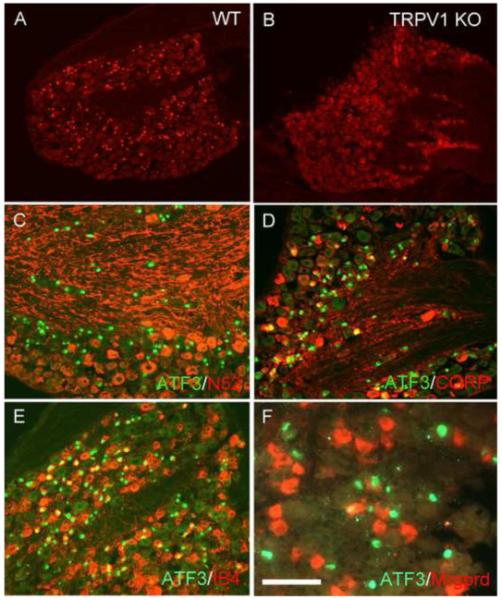
Figure 3. Capsaicin-induced ATF3 expression in unmyelinated afferents of both the peptidergic and nonpeptidergic class is TRPV1-dependent
(A-B) In wild-type animals (A) capsaicin induces ATF3 expression (red) in large numbers of DRG neurons. By contrast, in TRPV1 null mice, the same dose of capsaicin fails to induce ATF3, indicating that the capsaicin-induced ATF3 expression is TRPV1-dependent. (C-F) In wild-type mice, capsaicin induces ATF3 expression (green) almost exclusively in unmyelinated afferents (only ~4% are N52+, a marker of neurons with myelinated axons, red in C). The capsaicin-induced ATF3 expression occurs in both the peptidergic/CGRP-immunoreactive, (red in D) and nonpeptidergic (bind IB4, red in E) subsets of unmyelinated DRG neurons. But the ATF3 expression only occurred in a very small percentage of Mrgprd subset of IB4 afferents (<5%) red in F). Calibration bar A-B 200μm; C-E 100μm and F 75μm.
Figure 4
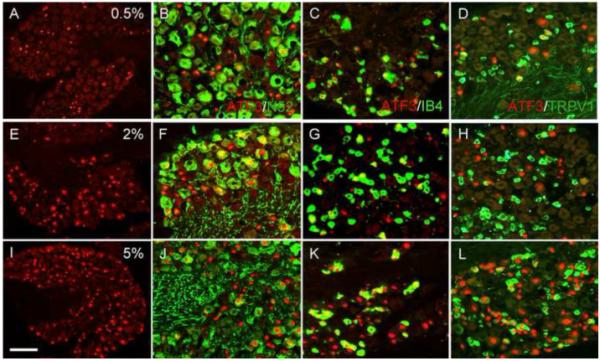
Figure 4. Formalin injures both TRPV1 and non-TRPV1 expressing unmyelinated afferents
(A-L) Formalin induces ATF3 expression (red) in large numbers of DRG neurons in a dose-dependent manner, including both myelinated afferents (N52+, green in B, F and J) and unmyelinated afferents that bind IB4 (green in C, G and K). (D, H and L). As for capsaicin, formalin induces ATF3 (red) in both TRPV1 (green) and non-TRPV1 expressing sensory neurons. Calibration bar A, E and I 200μm; B-D, F-H and J-L 75μm.
Figure 5
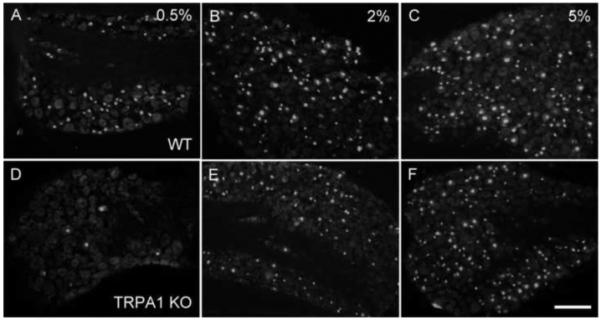
Figure 5. TRPA1 is required for the induction of ATF3 expression by low doses of formalin
(A-C) In wild-type mice, intraplantar injection of formalin induces expression of ATF3 (red) in large numbers of DRG neurons in a dose-dependent manner. (D-F) The expression induced by the low dose (D), but not high doses of formalin (E, F), was blocked in TRPA1 null mice. Calibration bar 200μm.
Figure 6
Figure 6. TRPA1 is not restricted to TRPV1 expressing DRG neurons
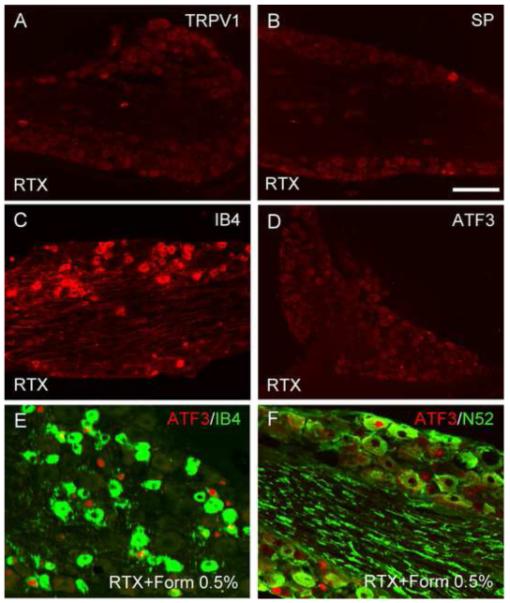
(A-D) TRPV1 expression is lost in resiniferatoxin (RTX)-treated mice (red in A) as is immunoreactivity for substance P (SP, a marker of peptidergic neurons, red in B). In contrast, IB4 binding (red in C) is unchanged, indicating that the latter neurons are TRPV1-negative. Compared to the contralateral side (D), 0.5% formalin induces ATF3 in a significantly higher number of DRG neurons, most of which are nonpeptidergic (~63% bind IB4; green in E). A smaller proportion (~10%) has myelinated axons (N52+; green in F). Given that 0.5% formalin fails to induce ATF3 in TRPA1 mutant mice, these results point to the presence of a nonpeptidergic population of afferents that expresses TRPA1, but not TRPV1. Calibration bar A-C 200μm; E-F 75μm.
Figure 7
Figure 7. ATF3 expression induced by mustard oil requires TRPA1
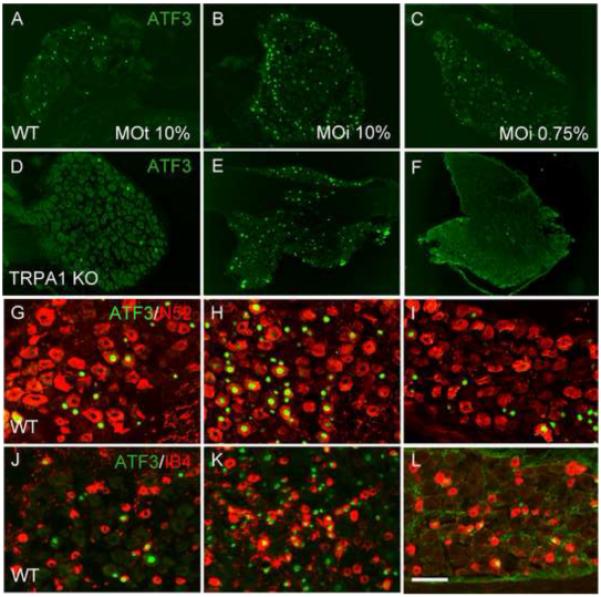
(A-C) In wild-type mice, both topical application (MOt; A) and intraplantar (MOi; B-C) injection of mustard oil induces ATF3 expression (green) in large numbers of DRG neurons. (D-F) These effects are eliminated in TRPA1 null mice (D and F). By contrast, the ATF3 expression induced by an intraplantar injection of 10% MO persisted in the TRPA1 mutant mice (E). (G-L) Mustard oil induces ATF3 (green) in both myelinated (N52+; red in G-I) and unmyelinated nonpeptidergic (bind IB4, red in J-L) afferents. Calibration bar A-F 200μm; G-L 75μm.
Figure 8
Figure 8. Menthol-induced ATF3 expression is TRPM8-independent
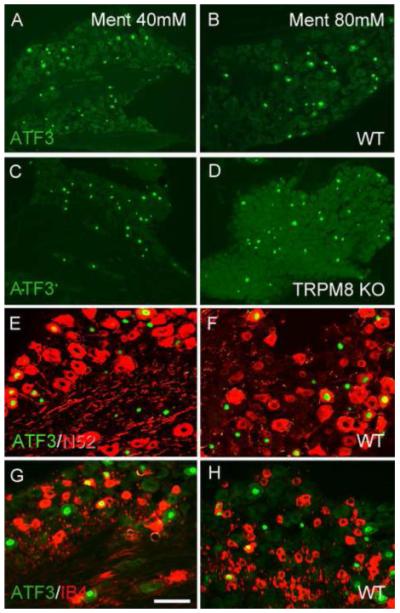
(A-D) Menthol (Ment) induces ATF3 expression (green) in large numbers of DRG neurons, in both wild-type (A-B) and TRPM8 null mice (C-D), indicating that TRPM8 is not required for the full induction of ATF3 by menthol. (E-H) Menthol induces ATF3 (green) in both myelinated (N52+; red in E-F) and unmyelinated nonpeptidergic (bind IB4, red in G-H) afferents. Calibration bar A-D 200μm; E-H 75μm.

References

    1. Amir R, Devor M. Functional cross-excitation between afferent A- and C-neurons in dorsal root ganglia. Neuroscience. 2000;95:189–195. - PubMed
    1. Andersson DA, Gentry C, Moss S, Bevan S. Transient receptor potential A1 is a sensory receptor for multiple products of oxidative stress. J Neurosci. 2008;28:2485–2494. - PMC - PubMed
    1. Bandell M, Story GM, Hwang SW, Viswanath V, Eid SR, Petrus MJ, Earley TJ, Patapoutian A. Noxious cold ion channel TRPA1 is activated by pungent compounds and bradykinin. Neuron. 2004;41:849–857. - PubMed
    1. Bang S, Hwang SW. Polymodal ligand sensitivity of TRPA1 and its modes of interactions. J Gen Physiol. 2009;133:257–262. - PMC - PubMed
    1. Basbaum AI, Bautista DM, Scherrer G, Julius D. Cellular and molecular mechanisms of pain. Cell. 2009;139:267–284. - PMC - PubMed

Publication types

MeSH terms