. 2010 Sep;54(9):3770-5.
doi: 10.1128/AAC.00620-10. Epub 2010 Jul 6.

Optimized Nile Red efflux assay of AcrAB-TolC multidrug efflux system shows competition between substrates

Affiliations

Optimized Nile Red efflux assay of AcrAB-TolC multidrug efflux system shows competition between substrates

Jürgen A Bohnert et al. Antimicrob Agents Chemother. 2010 Sep.

Abstract

AcrAB-TolC is the major constitutively expressed efflux pump system that provides resistance to a variety of antimicrobial agents and dyes in Escherichia coli. However, no systematically optimized real-time dye efflux assay has been published for the measurement of its activity and for detection of possible competition between substrates. Here, we report on the development of such an assay using a lipophilic dye, Nile Red. Energy-depleted cells were loaded with the dye in the presence of low (10 microM or less) concentrations of the proton conductor carbonyl cyanide m-chlorophenylhydrazone (CCCP). The CCCP was then removed, and efflux was triggered by energization with glucose. Various known efflux pump inhibitors and antimicrobials were checked for the ability to slow down Nile Red efflux, presumably through competition. Besides the known inhibitors Phe-Arg-beta-naphthylamide and 1-naphthyl-methylpiperazine, several tetracyclic compounds (doxorubicin, minocycline, chlortetracycline, doxycycline, and tetracycline) and tetraphenylphosphonium chloride were found to interfere with dye efflux. This inhibition could not be explained by the depletion of proton motive force. None of the other tested antimicrobials, including macrolides, fluoroquinolones, and beta-lactams, had any impact on Nile Red efflux, even at concentrations of up to 1 mM.


Figures
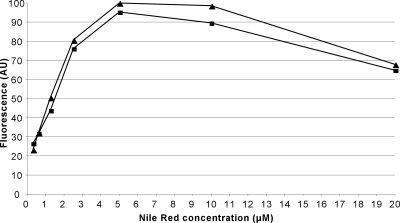
FIG. 1.
FIG. 1.
Nile Red loading (determined as relative fluorescence units) in strain 3-AG100 before the energization of efflux, depicted as a function of the Nile Red concentration. Two independent experiments are shown. Fluorescence intensity is shown in arbitrary units (AU).
FIG. 2.
FIG. 2.
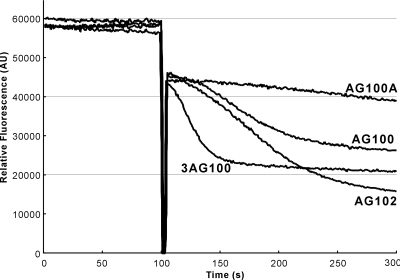
Nile Red efflux after addition of 50 mM glucose at 100 s to de-energized cells displaying various levels of acrAB expression, from none (AG100A) to wild-type level constitutive expression (AG100) and overexpression (a modest level [AG102] and a high level [3-AG100]).
FIG. 3.
FIG. 3.
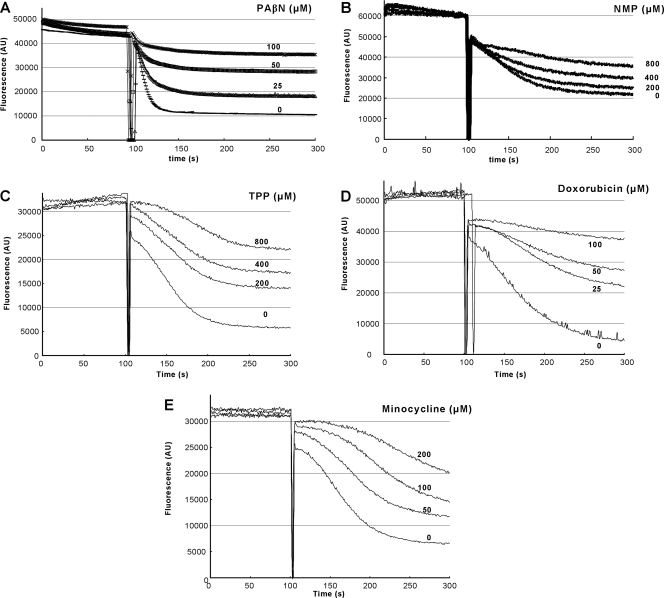
Dose-dependent inhibition of Nile Red efflux by presumed competitors. Efflux was triggered at 100 s by the addition of 50 mM glucose. The intensity of fluorescence emission from Nile Red is shown in arbitrary units (AU). (A) Effect of PAβN in strain 3-AG100. (B) Effect of NMP in strain AG102. (C) Effect of TPP in strain AG102. (D) Effect of doxorubicin in strain AG102. As indicated in the text, doxorubicin was present only in the preincubation buffer and was removed from the assay mixture. (E) Effect of minocycline in strain AG102. Minocycline was present only in the preincubation buffer and was removed from the assay mixture.

References

    1. Aires, J. R., and H. Nikaido. 2005. Aminoglycosides are captured from both periplasm and cytoplasm by the AcrD multidrug efflux transporter of Escherichia coli. J. Bacteriol. 187:1923-1929. - PMC - PubMed
    1. Bohnert, J. A., and W. V. Kern. 2005. Selected arylpiperazines are capable of reversing multidrug resistance in Escherichia coli overexpressing RND efflux pumps. Antimicrob. Agents Chemother. 49:849-852. - PMC - PubMed
    1. Bohnert, J. A., S. Schuster, M. A. Seeger, E. Fahnrich, K. M. Pos, and W. V. Kern. 2008. Site-directed mutagenesis reveals putative substrate binding residues in the Escherichia coli RND efflux pump AcrB. J. Bacteriol. 190:8225-8229. - PMC - PubMed
    1. Elkins, C. A., and L. B. Mullis. 2007. Substrate competition studies using whole-cell accumulation assays with the major tripartite multidrug efflux pumps of Escherichia coli. Antimicrob. Agents Chemother. 51:923-929. - PMC - PubMed
    1. Greenspan, P., and S. D. Fowler. 1985. Spectrofluorometric studies of the lipid probe, Nile Red. J. Lipid Res. 26:781-789. - PubMed

Publication types

MeSH terms

LinkOut - more resources