Review
. 2010 Sep;30(9):1564-76.
doi: 10.1038/jcbfm.2010.101. Epub 2010 Jul 7.

MicroRNAs as effectors of brain function with roles in ischemia and injury, neuroprotection, and neurodegeneration

Affiliations
Review

MicroRNAs as effectors of brain function with roles in ischemia and injury, neuroprotection, and neurodegeneration

Julie A Saugstad. J Cereb Blood Flow Metab. 2010 Sep.

Abstract

MicroRNAs are small RNAs that function as regulators of posttranscriptional gene expression. MicroRNAs are encoded by genes, and processed to form ribonucleoprotein complexes that bind to messenger RNA (mRNA) targets to repress translation or degrade mRNA transcripts. The microRNAs are particularly abundant in the brain where they serve as effectors of neuronal development and maintenance of the neuronal phenotype. They are also expressed in dendrites where they regulate spine structure and function as effectors in synaptic plasticity. MicroRNAs have been evaluated for their roles in brain ischemia, traumatic brain injury, and spinal cord injury, and in functional recovery after ischemia. They also serve as mediators in the brain's response to ischemic preconditioning that leads to endogenous neuroprotection. In addition, microRNAs are implicated in neurodegenerative disorders, including Alzheimer's, Huntington, Parkinson, and Prion disease. The discovery of microRNAs has expanded the potential for human diseases to arise from genetic mutations in microRNA genes or sequences within their target mRNAs. This review discusses microRNA discovery, biogenesis, mechanisms of gene regulation, their expression and function in the brain, and their roles in brain ischemia and injury, neuroprotection, and neurodegeneration.


Figures
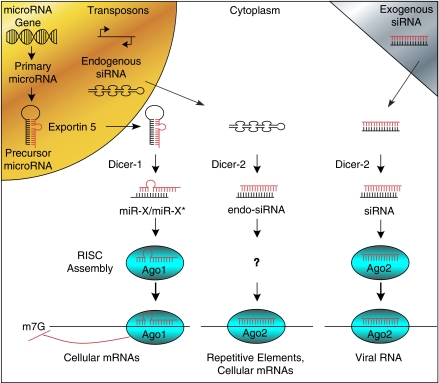
Figure 1
Figure 1
Biogenesis of microRNAs, endogenous short interfering RNAs (siRNAs), and exogenous siRNAs. Endogenous microRNAs are transcribed from nuclear genes into primary microRNA transcripts containing an ∼70 nucleotide hairpin loop structure, which are cleaved into precursor microRNA transcripts. The nuclear protein, Exportin 5, transports precursor microRNAs into the cytoplasm, where it is cleaved by Dicer to an imperfect miR-X:miR-X* duplex of ∼20 to 25 nucleotides. One strand of the duplex is degraded, and the remaining, mature microRNA binds to Dicer and Argonaute (Ago) proteins to form RNA-induced silencing complexes (RISCs). MicroRNAs target sequences within cellular messenger RNAs (mRNAs) causing repression of translation initiation and subsequent degradation of some mRNAs. Parallel processes in the cytoplasm produce siRNAs derived from endogenous transposons, which can target repetitive elements and cellular mRNAs, or from exogenous siRNAs that target viral mRNAs.
Figure 2
Figure 2
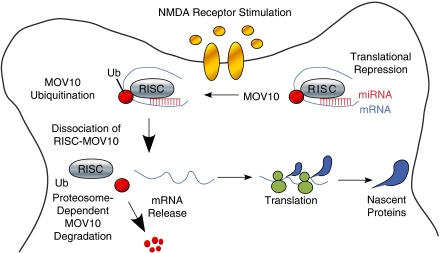
Model for microRNAs as effectors of synaptic learning and memory. Synapses that contain RNA-induced silencing complex (RISC)-bound messenger RNAs (mRNAs) respond to N-methyl--aspartic acid receptor stimulation by dissociation of the translationally repressed mRNAs and ubiquitination (Ub) of the RISC-associated protein, MOV10. The freed mRNAs enter the polysome compartment where translation is initiated, and ubiquitinated MOV10 is rapidly degraded by the proteasome. This model accounts for the paradoxical requirement of both protein degradation and protein synthesis that are required for persistent changes in synaptic strength that are necessary for learning and memory. Adapted from Banerjee et al (2009).
Figure 3
Figure 3
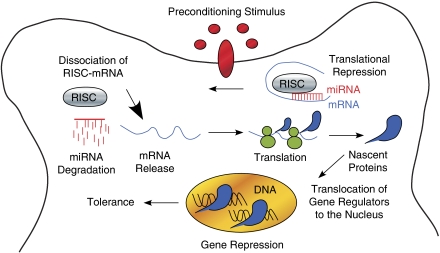
Model for microRNAs as effectors of preconditioning-induced tolerance. Synapses that contain RNA-induced silencing complex (RISC)-bound messenger RNA (mRNAs) respond to a preconditioning stimulus by dissociation of the translationally repressed mRNAs and degradation of the microRNAs. The freed mRNAs are translated, and new proteins include transcriptional regulators that translocate into the nucleus and regulate gene expression. This model accounts for the know features of preconditioning-induced tolerance, the requirement of new protein synthesis and transcriptional repression in tolerance.

References

    1. Alexiou P, Maragkakis M, Papadopoulos GL, Reczko M, Hatzigeorgiou AG. Lost in translation: an assessment and perspective for computational microRNA target identification. Bioinformatics. 2009;25:3049–3055. - PubMed
    1. Ambros V. The functions of animal microRNAs. Nature. 2004;431:350–355. - PubMed
    1. Aravin AA, Hannon GJ, Brennecke J. The Piwi-piRNA pathway provides an adaptive defense in the transposon arms race. Science. 2007;318:761–764. - PubMed
    1. Bak M, Silahtaroglu A, Moller M, Christensen M, Rath MF, Skryabin B, Tommerup N, Kauppinen S. MicroRNA expression in the adult mouse central nervous system. RNA. 2008;14:432–444. - PMC - PubMed
    1. Banerjee S, Neveu P, Kosik KS. A coordinated local translational control point at the synapse involving relief from silencing and MOV10 degradation. Neuron. 2009;64:871–884. - PubMed

MeSH terms