doi: 10.3410/B2-31.
Epub 2010 Apr 27.
Understanding lipid rafts and other related membrane domains
- PMID: 20606718
- PMCID: PMC2894464
- DOI: 10.3410/B2-31
Item in Clipboard
Understanding lipid rafts and other related membrane domains
F1000 Biol Rep.
2010.
Abstract
Evidence in support of the classical lipid raft hypothesis has remained elusive. Data suggests that transmembrane proteins and the actin-containing cortical cytoskeleton can organize lipids into short-lived nanoscale assemblies that can be assembled into larger domains under certain conditions. This supports an evolving view in which interactions between lipids, cholesterol, and proteins create and maintain lateral heterogeneity in the cell membrane.
Figures
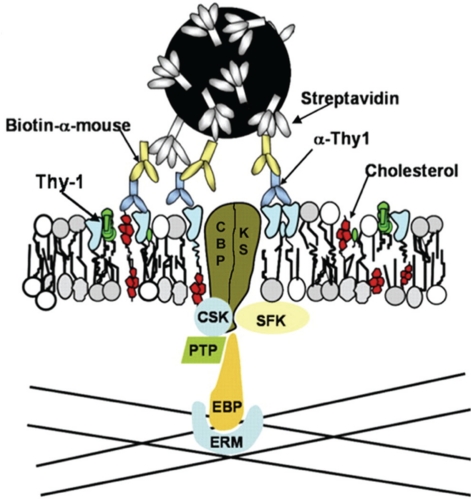
The glycosylphosphatidylinositol (GPI)-anchored protein Thy-1 engages membrane lipids and proteins for transmembrane signaling. Thy-1 crosslinking by streptavidin-coated quantum dots aggregates GPI lipid tails in the outer leaflet of the plasma membrane in a cholesterol-dependent manner. Carboxyl-terminal Src kinase (Csk)-binding protein (CBP), a transmembrane protein, is recruited to or captured by Thy-1 clusters along with Src-family kinase substrates (KS). CBP or KS (or both) are phosphorylated by Src-family kinases (SFK), enabling CBP to bind to actin filaments via an EBP50-ERM (ezrin/radixin/moesin-binding phosphoprotein 50-ezrin/radixin/moesin) adaptor linkage resulting in a transient anchorage. When either CBP or the adaptors are dephosphorylated by an unspecified protein tyrosine phosphatase (PTP) the anchorage is terminated. Image adapted from [20]; Chen et al., J Cell Sci 2009.
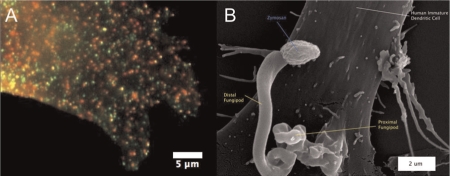
C-type lectins (CLRs) form a type of plasma membrane domain that is not dependent on cholesterol. (A) Plasma membrane domains containing mixtures (yellow) of dendritic cell-specific intracellular adhesion molecule-3-grabbing non-integrin (DC-SIGN) (green) and CD206 (red) are observed on a monocyte-derived dendritic cell (DC) by immunofluorescence. DC-SIGN domains are known sites of binding and entry for a range of pathogens including HIV-1. (B) Yeast cell wall material is sensed by these CLR membrane domains, triggering a unique protrusive response, the fungipod. The image shows an example of a DC fungipod formed via CD206 ligation by a fixed Saccharomyces cerevisiae particle (zymosan), visualized by scanning electron microscopy (9500×). Figure 2B was reproduced from [44], Neumann & Jacobson, PLoS Pathog 2010.
References
-
- Kawai K, Fujita M, Nakao M. Lipid components of two different regions of an intestinal epithelial cell membrane of a mouse. Biochim Biophys Acta. 1974;369:222–33. - PubMed
-
- Lingwood D, Simons K. Lipid rafts as a membrane-organizing principle. Science. 2010;327:46–50. doi: 10.1126/science.1174621. - DOI - PubMed
-
<ext-link ext-link-type="uri" xlink:href="http://www.f1000biology.com/article/id/1543956">F1000 Factor 6.0 Must Read</ext-link>
Evaluated by Kenneth Yamada 20 Jan 2010