


Patient perspectives of clinical care and patient navigation in follow-up of abnormal mammography
- PMID: 20607432
- PMCID: PMC3019311
- DOI: 10.1007/s11606-010-1436-4
Patient perspectives of clinical care and patient navigation in follow-up of abnormal mammography
Abstract
Background: Racial and ethnic disparities in cancer care and survival are well documented. Patient navigation has been shown to improve timely follow-up of abnormal breast screenings for underserved patients. Few studies showed the impact of navigation on patient experiences of care.
Objective: We compared the experiences of patients enrolled in a patient navigator program and non-navigated patients referred to a hospital breast center for follow-up of abnormal mammogram in an underserved community health center population.
Design: Group comparison study using data from a mail and telephone survey to measure the experience of navigated and non-navigated patients.
Participants: English- and Spanish-speaking patients with abnormal mammography attending the Avon Breast Center between April 1, 2005 and April 30, 2007. Seventy-two navigated patients and 181 non-navigated patients completed surveys; the survey response rate was 53.6%.
Main measures: Timeliness of care, preparation for the visit to the breast center, ease of access, quality of care, provider communication, unmet need and patient satisfaction.
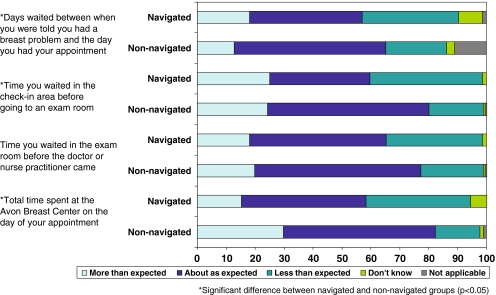
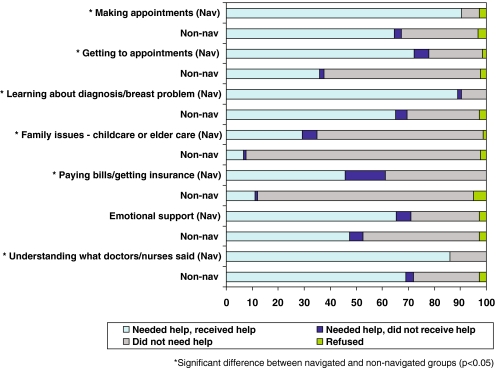
Key results: Most measures of the patient experience did not differ between navigated and non-navigated patients. Overall quality of care was rated as excellent (55% vs 62%, p = 0.294). Navigated patients were significantly more likely than non-navigated to 'definitely' understand what to expect at their visit (79% vs 60%, p = 0.003), to receive a reminder letter or telephone call (89% vs 77%, p = 0.029), and to feel welcome (89% vs 75%, p = 0.012). Navigated patients were less likely than non-navigated to rate the concern shown for their cultural/religious beliefs as excellent (45% vs 54%, p = 0.014).
Conclusions: Assessing patient perspectives is essential to evaluate the success of quality improvement interventions. In our center, we measured few significant disparities in the perceptions of care of these two very different populations of patients, although, there are still areas in which our program needs improvement. Further research is needed to understand the effectiveness of patient navigation programs in reducing racial and ethnic disparities.
Figures
Comment in
-
Patient navigation: the promise to reduce health disparities.J Gen Intern Med. 2011 Feb;26(2):110-2. doi: 10.1007/s11606-010-1593-5. J Gen Intern Med. 2011. PMID: 21161422 Free PMC article. No abstract available.
References
-
- Ries LAG, Melbert D, Krapcho M et al (eds). SEER Cancer Statistics Review, 1975–2004, National Cancer Institute. Available from URL: http://seer.cancer.gov/csr/1975_2004/ [accessed June 8, 2010].
-
- Smedley BD, Stith AY, Nelson AR (eds). Unequal treatment: Confronting racial and ethnic disparities in health care. Institute of Medicine Committee on Understanding and Eliminating Racial and Ethnic Disparities in Health Care. Washington, DC: National Academies Press 2003. - PubMed
-
- US Department of Health and Human Services. Making cancer health disparities history. Trans-HHS Cancer Health Disparities Progress Review Group. March 2004. Available from URL: http://www.hhs.gov/chdprg/pdf/chdprg.pdf [accessed June 8, 2010].
Publication types
MeSH terms
LinkOut - more resources
Full Text Sources
Medical
Miscellaneous
