


Intergenerational mobility in the post-1965 immigration era: estimates by an immigrant generation cohort method
- PMID: 20608102
- PMCID: PMC3000029
- DOI: 10.1353/dem.0.0105
Intergenerational mobility in the post-1965 immigration era: estimates by an immigrant generation cohort method
Abstract
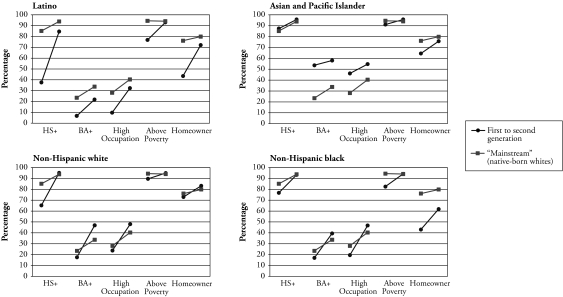
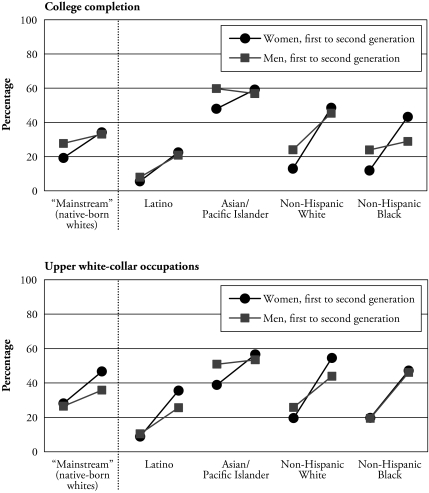
The new second generation of the post-1965 immigration era is observed as children with their parents in 1980 and again as adults 25 years later. Intergenerational mobility is assessed for both men and women in four major racial/ethnic groups, both in regard to children's status attainment relative to parents and with regard to the rising societal standards proxied by native-born non-Hispanic whites. A profile of intergenerational mobility is prepared using multiple indicators of status attainment: high school and college completion, upper white-collar occupation, poverty, and homeownership. The immigrant generation cohort method we introduce accounts for four distinct temporal dimensions of immigrant progress, clarifying inconsistencies in the literature and highlighting differences in mobility between racial/ethnic groups and with respect to different outcome measures. The immigrant generation cohort method consistently finds greater intergenerational mobility than suggested by alternative approaches. Our analysis also shows that the intergenerational progress of women is greater than that of men and provides a more complete record of immigrant mobility overall. Findings for individual racial/ethnic groups accord with some expectations in the literature and contradict others.
Figures
References
-
- Alba R. Italian-Americans: Into the Twilight of Ethnicity. Englewood Cliffs, NJ: Prentice Hall; 1985.
-
- Alba RD, Nee V. Remaking the American Mainstream: Assimilation and the New Immigration. Cambridge, MA: Harvard University Press; 2003.
-
- Bean FD, Chapa J, Berg RR, Sowards KA. “Educational and Sociodemographic Incorporation Among Hispanic Immigrants to the United States.”. In: Edmonston B, Passel JS, editors. Immigration and Ethnicity: The Integration of America’s Newest Arrivals. Washington, DC: The Urban Institute Press; 1994. pp. 73–99.
-
- Bean FD, Stevens G. America’s Newcomers and the Dynamics of Diversity. New York: Russell Sage Foundation; 2003.
-
- Bean FD, Tienda M. The Hispanic Population of the United States. New York: Russell Sage Foundation; 1987.
Publication types
MeSH terms
Grants and funding
LinkOut - more resources
Full Text Sources
