Postprandial energy expenditure in whole-food and processed-food meals: implications for daily energy expenditure
- PMID: 20613890
- PMCID: PMC2897733
- DOI: 10.3402/fnr.v54i0.5144
Postprandial energy expenditure in whole-food and processed-food meals: implications for daily energy expenditure
Abstract
Background: Empirical evidence has shown that rising obesity rates closely parallel the increased consumption of processed foods (PF) consumption in USA. Differences in postprandial thermogenic responses to a whole-food (WF) meal vs. a PF meal may be a key factor in explaining obesity trends, but currently there is limited research exploring this potential link.
Objective: The goal was to determine if a particular PF meal has a greater thermodynamic efficiency than a comparable WF meal, thereby conferring a greater net-energy intake.
Design: Subjective satiation scores and postprandial energy expenditure were measured for 5-6 h after isoenergetic meals were ingested. The meals were either 'whole' or 'processed' cheese sandwiches; multi-grain bread and cheddar cheese were deemed whole, while white bread and processed cheese product were considered processed. Meals were comparable in terms of protein (15-20%), carbohydrate (40-50%), and fat (33-39%) composition. Subjects were healthy women (n=12) and men (n=5) studied in a crossover design.
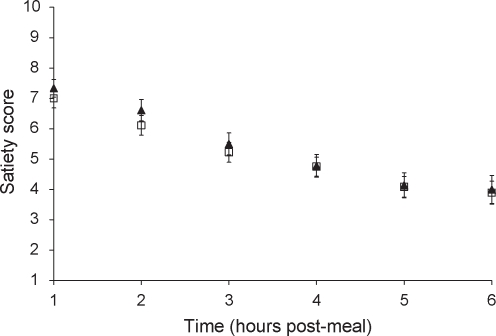
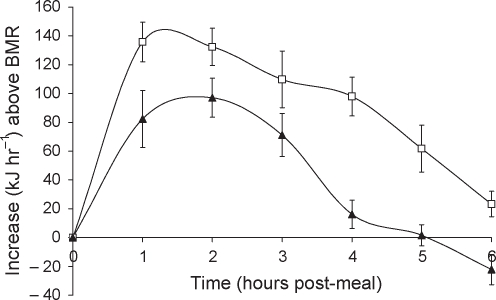
Results: There were no significant differences in satiety ratings after the two meals. Average energy expenditure for the WF meal (137+/-14.1 kcal, 19.9% of meal energy) was significantly larger than for the PF meal (73.1+/-10.2 kcal, 10.7% of meal energy).
Conclusion: Ingestion of the particular PF meal tested in this study decreases postprandial energy expenditure by nearly 50% compared with the isoenergetic WF meal. This reduction in daily energy expenditure has potential implications for diets comprised heavily of PFs and their associations with obesity.
Keywords: DIT; diet; energy; food processing; metabolism; nutrition; obesity.
Figures
References
-
- US Centers for Disease Control and Prevention. National Center for Health Statistics. Health, United States. Atlanta, GA: US Department of Health and Human Services; 2003.
-
- World Health Organization (WHO) Diet, nutrition and the prevention of chronic diseases. 2003 Report of a joint WHO/FAO Expert Consultation. WHO Technical Report Series No. 916. Geneva. - PubMed
-
- Anand RS, Basiotis P, Kennedy E. Rise in amount of total fat and number of calories consumed by Americans. Fed Am Soc Exp Biol J. 1997;11:A183. (Abstract)
-
- Robert Wood Johnson Foundation and Trust for America's Health. F as in fat, How obesity policies are failing in America. Princeton, NJ/Washington, DC: 2009.
-
- Cutler DM, Glaeser EL, Shapiro JM. Why have Americans become more obese? J Econ Perspectives. 2003;17:93–118.
LinkOut - more resources
Full Text Sources