


Changing trends in oral squamous cell carcinoma with particular reference to young patients: 1971-2006. The Emory University experience
- PMID: 20614324
- PMCID: PMC2807552
- DOI: 10.1007/s12105-008-0054-5
Changing trends in oral squamous cell carcinoma with particular reference to young patients: 1971-2006. The Emory University experience
Abstract
Background: Several recent reports suggest an increasing incidence of oral squamous cell carcinoma (OSCC) among young persons in many regions of the world--a trend which is particularly concerning given the overall stabilization or even decline in incidence rates for head and neck cancer in general. The aim of this study is to determine whether there has been an increase in the number of cases of OSCC diagnosed in patients < 40 years old by our biopsy service from 1971 to 2006.
Methods: A retrospective review of all OSCC cases diagnosed from 1971 to 2006 by the Emory University Hospital Oral Pathology biopsy service was performed. A comparison of demographic information, frequency, location and histologic grade was made between these cases as a whole and those occurring in a subset of patients < 40 years old. Statistical procedures included chi-square analyses.
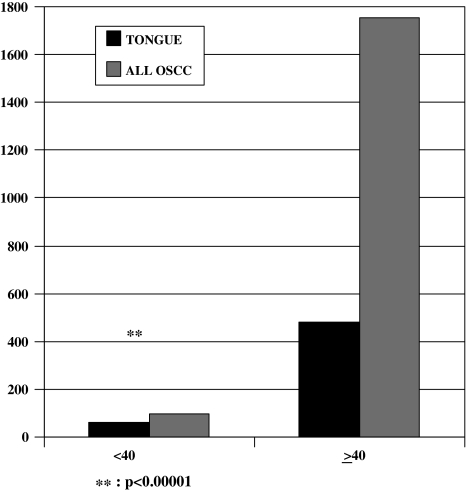
Results: From 1971-2006, 1,919 cases of OSCC were diagnosed, and 95 (5.0%) occurred in patients < 40 years old. A total of 8 cases were diagnosed from 1971 to 1980, compared to 36 cases during the period 1981-1990, 31 during the period 1991-2000 and 21 cases from 2001 to 2006. The increase in OSCC incidence from the 1970s when compared to 1981-2000 was statistically significant (P < 0.002). A 1.7:1 male:female ratio was seen in all decades. The mobile (oral) tongue was the most common location in all decades (62.1%) in young patients. In contrast, tongue cancers accounted for 27.4% in patients > or = 40. This difference between the two groups was statistically significant (P < 0.0001). Of great surprise, however, was the significant increase in tongue cancer during the study period in patients > or = 40 which accounted for 37.1% of all OSCC diagnoses from 2001 to 2006, compared to 20.5% of OSCC cases from 1971 to 1980 (P < 0.0001).
Conclusions: We demonstrated a greater than fourfold increase in the incidence of oral squamous cell carcinoma (OSCC) in young patients < 40 years old beginning in 1974 and peaking in the late 1980s, then remaining stable. The mobile tongue is the most common location for cancer in this age group accounting for 62.1% of cancers. However, the mobile tongue increasingly appears to be the most common site for oral cancer in all age groups.
Keywords: Incidence; Oral cancer; Tongue; Young.
Figures
References
-
- Ries LAG, Harkins D, Krapcho M, Mariotto A, Miller BA, Feuer EJ, et al., editors. SEER cancer statistics review, 1975–2004. Bethesda, MD: National Cancer Institute. http://www.seer.cancer.gov/csr/1975_2004/, based on November 2006 SEER data submission, posted to the SEER web site (2007).
-
- Schantz SP, Yu G-P. Head and neck cancer incidence trends in young Americans, 1973–1997, with a special analysis for tongue cancer. Archives of Otolaryngol Head Neck Surg. 2002;128:268–74. - PubMed
MeSH terms
LinkOut - more resources
Full Text Sources
Medical
