


Prevalence of and risk factors for chronic kidney disease in rural Nicaragua
- PMID: 20615905
- PMCID: PMC4592358
- DOI: 10.1093/ndt/gfq385
Prevalence of and risk factors for chronic kidney disease in rural Nicaragua
Abstract
Background: Mostly anecdotal reports describe a high prevalence of chronic kidney disease in northwestern Nicaragua, predominantly among younger men, resulting in substantial morbidity and mortality. The true prevalence, nature and aetiology of kidney disease in this region remain unknown.
Methods: We performed a population-based prevalence study in Quezalguaque, Nicaragua to assess the frequency of estimated glomerular filtration rate (eGFR) <60 mL/min/1.73 m(2), and compared the prevalence of reduced eGFR in Quezalguaque with the USA using the NHANES 1999-2006 data. We also conducted an embedded case-control study in a subset of participants to assess kidney disease risk factors.
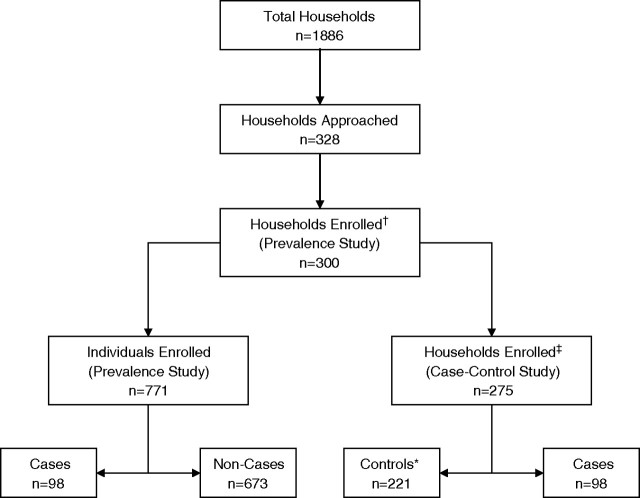
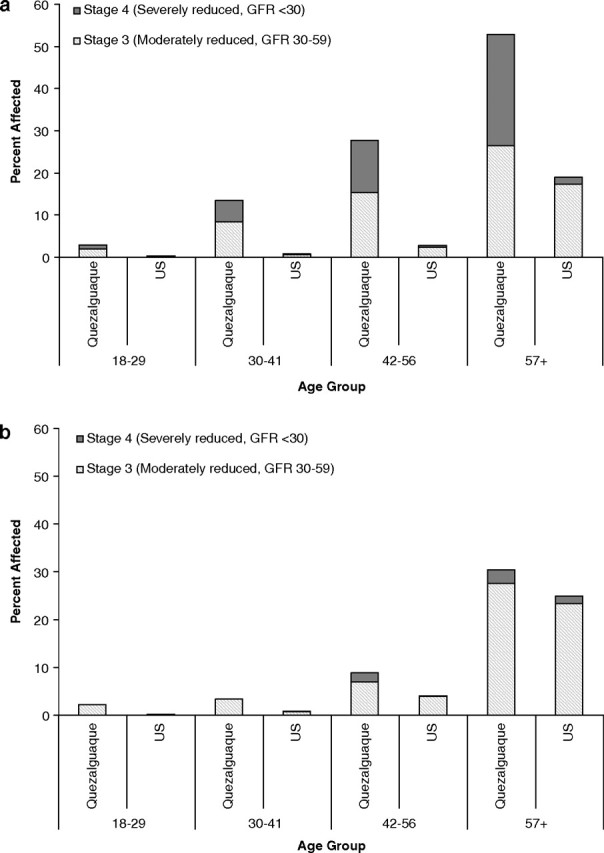
Results: From 1882 eligible households, 771 individuals from 300 households participated in the prevalence study, 98 (13%) of whom had reduced eGFR. Reduced eGFR was more common among older participants, men and participants living at lower altitudes. Among 18-29-year-old participants, 2.6% had reduced eGFR, and among 30-41-year-old participants, 7.4% had reduced eGFR; this compares with 0.2% and 0.8%, respectively, in NHANES. No individuals in these age groups were diabetic. Among cases, only 27% had dipstick proteinuria of 1+ or greater, compared with 7% of controls. Haematuria did not significantly differ between cases and controls (24% versus 18%). In age- and sex-adjusted models, hypertension and residence at lower altitude were independently associated with reduced eGFR, while occupational history was not associated with reduced eGFR.
Conclusions: Kidney disease appears common in residents of Quezalguaque, Nicaragua, particularly in younger men, with features most consistent with tubulointerstitial disease. Further research is needed to elucidate the causes of kidney disease in this region.
Figures
References
-
- Garcia-Trabanino R, Dominguez J, Jansa J, et al. Proteinuria e insuficiencia renal crónica en la costa de El Salvador: detección con métodos de bajo costo y factores asociados [Proteinuria and chronic renal failure in the coast of El Salvador: detection with low cost methods and associated factors] Nefrologia. 2005;25:31–38. - PubMed
-
- García-Trabanino R, Aguilar R, Reyes S, et al. Nefropatía terminal en pacientes de un hospital de referencia en El Salvador [Terminal nephropathology in patients in a reference hospital in El Salvador]. Revista Panamericana de Salud Pública. Pan Am J Public Health. 2002;12:202–206. - PubMed
-
- Cuadra S, Jakobsson K, Hogstedt C, et al. Chronic kidney disease: assessment of current knowledge and feasibility for regional research collaboration in Central America. SALTRA Technical Series on Work & Health 2, Heredia, Costa Rica. 2006. http://www.saltra.info/index.php?module=Pagesetter&tid=11.
-
- Alonso Medrano A, Perea W. Insuficiencia Renal Crónica (IRC) en trabajadores de caña de azúcar, Chinandega, Nicaragua: Febrero-Marzo 2002. In: Cuadra SN, Jakobsson K, Hogstedt C, Wesseling C. Chronic kidney disease: assessment of current knowledge and feasibility for regional research collaboration in Central America. Heredia, Costa Rica: SALTRA, IRET-UNA. 2006:11–42.
-
- Callejas Callejas L, Alonso Medrano CD, Mendoza Canales B. Insuficiencia renal crónica (IRC) en trabajadores de caña de azúcar, El Viejo, Chinandega, Nicaragua. In: Cuadra SN, Jakobsson K, Hogstedt C, Wesseling C. Chronic kidney disease: Assessment of current knowledge and feasibility for regional research collaboration in Central America. Heredia, Costa Rica: SALTRA, IRET-UNA. 2006:11–42.
Publication types
MeSH terms
Grants and funding
LinkOut - more resources
Full Text Sources
Medical
Research Materials
Miscellaneous
