. 2010 Jul 20;107(29):12766-70.
doi: 10.1073/pnas.1005484107. Epub 2010 Jul 6.

Long-lived quantum coherence in photosynthetic complexes at physiological temperature

Affiliations

Long-lived quantum coherence in photosynthetic complexes at physiological temperature

Gitt Panitchayangkoon et al. Proc Natl Acad Sci U S A. .

Abstract

Photosynthetic antenna complexes capture and concentrate solar radiation by transferring the excitation to the reaction center that stores energy from the photon in chemical bonds. This process occurs with near-perfect quantum efficiency. Recent experiments at cryogenic temperatures have revealed that coherent energy transfer--a wave-like transfer mechanism--occurs in many photosynthetic pigment-protein complexes. Using the Fenna-Matthews-Olson antenna complex (FMO) as a model system, theoretical studies incorporating both incoherent and coherent transfer as well as thermal dephasing predict that environmentally assisted quantum transfer efficiency peaks near physiological temperature; these studies also show that this mechanism simultaneously improves the robustness of the energy transfer process. This theory requires long-lived quantum coherence at room temperature, which never has been observed in FMO. Here we present evidence that quantum coherence survives in FMO at physiological temperature for at least 300 fs, long enough to impact biological energy transport. These data prove that the wave-like energy transfer process discovered at 77 K is directly relevant to biological function. Microscopically, we attribute this long coherence lifetime to correlated motions within the protein matrix encapsulating the chromophores, and we find that the degree of protection afforded by the protein appears constant between 77 K and 277 K. The protein shapes the energy landscape and mediates an efficient energy transfer despite thermal fluctuations.


Conflict of interest statement

The authors declare no conflict of interest.

Figures

Fig. 1.
Fig. 1.
Temperature dependence data. Representative two-dimensional electronic spectra of FMO are shown at the waiting time T = 400 fs and 77 K (A), 125 K (B), 150 K (C), and 277 K (D). The data are shown with an arcsinh color scale to highlight small features in both negative and positive portions of the real third-order nonlinear response. Peaks broaden at higher temperature due to faster dephasing between ground and excited states, preventing resolution of the lowest excited state. The quantum beat signals are extracted at the spectral position (white circle) corresponding to the location of 1–3 cross-peak predicted by a theoretical study (27). The beating signals (E) demonstrate agreement in phase and beating frequency among all four temperatures while showing shorter quantum beat lifetimes at higher temperatures.
Fig. 2.
Fig. 2.
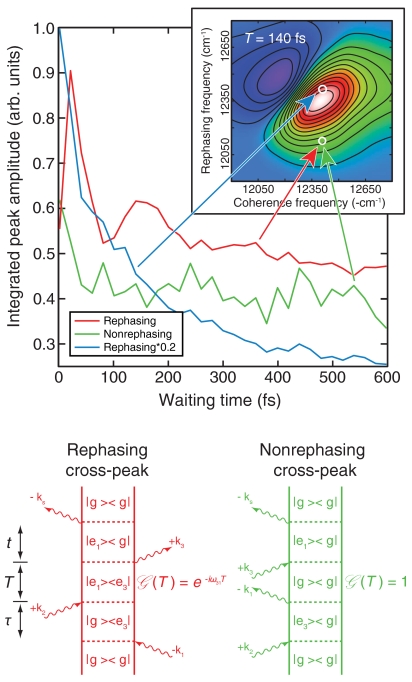
Room temperature quantum beating. Integrated peak amplitudes taken from the absorptive part of the 2D signal at 277 K are plotted as a function of waiting time. The rephasing signal at the indicated cross-peak (red line) shows multiple periods of quantum beating as it decays, while the nonrephasing signal (green line) shows no beating. As a further comparison, the rephasing signal at the indicated diagonal position (blue line) shows only smooth population decay. The magnitude of the diagonal signal was scaled by a factor of 0.2 to facilitate comparison with the off-diagonal signal. The inset shows the 2D spectrum of the absorptive rephasing signal taken at T = 140 fs. Below the spectra, Feynman diagrams representing the relevant Liouville pathways illustrate why beating arises only in the rephasing cross-peak signal.
Fig. 3.
Fig. 3.
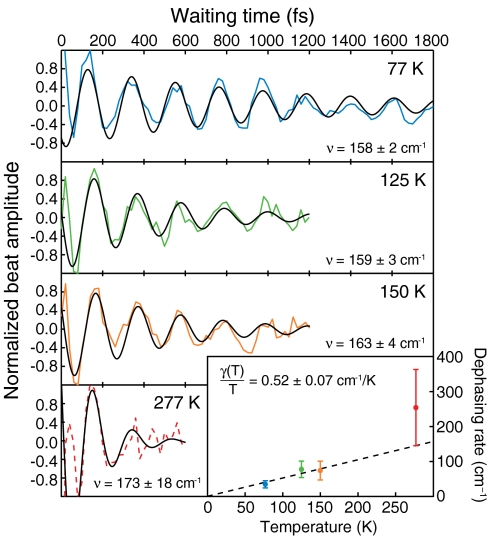
Temperature dependence of coherence dephasing. Integrated cross-peak amplitudes are taken from the absolute value of the combined 2D signal (rephasing + nonrephasing) after removal of exponential population decay at 77 K, 125 K, and 150 K (colored solid lines). The amplitude at 277 K is taken from the absorptive portion of the rephasing signal (dashed red line). The beating signals are normalized to their respective maxima and fit to the product of a sine function and an exponential decay (solid black lines). The beating frequency is given for each temperature. The dephasing rate taken from the exponential part of the fit is plotted as a function of temperature along with standard errors in the inset. The statistically weighted linear fit of these points (dashed black line) has a slope of 0.52 ± 0.07 cm-1/K (SD).

References

    1. Chain RK, Arnon DI. Quantum efficiency of photosynthetic energy-conversion. Proc Natl Acad Sci USA. 1977;74:3377–3381. - PMC - PubMed
    1. Engel GS, et al. Evidence for wavelike energy transfer through quantum coherence in photosynthetic systems. Nature. 2007;446:782–786. - PubMed
    1. Lee H, Cheng YC, Fleming GR. Coherence dynamics in photosynthesis: Protein protection of excitonic coherence. Science. 2007;316:1462–1465. - PubMed
    1. Calhoun TR, et al. Quantum coherence enabled determination of the energy landscape in light-harvesting complex II. J Phys Chem B. 2009;113:16291–16295. - PubMed
    1. Beljonne D, Curutchet C, Scholes GD, Silbey RJ. Beyond Forster resonance energy transfer in biological and nanoscale systems. J Phys Chem B. 2009;113:6583–6599. - PubMed

Publication types

MeSH terms

Substances

LinkOut - more resources