Case Reports
doi: 10.3340/jkns.2010.47.6.461.
Epub 2010 Jun 30.
Spontaneous epidural hematoma from skull base metastasis of hepatocellular carcinoma
Affiliations
- PMID: 20617094
- PMCID: PMC2899036
- DOI: 10.3340/jkns.2010.47.6.461
Item in Clipboard
Case Reports
Spontaneous epidural hematoma from skull base metastasis of hepatocellular carcinoma
J Korean Neurosurg Soc.
2010 Jun.
Abstract
We report a case of an acute spontaneous epidural hematoma (EDH) due to skull base metastasis in a 46-year-old male patient with hepatocellular carcinoma (HCC). The patient presented with the acute onset of severe headache followed by unconsciousness, and computed tomography showed a large EDH in the right temporal and parietal lobes with midline shift. Emergency evacuation of the EDH was performed, and the hemorrhage was determined to be secondary to skull base metastasis of HCC.
Keywords: Epidural hematoma; Hepatocellular carcinoma; Skull base metastasis.
Figures
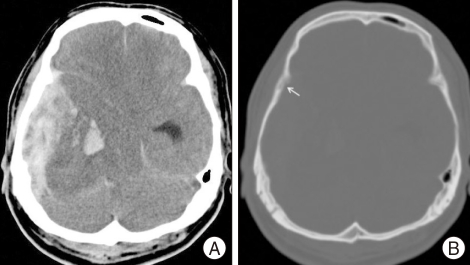
Non-contrast brain tomography and bone setting image. A : Brain computerized tomography shows epidural hematoma in the right temporal base with midline shift, obliteration of basal cistern, and enlarged left temporal horn of lateral ventricle. B : Decreased bone density in the greater wing of the right sphenoid bone (arrow) compared with the contralateral part is suspected in the bone setting image.
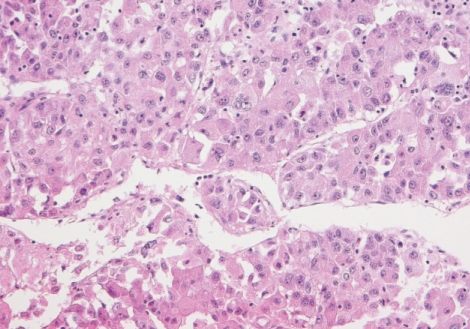
Histologic features of tumor. The tumor shows thick trabecular growth pattern with intercellular canaliculi resembling liver cell plates and sinusoids. The tumor cells maintain a polygonal shape and have abundant granular eosinophilic cytoplasm, round vesicular nuclei and prominent nucleoli (H&E, ×200).
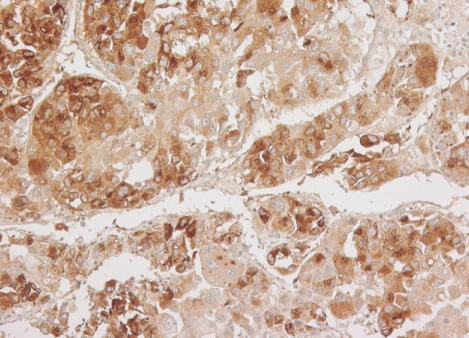
The immunohistochemical finding. The tumor cells show strong cytoplasmic immunoreactivity for α-fetoprotein.
References
-
- Aung TH, Po YC, Wong WK. Hepatocellular carcinoma with metastasis to the skull base, pituitary gland, sphenoid sinus, and cavernous sinus. Hong Kong Med J. 2002;8:48–51. - PubMed
-
- Chang L, Chen YL, Kao MC. Intracranial metastasis of hepatocellular carcinoma : review of 45 cases. Surg Neurol. 2004;62:172–177. - PubMed
-
- Endo M, Hamano M, Watanabe K, Wakai S. [Combined chronic subdural and acute epidural hematoma secondary to metastatic hepatocellular cancer : case report.] No Shinkei Geka. 1999;27:331–334. - PubMed
-
- Hayashi K, Matsuo T, Kurihara M, Daikoku M, Kitange G, Shibata S. Skull metastasis of hepatocellular carcinoma associated with acute epidural hematoma : a case report. Surg Neurol. 2000;53:379–382. - PubMed
-
- Hsieh CT, Sun JM, Tsai WC, Tsai TH, Chiang YH, Liu MY. Skull metastasis from hepatocellular carcinoma. Acta Neurochir (Wien) 2007;149:185–190. - PubMed
Publication types
LinkOut - more resources
Full Text Sources