. 2010 Sep 7;8(17):3831-46.
doi: 10.1039/c005219c. Epub 2010 Jul 8.

Recent advances in transition metal-catalyzed N-atom transfer reactions of azides

Affiliations

Recent advances in transition metal-catalyzed N-atom transfer reactions of azides

Tom G Driver. Org Biomol Chem. .

Abstract

Transition metal-catalyzed N-atom transfer reactions of azides provide efficient ways to construct new carbon-nitrogen and sulfur-nitrogen bonds. These reactions are inherently green: no additive besides catalyst is needed to form the nitrenoid reactive intermediate, and the by-product of the reaction is environmentally benign N(2) gas. As such, azides can be useful precursors for transition metal-catalyzed N-atom transfer to sulfides, olefins and C-H bonds. These methods offer competitive selectivities and comparable substrate scope as alternative processes to generate metal nitrenoids.


Figures
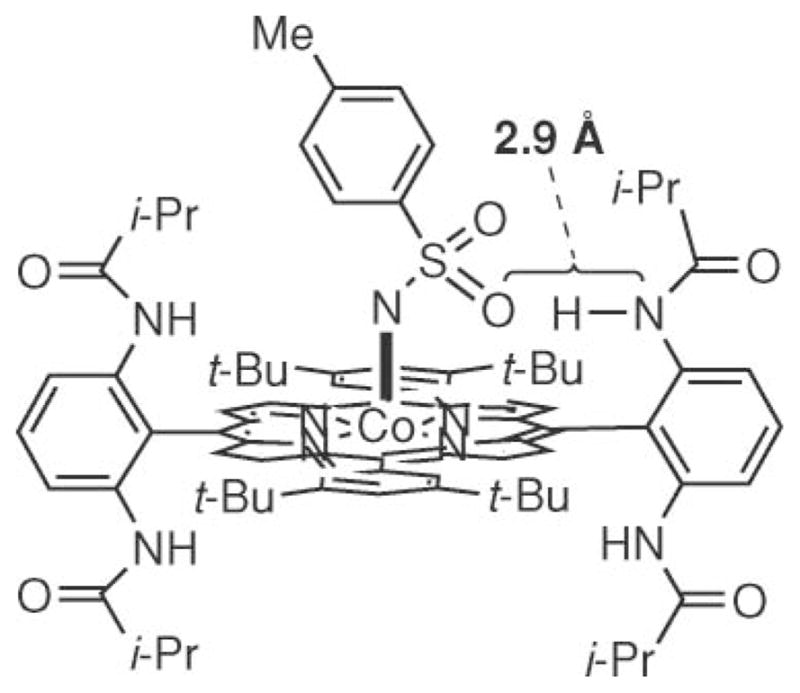
Fig. 1
Fig. 1
H-Bonding explanation for increased catalyst efficiency and lifetime.
Fig. 2
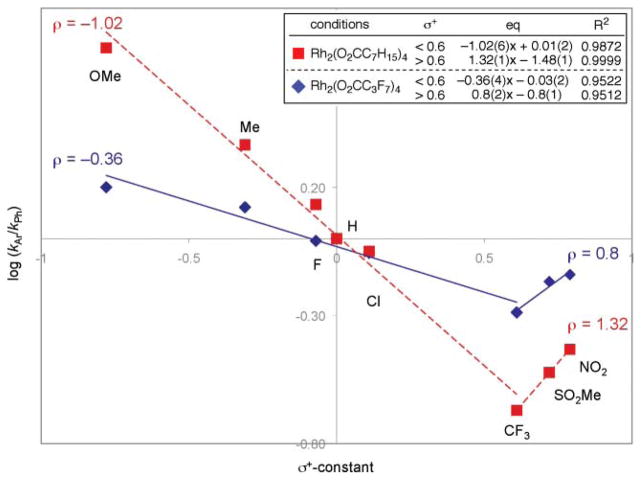
Fig. 2
Relationship of carbazole product ratio with Hammett equation.
Scheme 1
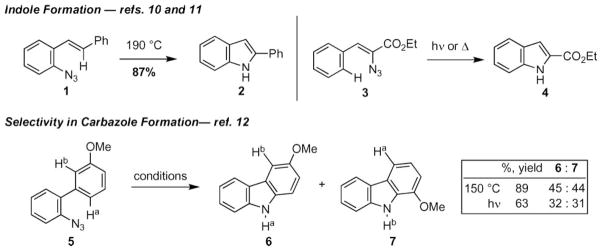
Scheme 1
Representative examples of intramolecular C–H bond amination to afford indoles or carbazoles.
Scheme 2
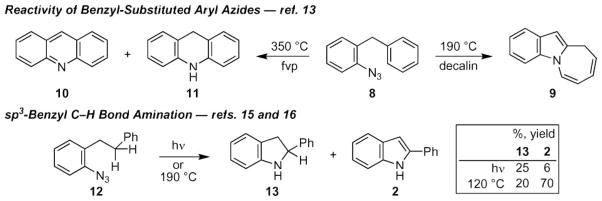
Scheme 2
Examples of intramolecular sp3-C–H bond amination processes.
Scheme 3
Scheme 3
Examples of intermolecular C–H Bond amination reactions.
Scheme 4
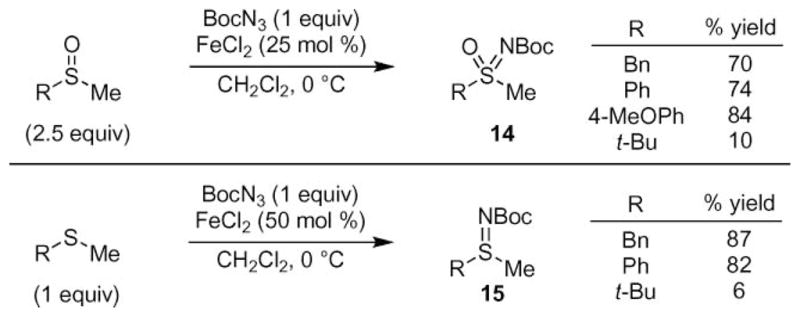
Scheme 4
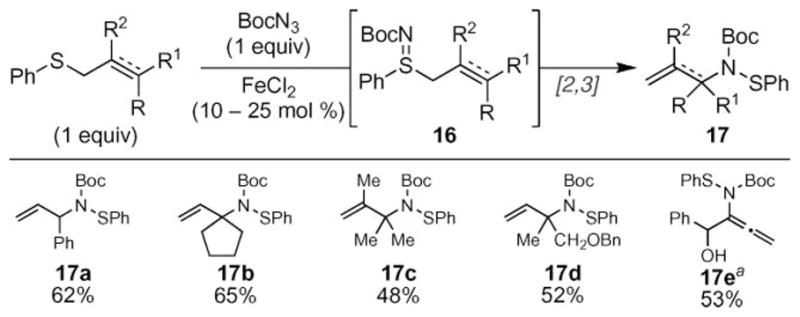
Bach reaction: tandem sulfimination–[2,3] sigmatropic rearrangement. adppeFeCl2 (10 mol%) used; see ref. .
Scheme 5
Scheme 5
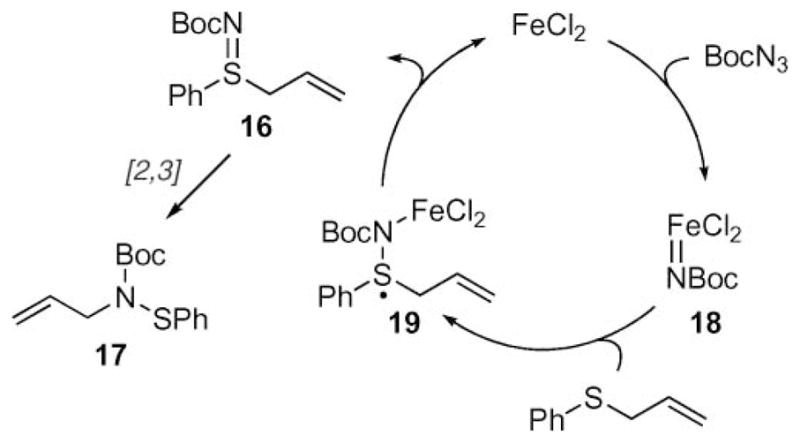
Proposed mechanism of the Bach reaction.
Scheme 6
Scheme 6
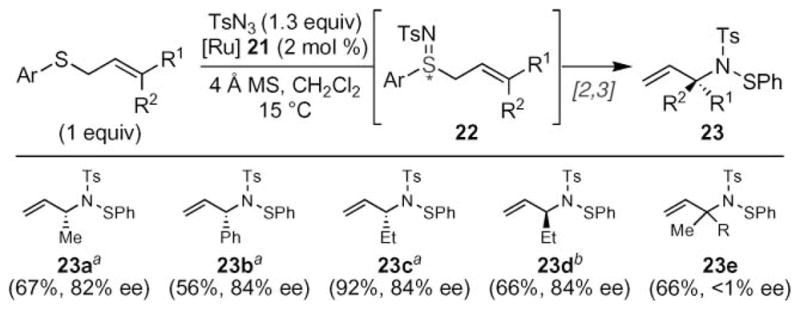
Asymmetric tandem sulfimination–[2,3] sigmatropic rearrangement. aAllyl sulfide approximately a 90 : 10 mixture of E : Z. bAllyl sulfide approximately a 10 : 90 E : Z.
Scheme 7
Scheme 7
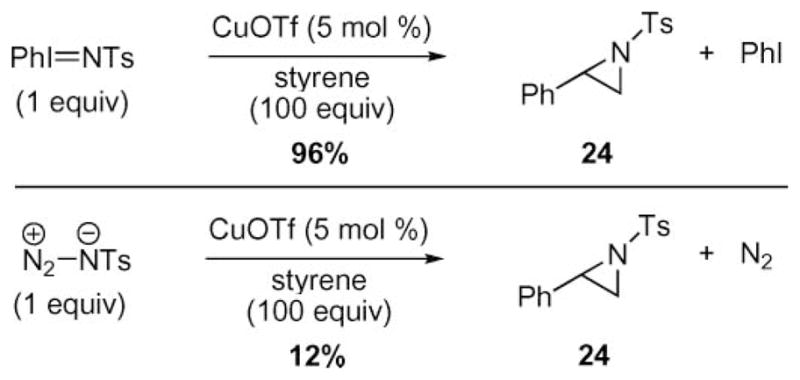
Comparison of the efficiency of copper-catalyzed nitrenoid transfer to styrene.
Scheme 8
Scheme 8
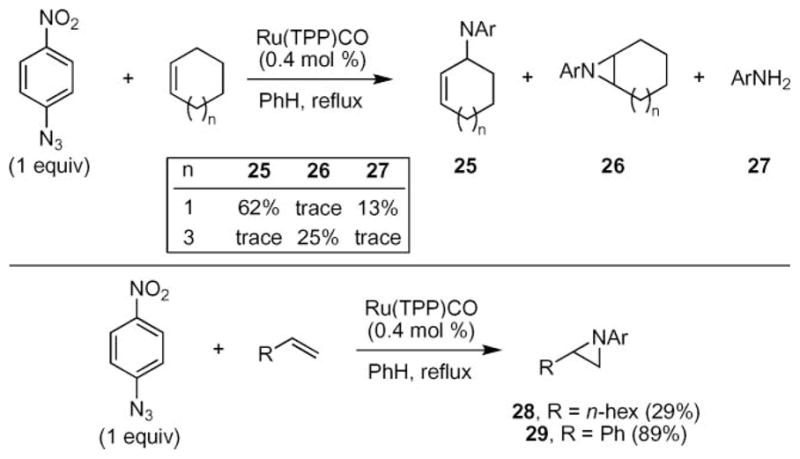
Ruthenium porphyrin-catalyzed aziridine formation from aryl azides.
Scheme 9
Scheme 9
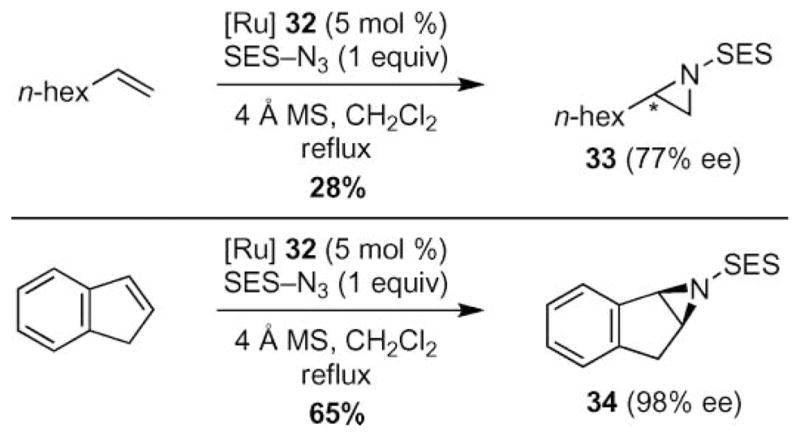
Increased substrate scope with perfluorinated ruthenium–salen 32 catalyst.
Scheme 10
Scheme 10
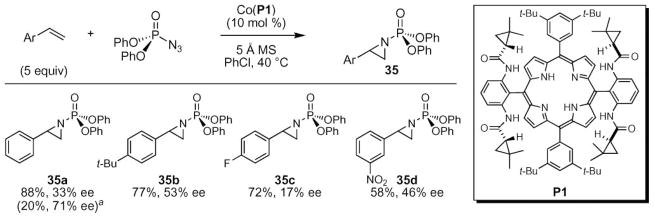
Asymmetric cobalt-catalyzed aziridination of styrenes using phosphoryl azide. a20 mol% DMAP added.
Scheme 11
Scheme 11
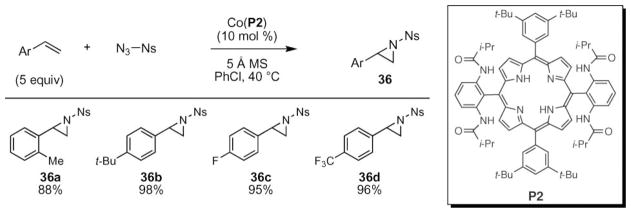
Scope of cobalt-catalyzed aziridination of styrenes using para-nosyl azide.
Scheme 12
Scheme 12
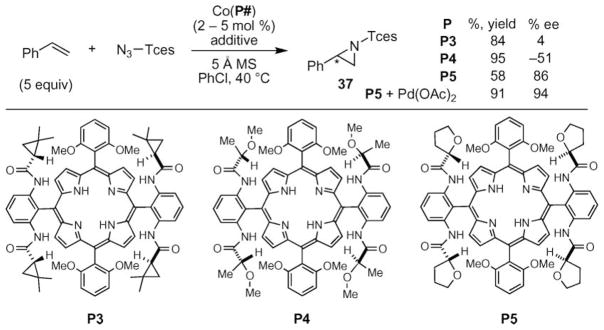
Optimization of cobalt-catalyzed aziridination of styrene using Tces–azide.
Scheme 13
Scheme 13
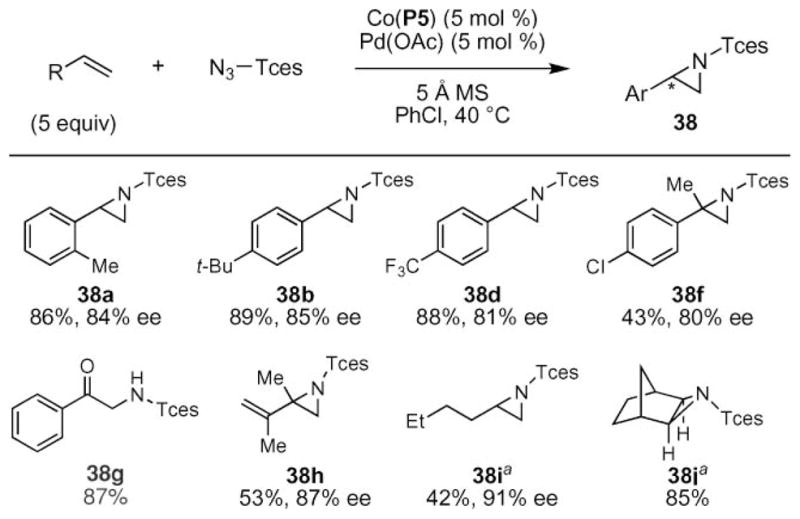
Scope of cobalt-catalyzed aziridination of styrenes using Tces–Azide. aPdOAc2 (5 mol%) used.
Scheme 14
Scheme 14
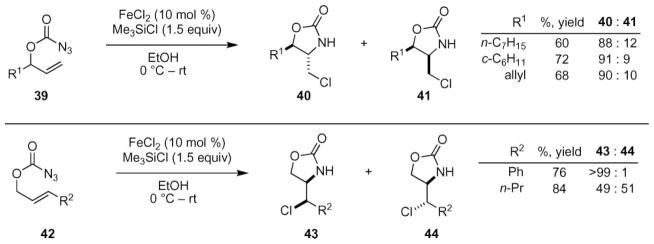
Fe(II)-catalyed intramolecular aminochlorination of olefins.
Scheme 15
Scheme 15
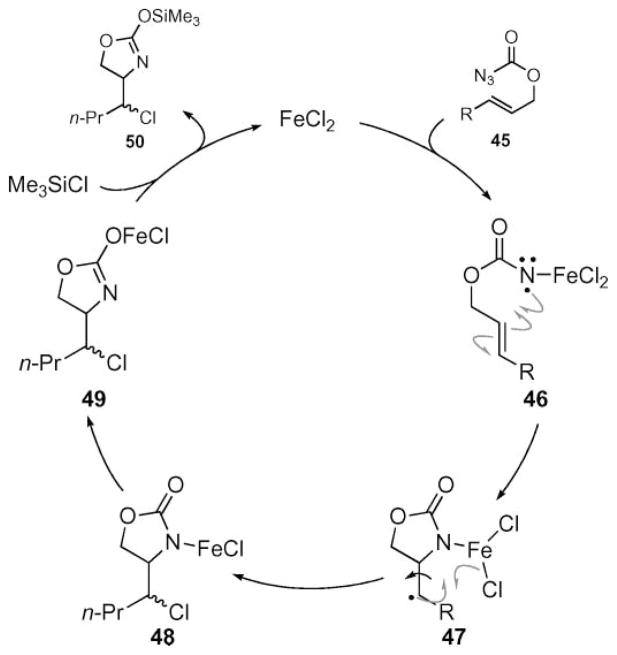
Proposed mechanism of Fe(II)-catalyzed intramolecular aminochlorination.
Scheme 16
Scheme 16
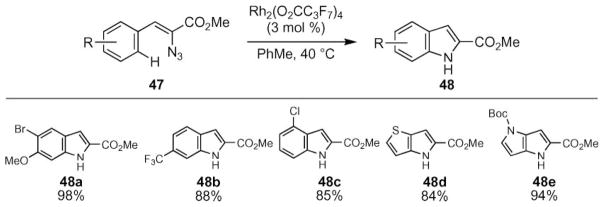
Representative examples of rhodium(II)-catalyzed indole formation.
Scheme 17
Scheme 17
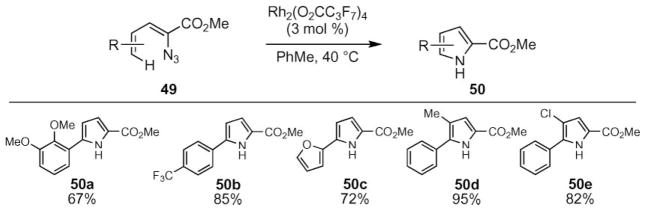
Representative examples of rhodium(II)-catalyzed pyrrole formation.
Scheme 18
Scheme 18
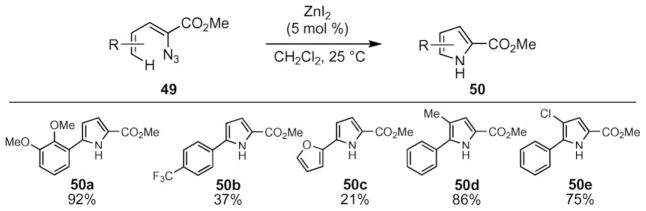
Representative examples of zinc-catalyzed pyrrole formation.
Scheme 19
Scheme 19
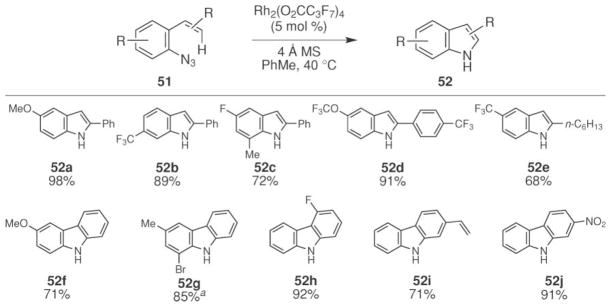
Representative examples of rhodium(II)-catalyzed indole and carbazole formation from aryl azides. aReaction performed on multi-gram scale.
Scheme 20
Scheme 20
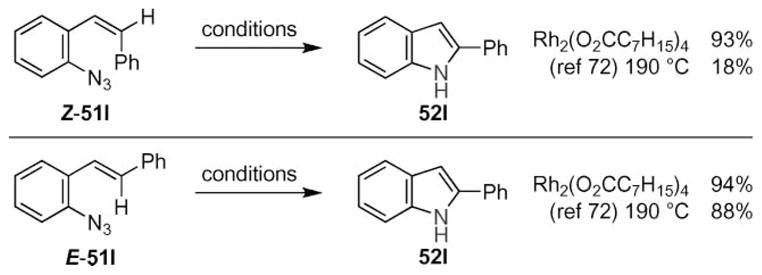
Stereospecificity of rhodium(II)-catalyzed indole formation from aryl azides.
Scheme 21
Scheme 21
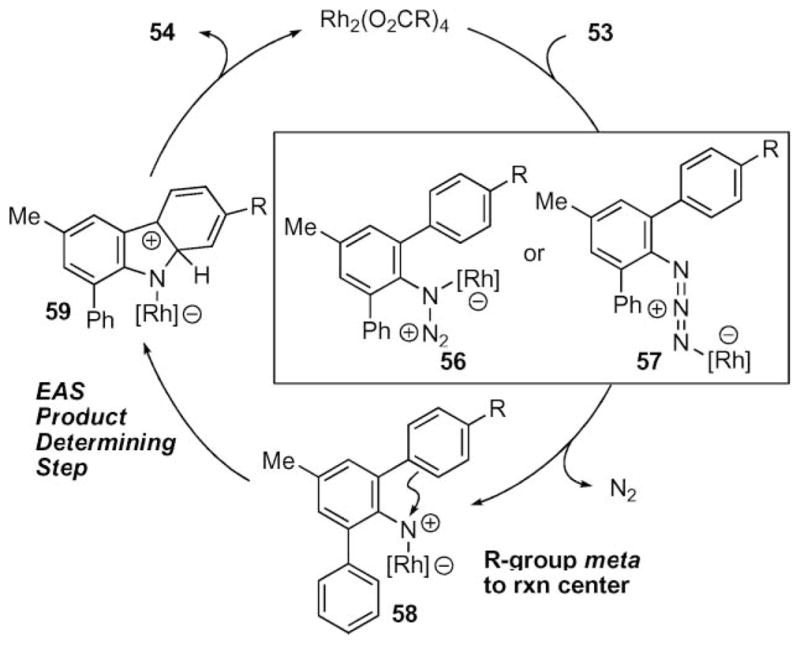
Disproven electrophilic aromatic substitution mechanism for carbazole formation.
Scheme 22
Scheme 22
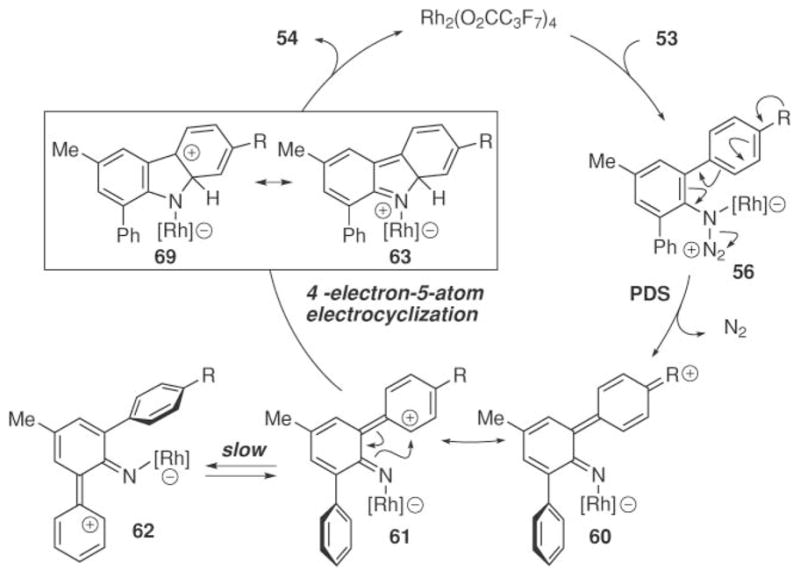
4π-Electron-5-atom-electrocyclization mechanism for carbazole formation.
Scheme 23
Scheme 23
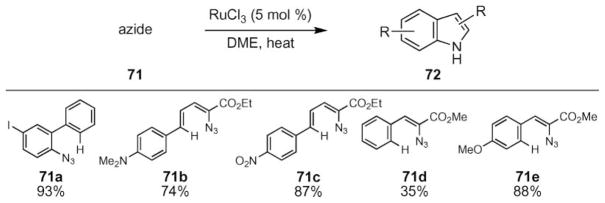
Representative examples of ruthenium(III)-catalyzed N-heterocycle formation.
Scheme 24
Scheme 24
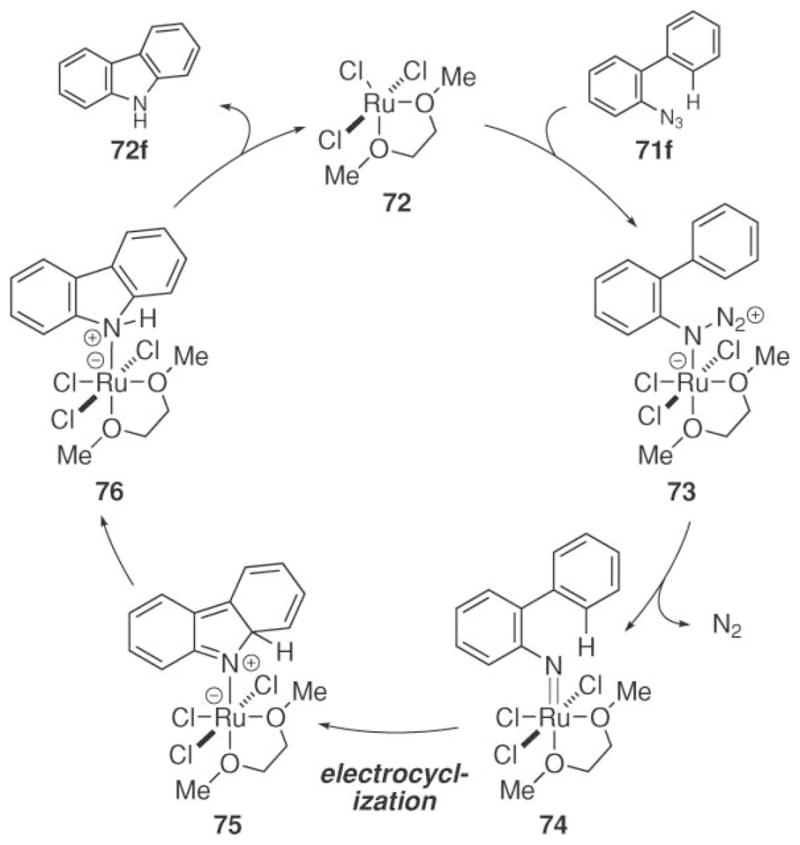
Potential electrocyclization mechanism for ruthenium(III)-catalyzed carbazole formation.
Scheme 25
Scheme 25
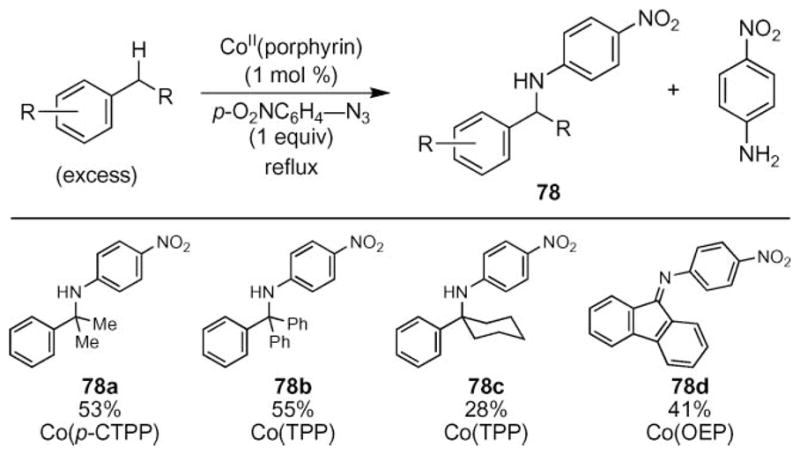
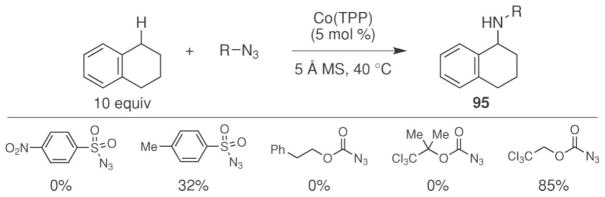
Cobalt-catalyzed sp3-C–H bond amination.
Scheme 26
Scheme 26
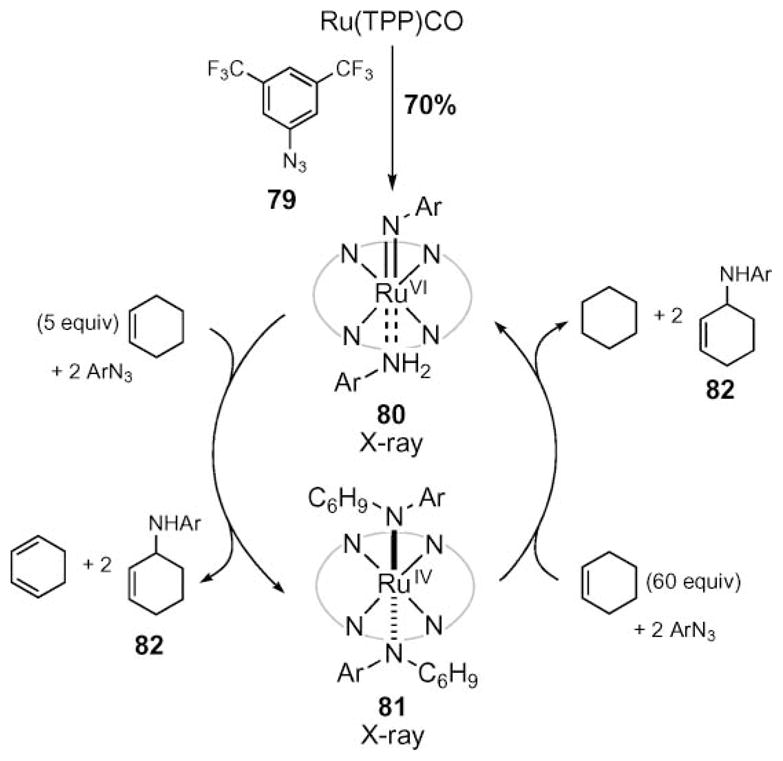
Characterization and reactivity of ruthenium porphyrin reactive intermediates.
Scheme 27
Scheme 27
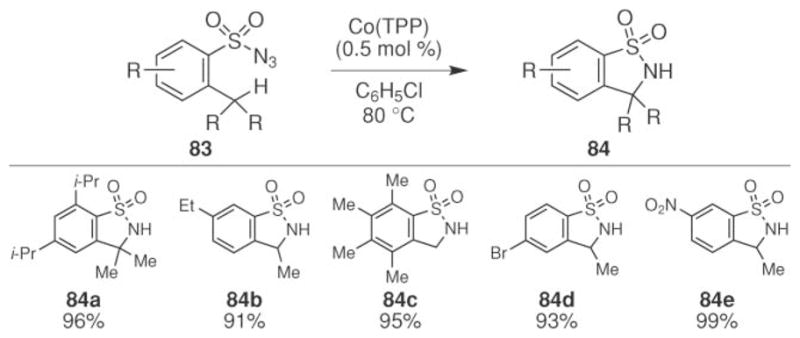
Cobalt-catalyzed intramolecular sp3-C–H bond amination of arylsulfonyl azides.
Scheme 28
Scheme 28
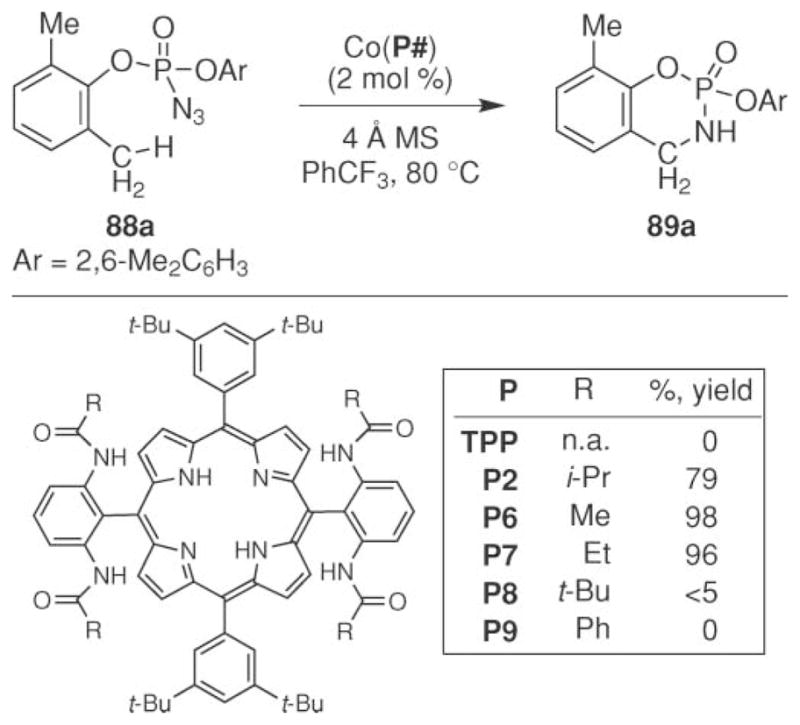
Cobalt-catalyzed intramolecular sp3 C–H bond amination of arylphosphoryl azides.
Scheme 29
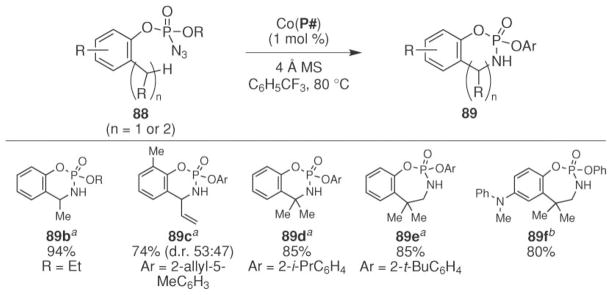
Scheme 29
Cobalt-catalyzed intramolecular sp3 C–H bond amination of arylphosphoryl azides. a2 mol% Co(P6) used. b2 mol% Co(P2) used.
Scheme 30
Scheme 30
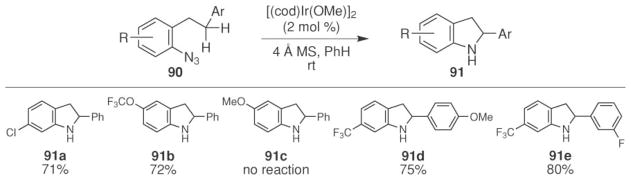
Iridium(I)-catalyzed indoline formation from aryl azides.
Scheme 31
Scheme 31
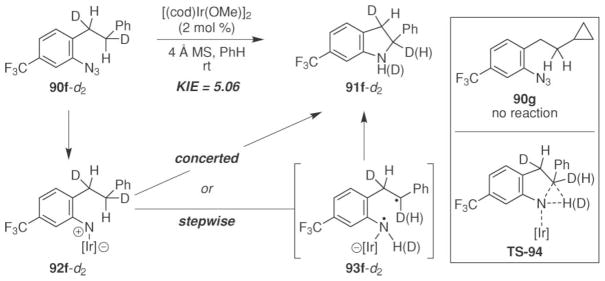
Potential mechanisms for Ir(I)-catalyzed indoline formation.
Scheme 32
Scheme 32
Cobalt-catalyzed intermolecular benzylic C–H bond amination.
Scheme 33
Scheme 33
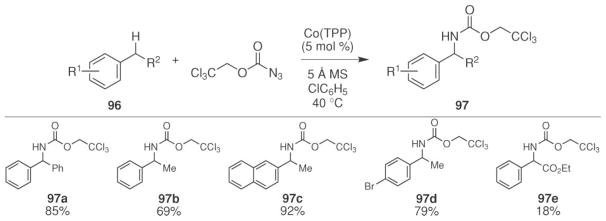
Scope of cobalt-catalyzed intermolecular benzylic C–H bond amination using Troc-N3.
Scheme 34
Scheme 34
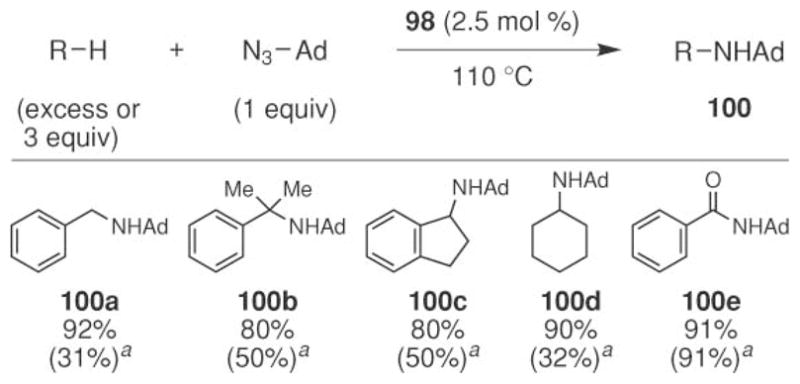
Scope of copper-catalyzed intermolecular sp3 C–H bond amination using adamantyl azide. a3 equiv of the alkane used.
Scheme 35
Scheme 35
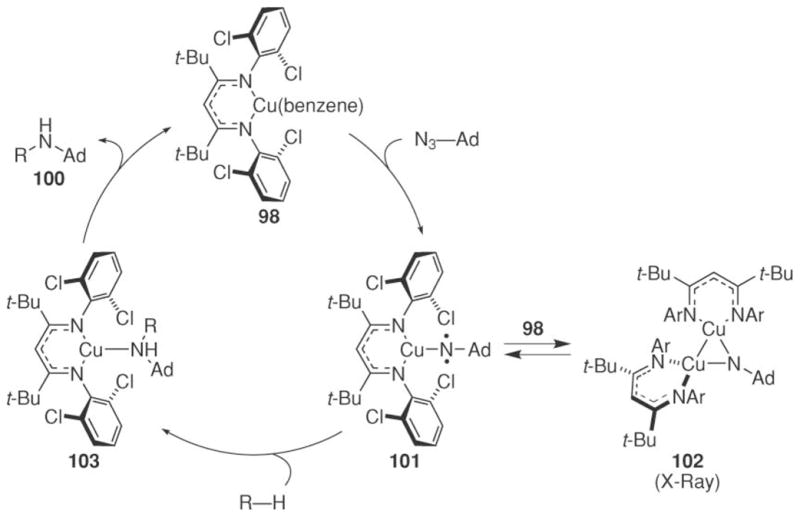
Potential mechanism for copper-catalyzed C–H bond amination of hydrocarbons.

References

    1. For recent reviews on the reactivity of azides, see: Bräse S, Gil C, Knepper K, Zimmermann V. Angew Chem, Int Ed. 2005;44:5188.Scriven EFV, Turnbull K. Chem Rev. 1988;88:297.L’abbé G. Angew Chem, Int Ed Engl. 1975;14:775.

    1. Grieβ P. Philos Trans R Soc London. 1864;13:377.
    2. Grieβ P. Justus Liebigs Ann Chem. 1865;50:275.
    1. For reviews, see: Becer CR, Hoogenboom R, Schubert US. Angew Chem, Int Ed. 2009;48:4900.Meldal M, Tornøe CW. Chem Rev. 2008;108:2952.Moses JE, Moorhouse AD. Chem Soc Rev. 2007;36:1249.Bock VD, Hiemstra H, Maarseveen JHv. Eur J Org Chem. 2006:51.Kolb HC, Finn MG, Sharpless KB. Angew Chem, Int Ed. 2001;40:2004.

    1. For original reports of copper-catalyzed “click” reactions, see: Rostovtsev VV, Green LG, Fokin VV, Sharpless KB. Angew Chem, Int Ed. 2002;41:2596.Tornøe CW, Christensen C, Meldal M. J Org Chem. 2002;67:3057.

    1. For reviews, see: Dauban P, Dodd RH. In: Amino Group Chemistry. Alfredo R Professor., editor. 2008. pp. 55–92.Davies HML, Manning JR. Nature. 2008;451:417.Du Bois J. Chemtracts. 2005;18:1.Espino CG, Du Bois J. In: Modern Rhodium-Catalyzed Organic Reactions. Evans PA, editor. Wiley; 2005. pp. 379–416.Du Bois J, Tomooka CS, Hong J, Carreira EM. Acc Chem Res. 1997;30:364.Mansuy D. Pure Appl Chem. 1990;62:741.

Publication types