


Review
doi: 10.1002/acr.20287.
Epub 2010 Jul 8.
Methodologic challenges in studying risk factors for progression of knee osteoarthritis
Affiliations
- PMID: 20617531
- PMCID: PMC2959151
- DOI: 10.1002/acr.20287
Item in Clipboard
Review
Methodologic challenges in studying risk factors for progression of knee osteoarthritis
Arthritis Care Res (Hoboken).
2010 Nov.
No abstract available
Figures
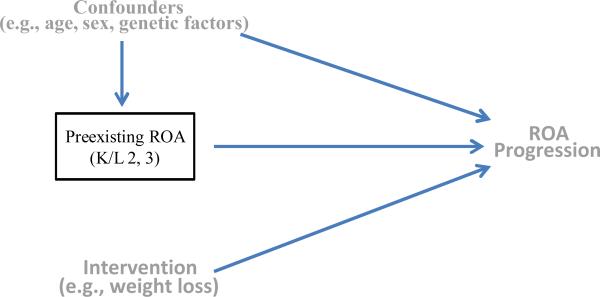
A causal diagram of a randomized trial showing assessment of the effect of an intervention regimen (e.g., weight loss) on the risk of ROA progression. Because the intervention regimen in this trial is randomly assigned to the study participants, the intervention regimen is not influenced by either potential confounders (e.g., age, sex, genetic factors, etc.) or previous ROA status, as indicated by the absence of arrows or causal paths directed towards the intervention regimen.
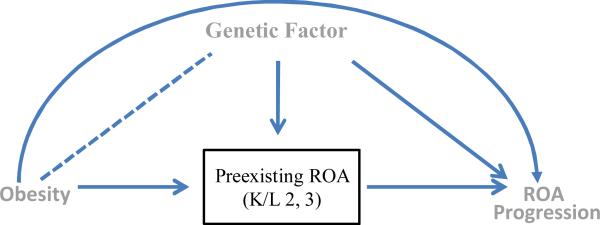
A causal diagram of an observational study showing the assessment of the effect of obesity on ROA progression among knees with preexisting ROA at baseline. Conditioning on baseline ROA results in its causes (i.e., obesity and the genetic factor) becoming directly associated, as indicated by a dotted line between obesity and genetic factors, even though these two factors are not associated before the knees developed ROA. Such conditioning opens an alternative path from obesity to ROA progression (i.e., obesity --- genetic factor → ROA progression), thus biasing the effect of obesity on ROA progression.

A causal diagram of an observational study showing the assessment of the effect of obesity on ROA progression among knees that have preexisting ROA at baseline and also have follow-up knee radiographs. Conditioning on a common effect, i.e., complete follow-up status (obesity → complete follow-up ← ROA progression) results in its causes (i.e., obesity and ROA progression) becoming directly associated, and opens an alternative path from obesity to ROA progression (i.e., obesity --- ROA progression). Thus, even if there is no association between obesity and ROA progression, conditioning on complete follow-up status tends to introduce a negative association between obesity and ROA progression.
Comment in
-
Bias introduced by conditioning on an intermediate variable: Comment on the article by Zhang et al.Arthritis Care Res (Hoboken). 2011 May;63(5):784. doi: 10.1002/acr.20443. Arthritis Care Res (Hoboken). 2011. PMID: 21309007 No abstract available.
References
Publication types
MeSH terms
Grants and funding
LinkOut - more resources
Full Text Sources
