Review
. 2010 Aug;59(3):269-79.
doi: 10.1111/j.1574-695X.2010.00704.x. Epub 2010 May 28.

The distributed genome hypothesis as a rubric for understanding evolution in situ during chronic bacterial biofilm infectious processes

Affiliations
Review

The distributed genome hypothesis as a rubric for understanding evolution in situ during chronic bacterial biofilm infectious processes

Garth D Ehrlich et al. FEMS Immunol Med Microbiol. 2010 Aug.

Abstract

Most chronic infectious disease processes associated with bacteria are characterized by the formation of a biofilm that provides for bacterial attachment to the host tissue or the implanted medical device. The biofilm protects the bacteria from the host's adaptive immune response as well as predation by phagocytic cells. However, the most insidious aspect of biofilm biology from the host's point of view is that the biofilm provides an ideal setting for bacterial horizontal gene transfer (HGT). HGT provides for large-scale genome content changes in situ during the chronic infectious process. Obviously, for HGT processes to result in the reassortment of alleles and genes among bacterial strains, the infection must be polyclonal (polymicrobial) in nature. In this review, we marshal the evidence that all of the factors are present in biofilm infections to support HGT that results in the ongoing production of novel strains with unique combinations of genic characteristics and that the continual production of large numbers of novel, but related bacterial strains leads to persistence. This concept of an infecting population of bacteria undergoing mutagenesis to produce a 'cloud' of similar strains to confuse and overwhelm the host's immune system parallels genetic diversity strategies used by viral and parasitic pathogens.


Figures
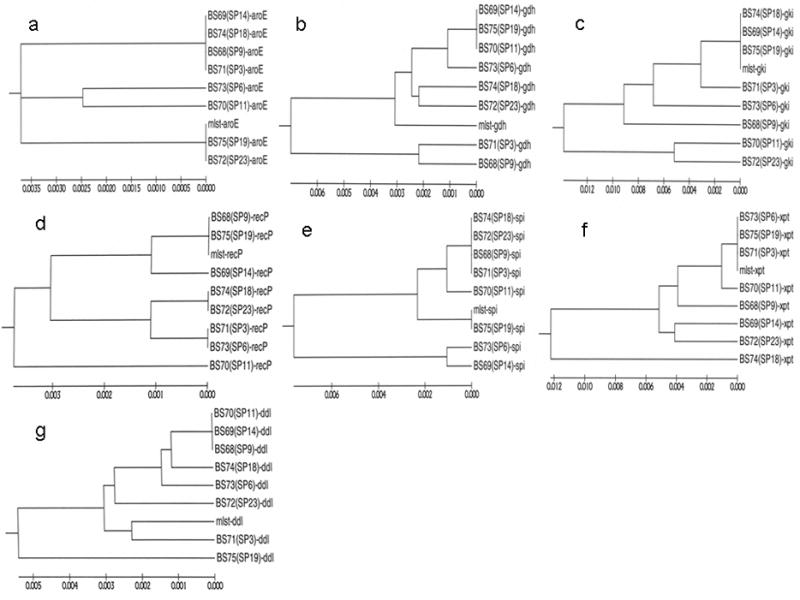
Figure 1
Figure 1
Phylogenetic trees were built for each of seven S. pneumoniae core genes using the same set of eight clinical strains. Each gene produces a different tree stucture (from the same set of strains) demonstrating the mosaic nature of the S. pneumoniae genome in general which results from extensive and continuous horizontal gene transfer. (a) – (g): Phylogenetic trees showing the relative distances of seven housekeeping loci among the eight clinical strains of S. pneumoniae including: a) the aroE gene encoding shikimate dehydrogenase; b) the gdh gene encoding glutamate dehydrogenase; c) the gki gene encoding glucose kinase; d) the recP gene encoding the RecP recombination protein; e) the spi gene encoding a signal peptidase; f) the xpt gene encoding xanthine phosphoribosyltransferase; and g) the ddl gene encoding D-alanyl-D-alanine ligase. Reference sequences were downloaded from http://www.mlst.net.mlst-aroE, mlst-gdh, mlst-recP, mlst-spi, mlst-xpt and mlst-ddl; h) Phylogenic tree reconstructed using concatenated sequences from all seven house-keeping genes (3,199 bp) of S. pneumoniae. Concatenated sequence mlst-7gene was made by using seven reference gene sequences from http://www.mlst.net.
Figure 2
Figure 2
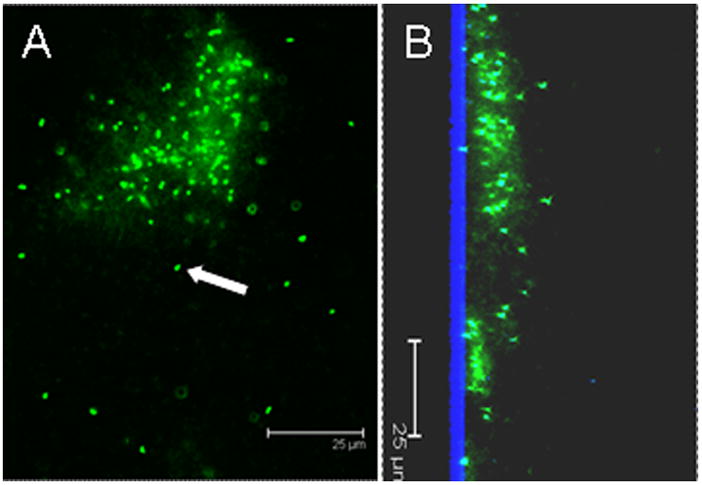
Confocal micrograph of a P. aeruginosa PAO1 biofilm grown on a glass substratum demonstrating extracellular DNA within the biofilm matrix surrounding the bacteria. A) plan view, and B) saggital section with the glass substratum is shown in blue by reflected light. The biofilm was stained with the DNA stain Syto9. The cells (an example of a non-matrix enclosed cell is shown with white arrow) were slightly overexposed to show the more diffuse signal from the extracellular DNA (eDNA) between the individual bacteria. This image demonstrates: 1) the close proximity of the cells within the biofilm; 2) that within biofilms, which are relatively quiescent (unlike laboratory planktonic cultures which are continually mixed), the cells have more time to interact (i.e. for conjugation), and 3) there is a pool of eDNA surrounding the cells which provides structural stability as well as serving as a source for transformation. Scale bars = 25 μm.
Figure 3
Figure 3
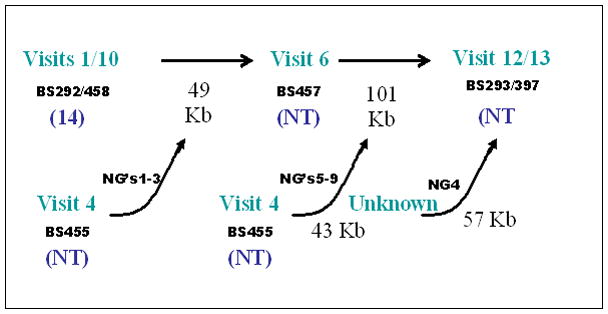
Schematic demonstrating the evolution of S. pneumoniae strains in situ during a naturally-occurring chronic polyclonal pediatric nasopharyngeal infection associated with multiple bouts of otitis media. Identical strains were isolated at visits 1 and 10, and at visits 12 and 13. The 1/10 isolates appear to be the ancestral strain which evolved to the visit 6 strain through the horizontal gene transfer (HGT) of three regions (NG’s) donated from the visit 4 strain. The visit 6 strain, in turn, evolved into the visit 12/13 strain by the HGT of five more NG’s from the visit 4 strain, as well as and an additional NG from an unrecovered strain.

References

    1. Aitken ML. Clinical trials of recombinant human DNase in cystic fibrosis patients. Monaldi Arch Chest Dis. 1993;48(6):653–656. - PubMed
    1. Apicella MA. Bacterial Otitis Media, the Chinchilla Middle Ear, and Biofilms. J Infect Dis. 2009;199(6):786–794. - PubMed
    1. Avery OT, MacLeod CM, McCarty M. Studies on the chemical nature of the substance inducing transformation of pneumococcal types. Induction of transformation by a desoxyribonucleic acid fraction isolated from pneumococcus type III. J Exp Med. 1944;89:137–158. - PMC - PubMed
    1. Bakaletz LO. Bacterial biofilms in otitis media: evidence and relevance. Pediatr Infect Dis J. 2007;26(10 Suppl):S17–9. Review. - PubMed
    1. Boles BR, Thoendel M, Singh PK. Self-generated diversity produces “insurance effects” in biofilm communities. Proc Natl Acad Sci U S A. 2004 Nov 23;101(47):16630–5. - PMC - PubMed

Publication types

LinkOut - more resources