


Comment
doi: 10.1016/j.neuron.2010.06.014.
Synapse-specific metaplasticity: to be silenced is not to silence 2B
Affiliations
- PMID: 20620866
- PMCID: PMC3501108
- DOI: 10.1016/j.neuron.2010.06.014
Item in Clipboard
Comment
Synapse-specific metaplasticity: to be silenced is not to silence 2B
Neuron.
.
Abstract
What happens to a single, presynaptically quiescent synapse among a population of active synapses? In this issue of Neuron, Ehlers and colleagues show that, far from being eliminated, these inactive synapses are primed for potentiation and incorporation into a new neural circuit through an upregulation of NR2B-containing NMDA receptors.
Figures
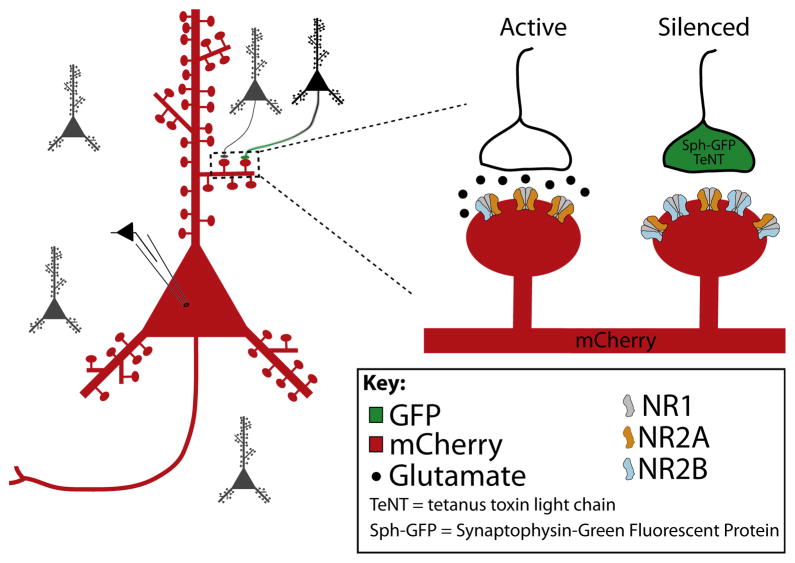
A small subset of cultured neurons were transfected with a viral construct containing synaptophysin-GFP (Sph-GFP), to visualize presynaptic terminals, and tetanus toxin light chain (TeNT), to greatly diminish neurotransmitter release. Individual postsynaptic neurons were transfected with a red fluorophore (mCherry), allowing the silenced synapses to be visually identified by overlap of red and green signals.
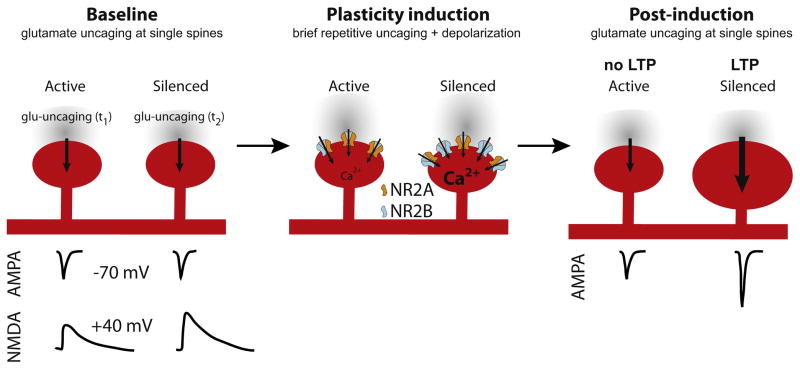
Two-photon uncaging of glutamate at single synapses allowed synaptic properties and plasticity to be assessed. Glutamate uncaging at individual spines revealed similar AMPA-receptor-mediated synaptic currents at active and silenced synapses (left panel), but enhanced NMDA receptor synaptic currents at silenced synapses. Weak bursts of glutamate uncaging paired with postsynaptic depolarization (a “subthreshold” stimulus at active synapses, middle panel) produced long-term potentiation and spine enlargement at silenced, but not active, synapses (right panel), likely due to enhanced NMDA EPSCs and greater fractional NR2B at silenced synapses.
Comment on
-
Metaplasticity at single glutamatergic synapses.Neuron. 2010 Jun 24;66(6):859-70. doi: 10.1016/j.neuron.2010.05.015. Neuron. 2010. PMID: 20620872 Free PMC article.
References
Publication types
Grants and funding
LinkOut - more resources
Full Text Sources
