


Poverty and common mental disorders in low and middle income countries: A systematic review
- PMID: 20621748
- PMCID: PMC4991761
- DOI: 10.1016/j.socscimed.2010.04.027
Poverty and common mental disorders in low and middle income countries: A systematic review
Abstract
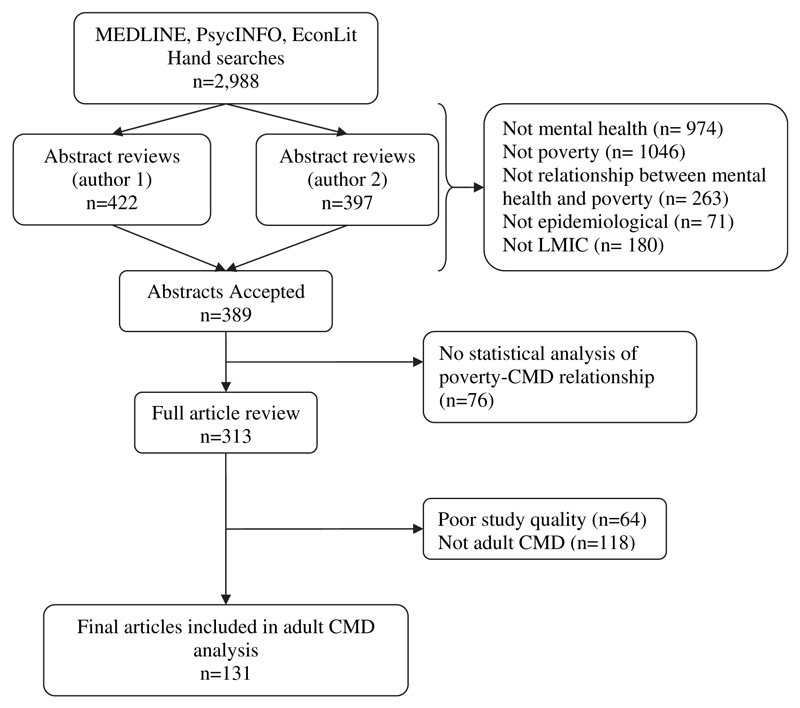
In spite of high levels of poverty in low and middle income countries (LMIC), and the high burden posed by common mental disorders (CMD), it is only in the last two decades that research has emerged that empirically addresses the relationship between poverty and CMD in these countries. We conducted a systematic review of the epidemiological literature in LMIC, with the aim of examining this relationship. Of 115 studies that were reviewed, most reported positive associations between a range of poverty indicators and CMD. In community-based studies, 73% and 79% of studies reported positive associations between a variety of poverty measures and CMD, 19% and 15% reported null associations and 8% and 6% reported negative associations, using bivariate and multivariate analyses respectively. However, closer examination of specific poverty dimensions revealed a complex picture, in which there was substantial variation between these dimensions. While variables such as education, food insecurity, housing, social class, socio-economic status and financial stress exhibit a relatively consistent and strong association with CMD, others such as income, employment and particularly consumption are more equivocal. There are several measurement and population factors that may explain variation in the strength of the relationship between poverty and CMD. By presenting a systematic review of the literature, this paper attempts to shift the debate from questions about whether poverty is associated with CMD in LMIC, to questions about which particular dimensions of poverty carry the strongest (or weakest) association. The relatively consistent association between CMD and a variety of poverty dimensions in LMIC serves to strengthen the case for the inclusion of mental health on the agenda of development agencies and in international targets such as the millenium development goals.
Copyright 2010 Elsevier Ltd. All rights reserved.
Conflict of interest statement
We declare that we have no conflicts of interest.
Figures
References
-
- Abas MA, Broadhead JC. Depression and anxiety among women in an urban setting in Zimbabwe. Psychological Medicine. 1997;27:59–71. - PubMed
-
- Adelekan ML, Ndom RJ, Ekpo M, Oluboka O. Epidemiology of childhood behavioural disorders in Ilorin, Nigeria–findings from parental reports. West African Journal of Medicine. 1999;18:39–48. [erratum appears in West African Journal of Medicine 1999 Apr–Jun; 18(2):152] - PubMed
-
- Adewuya AO, Ola BA, Aloba OO, Mapayi BM, Okeniyi JAO. Impact of postnatal depression on infants’ growth in Nigeria; African Psychiatric Association and Allied Professionals meeting, Addis Ababa, Ethiopia; 2006.
-
- Ahmed SM, Rana AKMM, Chowdhury M, Bhuiya A. Measuring perceived health outcomes in non-western culture: does SF-36 have a place? Journal of Health, Population and Nutrition. 2002;20:334–342. - PubMed
Publication types
MeSH terms
Grants and funding
LinkOut - more resources
Full Text Sources
Medical
