. 2010 Sep 17;285(38):29279-85.
doi: 10.1074/jbc.C110.114124. Epub 2010 Jul 9.

EGF-induced Grb7 recruits and promotes Ras activity essential for the tumorigenicity of Sk-Br3 breast cancer cells

Affiliations

EGF-induced Grb7 recruits and promotes Ras activity essential for the tumorigenicity of Sk-Br3 breast cancer cells

Pei-Yu Chu et al. J Biol Chem. .

Abstract

Co-amplification and co-overexpression of ErbB2 and Grb7 are frequently found in various cancers, including breast cancer. Biochemical and functional correlations of the two molecules have identified Grb7 to be a pivotal mediator downstream of ErbB2-mediated oncogenesis. However, it remains largely unknown how Grb7 is involve in the ErbB2-mediated tumorigenesis. In this study, we show that Grb7-mediated cell proliferation and growth are essential for the tumorigenesis that occurs in ErbB2-Grb7-overexpressing breast cancer cells. Intrinsically, EGF-induced de novo Grb7 tyrosine phosphorylation/activation recruits and activates Ras-GTPases and subsequently promotes the phosphorylation of ERK1/2, thereby stimulating tumor growth. Furthermore, we also found the anti-tumor effect could be synergized by co-treatment with Herceptin plus Grb7 knockdown in Sk-Br3 breast cancer cells. Our findings illustrate an underlying mechanism by which Grb7 promotes tumorigenesis through the formation of a novel EGFR-Grb7-Ras signaling complex, thereby highlighting the potential strategy of targeting Grb7 as an anti-breast cancer therapy.


Figures
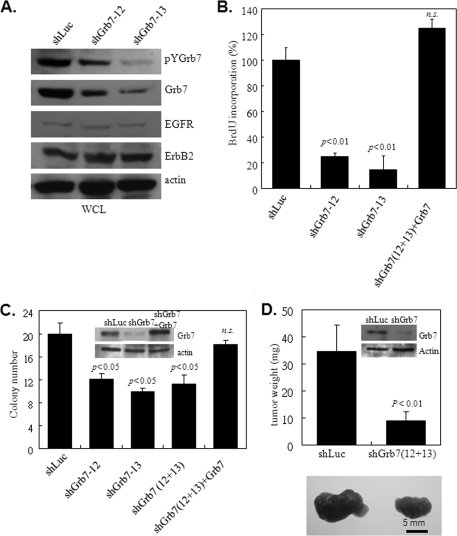
FIGURE 1.
FIGURE 1.
Grb7 is essential for Sk-Br3 breast cancer cell growth in vitro and in vivo. A, Grb7 expression and phosphorylation were markedly decreased by infection with two different lentivirus-bearing shGrb7 knockdowns, shGrb7-12 and shGrb7-13. WCL, whole cell lysates. B, Sk-Br3 cells with (shGrb7-12 or shGrb7-13) or without (shLuc or shGrb7+Grb7) knockdown of Grb7 were subjected to a measurement of cell proliferation by BrdU incorporation in the presence of 10 ng/ml EGF after serum starvation for 24 h in DMEM with 0.5% FBS. C, approximately 5 × 10⁴ Sk-Br3 cells with or without Grb7 knockdown (shGrb7-12 or shGrb7-13 or combination) or re-expressing wild type Grb7 in Grb7 knockdown cells (combination of shGrb7-12 and shGrb7-13) were subjected to a soft agar assay in the presence of EGF (10 ng/ml) to examine the capability for anchorage-independent growth of these tumor cells. D, Sk-Br3 cells with (combination of shGrb7-12 and shGrb7-13) or without (shLuc) Grb7 knockdown were implanted into 8-week-old SCID mice. Tumor volumes and numbers were measured at the 21st day after injection. Data are represented as the mean ± S.E. of at least three independent experiments, or nine mice for each. N.S., nonsignificance.
FIGURE 2.
FIGURE 2.
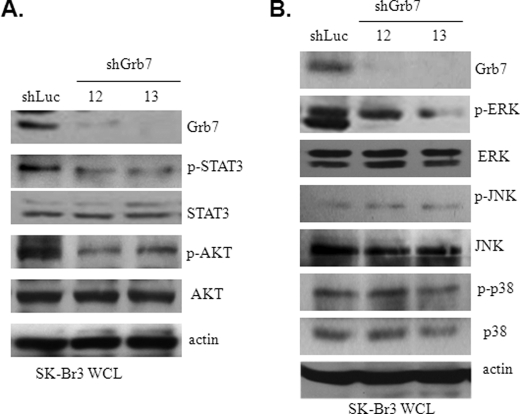
EGF-induced Grb7-mediated downstream signaling. A and B, cell lysates from the shLuc- or shGrb7-infected (shGrb7-12 or shGrb7-13) Sk-Br3 cells were subjected to Western blotting with various antibodies, as indicated, to examine the potential downstream signaling targets of EGF-induced Grb7 activation. WCL, whole cell lysates; p indicates phosphorylation.
FIGURE 3.
FIGURE 3.
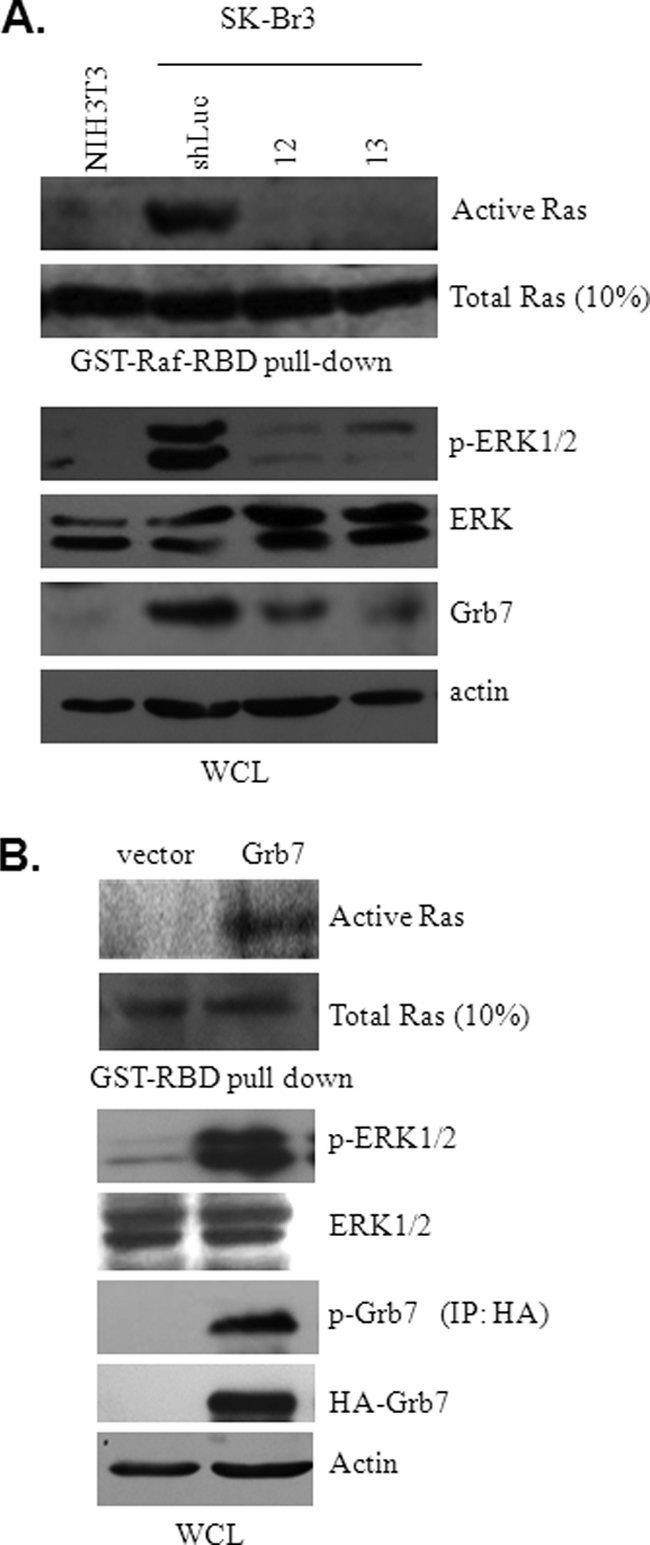
Grb7-mediated Ras activation is essential for ERK phosphorylation. A, cell lysates from the shLuc- or shGrb7-infected (shGrb7-12 or shGrb7-13) Sk-Br3 cells were subjected to GST-Raf-RBD pulldown assays and/or Western blotting with various antibodies, as indicated. There is undetectable endogenous Grb7 in NIH3T3 cells that was used as a control. p indicates phosphorylation. B, cell lysates from NIH3T3 cells transfected with either pKH3-Grb7 or vector alone and then subjected to a GST-Raf-RBD pulldown followed by Western analysis. For all experiments, cells were serum-starved for 24 h and stimulated by 10 ng/ml EGF for 15 min prior to collection of the cell lysates. IP, immunoprecipitation; WCL, whole cell lysate. p indicates phosphorylation.
FIGURE 4.
FIGURE 4.
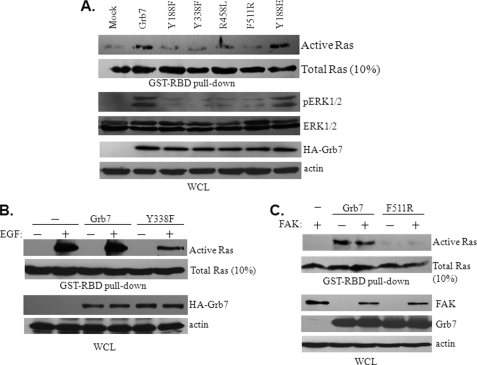
EGF-induced Grb7 dimerization and phosphorylation are required for Ras-ERK activation. A, Sk-Br3 cells were transfected with either wild type Grb7 or mutants, as indicated, to determine the effect on Ras activation using a GST-Raf-RBD pulldown assay and the phosphorylation of ERK1/2 in the presence of 10 ng/ml EGF. WCL, whole cell lysates; p indicates phosphorylation. B, NIH3T3 cells were transfected with wild type Grb7, Y338F, or vector alone in the presence or absence of EGF stimulation and were then subjected to a GST-Raf-RBD pulldown assay. C, NIH3T3 cells were transfected with wild type Grb7, the F511R mutant, or vector alone or in combination with FAK or without FAK and were then subjected to a GST-Raf-RBD pulldown assay. WCL, whole cell lysate.
FIGURE 5.
FIGURE 5.
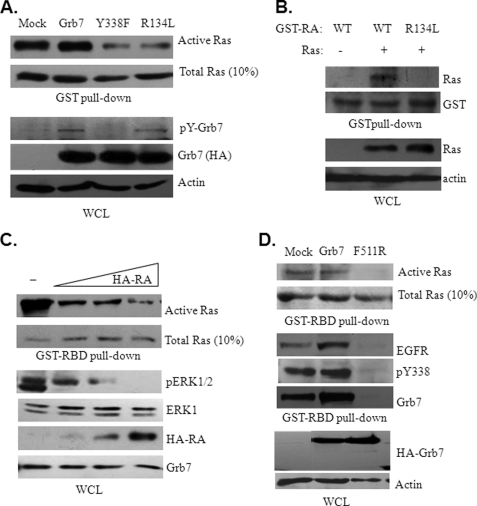
Ras activation through direct interaction with the RA domain of Grb7 is crucial for EGF-induced ERK phosphorylation in Sk-Br3 breast cancer cells. A, Sk-Br3 cells were transfected with either wild type Grb7 or mutants, as indicated, to determine the effect on Ras activation using a GST-Raf-RBD pulldown assay and the phosphorylation of Grb7 and its mutants in the presence of 10 ng/ml EGF. WCL, whole cell lysates; p indicates phosphorylation. B, cell lysates from 293 cells with or without overexpressing the constitutively active form RasV12G were incubated with recombinant GST fusion protein containing the wild type RA domain of Grb7 or harboring an R134L point mutation. The GST pulldown assay was performed to determine the binding capability for the Grb7 RA domain and its R134L mutant with the constitutively active form RasV12G. C, Sk-Br3 cells overexpressed different amounts of the RA domain of Grb7, and the effects on Ras activity and ERK phosphorylation were determined by a GST-RBD pulldown assay and Western blot analyses, respectively. D, EGF-stimulated cell lysates from Sk-Br3 cells transfected with either wild type Grb7 or F511R were subjected to a GST pulldown followed by Western blot analyses to determine the association among EGFR, Grb7, and activated Ras.
FIGURE 6.
FIGURE 6.
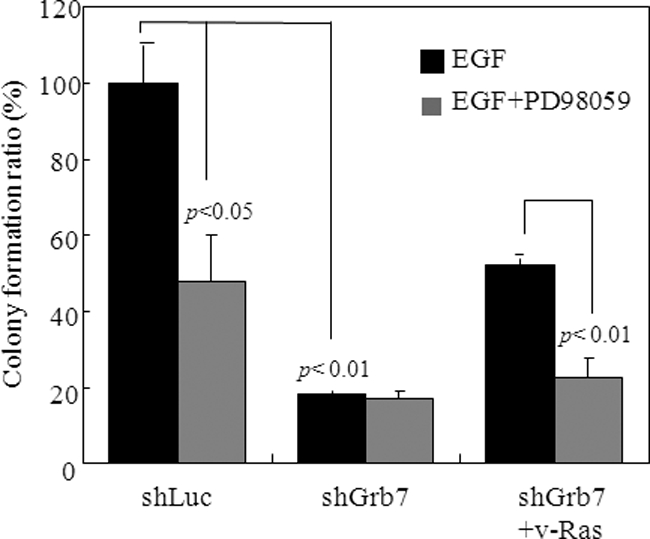
EGF-induced Grb7-mediated Ras-ERK activation is essential for tumorigenesis in breast cancer. Sk-Br3 cells with or without Grb7 knockdown (combination of shGrb7-12 and shGrb7-13) or expressing the constitutively active form RasV12G were subjected to soft agar assays in the presence of EGF (10 ng/ml) in combination with PD98059 or without PD98059 to examine the effect on the anchorage-independent growth of tumor cells. Data are represented as the mean ± S.E. of at least three independent experiments.
FIGURE 7.
FIGURE 7.
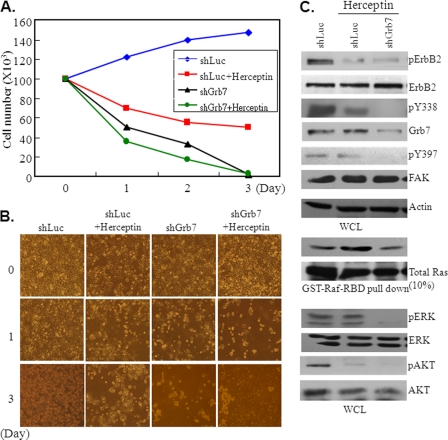
Synergized anti-tumor effect by co-treatment with Herceptin and Grb7 knockdown. A, cell numbers of Sk-Br3 breast cancer cells treated with shLuc, Herceptin, shGrb7 (shGrb7-12 and shGrb7-13), and shGrb7 plus Herceptin were measured at the 1st, 2nd, and 3rd day after the treatments. B, representative images of Sk-Br3 cells treated with shLuc, Herceptin, shGrb7, and combination were photographed and shown. C, cell lysates from the various treatments, shLuc, Herceptin, and Herceptin plus shGrb7 in Sk-Br3 breast cancer cells were subjected to Western blotting with various antibodies, as indicated. WCL, whole cell lysates; p indicates phosphorylation.

References

    1. Han D. C., Shen T. L., Guan J. L. (2001) Oncogene 20, 6315–6321 - PubMed
    1. Shen T. L., Guan J. L. (2004) Front. Biosci. 9, 192–200 - PubMed
    1. Li H., Sánchez-Torres J., del Carpio A. F., Nogales-González A., Molina-Ortiz P., Moreno M. J., Török K., Villalobo A. (2005) Oncogene 24, 4206–4219 - PubMed
    1. Shen T. L., Han D. C., Guan J. L. (2002) J. Biol. Chem. 277, 29069–29077 - PubMed
    1. Depetris R. S., Hu J., Gimpelevich I., Holt L. J., Daly R. J., Hubbard S. R. (2005) Mol. Cell 20, 325–333 - PMC - PubMed

Publication types

MeSH terms