


Rationally designed logic integration of regulatory signals in mammalian cells
- PMID: 20622866
- PMCID: PMC2934882
- DOI: 10.1038/nnano.2010.135
Rationally designed logic integration of regulatory signals in mammalian cells
Abstract
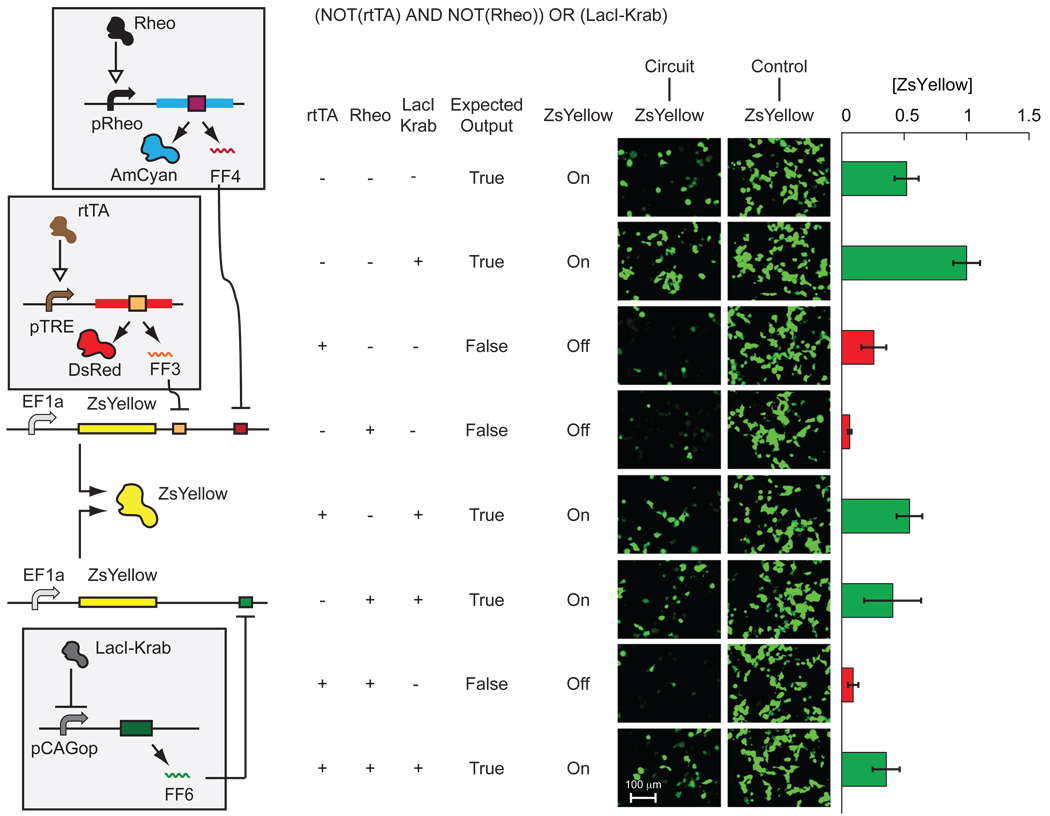
Molecular-level information processing is essential for 'smart' in vivo nanosystems. Natural molecular computing, such as the regulation of messenger RNA (mRNA) synthesis by special proteins called transcription factors, has inspired engineered systems that can control the levels of mRNA with certain combinations of transcription factors. Here, we show an alternative approach to achieving general-purpose control of mRNA and protein levels by logic integration of transcription factor input signals in mammalian cells. The transcription factors regulate synthetic genes coding for small regulatory RNAs (called microRNAs), which, in turn, control the mRNA of interest (the output) via an RNA interference pathway. The simplicity of these modular interactions makes it possible, in theory, to implement any arbitrary logic relation between the transcription factors and the output. We construct, test and optimize increasingly complex circuits with up to three transcription factor inputs, establishing a platform for in vivo molecular computing.
Figures


Comment in
-
Nanobiotechnology: Scaling up synthetic gene circuits.Nat Nanotechnol. 2010 Sep;5(9):631-3. doi: 10.1038/nnano.2010.178. Nat Nanotechnol. 2010. PMID: 20818407 No abstract available.
References
-
- Shapiro E, Benenson Y. Bringing DNA computers to life. Sci. Amer. 2006;294:44–51. - PubMed
-
- Shen-Orr SS, Milo R, Mangan S, Alon U. Network motifs in the transcriptional regulation network of Escherichia coli. Nature Genetics. 2002;31:64–68. - PubMed
-
- Lee TI, et al. Transcriptional regulatory networks in Saccharomyces cerevisiae. Science. 2002;298:799–804. - PubMed
-
- Weiss R, Homsy GE, Knight TF. In: Evolution as Computation: DIMACS Workshop. Landweber LF, Winfree E, editors. Springer; 1999. pp. 275–295.
Publication types
MeSH terms
Substances
Grants and funding
LinkOut - more resources
Full Text Sources
Other Literature Sources
