Review
. 2010:26:503-32.
doi: 10.1146/annurev-cellbio-051809-102012.

Chromatin regulatory mechanisms in pluripotency

Affiliations
Review

Chromatin regulatory mechanisms in pluripotency

Julie A Lessard et al. Annu Rev Cell Dev Biol. 2010.

Abstract

Stem cells of all types are characterized by a stable, heritable state permissive of multiple developmental pathways. The past five years have seen remarkable advances in understanding these heritable states and the ways that they are initiated or terminated. Transcription factors that bind directly to DNA and have sufficiency roles have been most easy to investigate and, perhaps for this reason, are most solidly implicated in pluripotency. In addition, large complexes of ATP-dependent chromatin-remodeling and histone-modification enzymes that have specialized functions have also been implicated by genetic studies in initiating and/or maintaining pluripotency or multipotency. Several of these ATP-dependent remodeling complexes play non-redundant roles, and the esBAF complex facilitates reprogramming of induced pluripotent stem cells. The recent finding that virtually all histone modifications can be rapidly reversed and are often highly dynamic has raised new questions about how histone modifications come to play a role in the steady state of pluripotency. Another surprise from genetic studies has been the frequency with which the global effects of mutations in chromatin regulators can be largely reversed by a single target gene. These genetic studies help define the arena for future mechanistic studies that might be helpful to harness pluripotency for therapeutic goals.


Figures
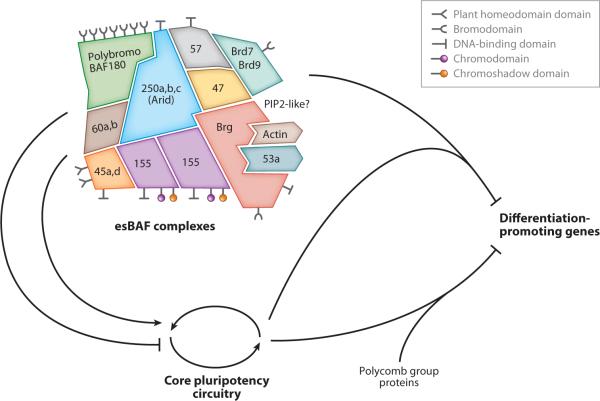
Figure 1
Figure 1
A functionally and structurally specialized SWI/SNF-like complex, esBAF, cobinds across the genome with the factors of the pluripotency transcriptional circuit as well as those that initiate and maintain pluripotency. esBAF complexes are distinguished by containing a homodimer of BAF155 but not 170; Brg but not Brm; BAF45a and d, but not b and c; and BAF53a but not BAF53b. Proteomic studies of endogenous complexes have demonstrated biochemical interactions with Sox2, Oct4, and many of the proteins involved in induced pluripotent stem (IPS) cell formation or embryonic stem (ES) cell maintenance. Of particular note was the absence of binding to general transcription factors or proteins such as Sp-1 or Fos that are present at high levels in ES cells, indicating that the interactions of esBAF are functionally dedicated to pluripotency. In addition, esBAF complexes occupy the promoters of nearly all genes of the core pluripotency network, such as Oct4, Sox2, c-myc, KLF4, Sall4, TCF3, and Nanog. esBAF complexes also co-occupy target genes of Oct4, Sox2, and Nanog, suggesting a functional interaction between esBAF complexes and the core pluripotency circuitry. Recently, components of esBAF were shown also to facilitate pluripotency (Singhal et al. 2010). The subunits are shown as interlocking pieces to indicate that they must be partially denatured (2 M urea) to dissociate from the complex. The positions are not necessarily accurate.
Figure 2
Figure 2
BAF complexes commonly repress their targets at a distance (indicated here for the CD4 gene). In developing T lymphocytes, BAF complexes bind to the CD4 silencer and repress transcription of the CD4 gene at a distance. Deletion of Brg or the silencer itself by homologous recombination results in similar phenotypes with derepression of the CD4 gene in common lymphoid progenitors. This mode of function is probably the norm for BAF complexes as shown from genome-wide studies of embryonic stem cells. Highlighting fundamental mechanistic differences in the control of gene expression, mammalian BAF complexes primarily repress transcription from a distance, whereas the yeast SWI/SNF complex regulates all known targets by activation from promoters.
Figure 3
Figure 3
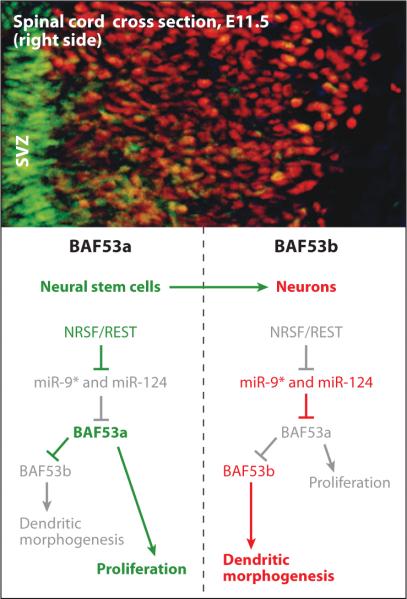
Genetic/epigenetic circuitry controlling mitotic exit of neural stem cells. (left) In neural stem cells in the subventricular zone (SVZ), NRSF/REST represses the microRNAs miR-9* and miR-124, allowing constitutive expression of BAF53a (green) and proliferation. npBAF complexes containing BAF53a repress BAF53b, preventing dendritic morphogenesis. Inactive paths are gray. (right) In postmitotic neurons, REST is repressed, leading to expression of miR-9* and miR-124, repression of BAF53a, and derepression of BAF53b (red). BAF53b is necessary for dendritic development in both mice and Drosophila. Photograph by Brett Staahl.
Figure 4
Figure 4
Potential roles of the Polycomb repressive complex 1 (PRC1) and PRC2 complexes in the maintenance of multipotent and pluripotent cells. A/P, anterior/posterior; HSC, hemopoietic stem cell; NSC, neural stem cell.

References

    1. Agarwal N, Hardt T, Brero A, Nowak D, Rothbauer U, et al. MeCP2 interacts with HP1 and modulates its heterochromatin association during myogenic differentiation. Nucleic Acids Res. 2007;35(16):5402–8. - PMC - PubMed
    1. Agger K, Cloos PA, Christensen J, Pasini D, Rose S, et al. UTX and JMJD3 are histone H3K27 demethylases involved in HOX gene regulation and development. Nature. 2007;449(7163):731–34. - PubMed
    1. Ahmad K, Henikoff S. Centromeres are specialized replication domains in heterochromatin. J. Cell Biol. 2001;153(1):101–10. - PMC - PubMed
    1. Avilion AA, Nicolis SK, Pevny LH, Perez L, Vivian N, Lovell-Badge R. Multipotent cell lineages in early mouse development depend on SOX2 function. Genes Dev. 2003;17(1):126–40. - PMC - PubMed
    1. Azuara V, Perry P, Sauer S, Spivakov M, Jorgensen HF, et al. Chromatin signatures of pluripotent cell lines. Nat. Cell Biol. 2006;8(5):532–38. - PubMed

LinkOut - more resources