Comparative Study
. 2010 Jul 12:2:325-35.
doi: 10.1093/gbe/evq023.

DNA slippage occurs at microsatellite loci without minimal threshold length in humans: a comparative genomic approach

Affiliations
Comparative Study

DNA slippage occurs at microsatellite loci without minimal threshold length in humans: a comparative genomic approach

Sébastien Leclercq et al. Genome Biol Evol. .

Abstract

The dynamics of microsatellite, or short tandem repeats (STRs), is well documented for long, polymorphic loci, but much less is known for shorter ones. For example, the issue of a minimum threshold length for DNA slippage remains contentious. Model-fitting methods have generally concluded that slippage only occurs over a threshold length of about eight nucleotides, in contradiction with some direct observations of tandem duplications at shorter repeated sites. Using a comparative analysis of the human and chimpanzee genomes, we examined the mutation patterns at microsatellite loci with lengths as short as one period plus one nucleotide. We found that the rates of tandem insertions and deletions at microsatellite loci strongly deviated from background rates in other parts of the human genome and followed an exponential increase with STR size. More importantly, we detected no lower threshold length for slippage. The rate of tandem duplications at unrepeated sites was higher than expected from random insertions, providing evidence for genome-wide action of indel slippage (an alternative mechanism generating tandem repeats). The rate of point mutations adjacent to STRs did not differ from that estimated elsewhere in the genome, except around dinucleotide loci. Our results suggest that the emergence of STR depends on DNA slippage, indel slippage, and point mutations. We also found that the dynamics of tandem insertions and deletions differed in both rates and size at which these mutations take place. We discuss these results in both evolutionary and mechanistic terms.


Figures

F<sc>IG</sc>. 1.—
FIG. 1.—
Divergence rates (log scale) for human focal (a) insertions and (b) deletions at STR loci of period 1–6 and length 1–20. Large black squares represent the NR divergence rate for the curves they are associated with. CIs were not displayed for the sake of clarity.
F<sc>IG</sc>. 2.—
FIG. 2.—
Proportion of observed tandem duplications among focal insertions at STR loci of period 1–6 and length 1–20. The white circles in each histogram represents the NR proportion. Black circles are proportions for STRs of length from (period+1) to 20. 95% CIs are represented as vertical, shaded areas. Horizontal, red bars represent the expected proportions when inserted motifs are random, and depend on motif size and composition (see Methods for details). For tetra- to hexanucleotides, these bars are indistinguishable from the abscissa line.
F<sc>IG</sc>. 3.—
FIG. 3.—
Divergence rate (log scale) for human substitutions at sites adjacent to STR loci of period 1–6 and length 1–20. 95% CIs are represented with dashed lines. Horizontal red lines give the NR divergence rates for each period.
F<sc>IG</sc>. 4.—
FIG. 4.—
Divergence rate (log scale) for human nonfocal insertions and deletions at di- and trinucleotides of length 2–10. Nonfocal indels have size of 1, 3, and 5 bp for dinucleotides, and 1, 2, 4, and 5 bp for trinucleotides. CIs are given as shaded areas. A, B, and C in the right-hand panels refer to NR divergence rates for 1-bp (A) and 3-bp (B) deletions at dinucleotidic loci and 2-bp deletions at trinucleotidic loci (C). The red lines indicate the upper and lower limits of their CIs. The four other NR divergence rates were not displayed because they were included in the CIs of the relevant nonfocal deletions. Values for loci larger than 10 bp were not depicted because of too large confidence intervals.
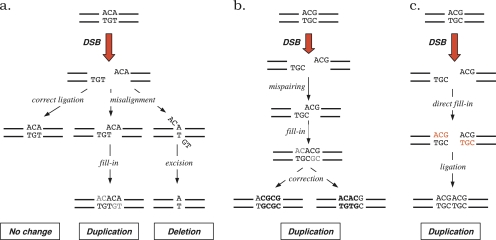
F<sc>IG</sc>. 5.—
FIG. 5.—
Models of indel slippage induced by NHEJ. Ligation of complementary ends is a molecular mechanism dedicated to repair DSB in all living organisms. It is an efficient, error-free process. (a) NHEJ occurs when complementary strands misalign during ligation, because of microhomologies in the cleaved sequence. This process can lead to tandem duplications or deletions of a few bases, depending on the misalignment (Paques and Haber 1999). (b) Mispairing during ligation can lead to tandem duplications of a few bases in the absence of microhomology. The duplicated motif depends on the direction of the mismatch correction. The size of the duplicated fragment is shorter by one nucleotide than the cleavage size. (c) An alternative NHEJ process includes direct fill-in of complementary ends, followed by a ligation of double-strand ends (Roth et al. 1985). This process leads to tandem duplication of the cleaved bases, even in the absence of microhomology.

References

    1. Angers B, Bernatchez L. Complex evolution of a salmonid microsatellite locus and its consequences in inferring allelic divergence from size information. Mol Biol Evol. 1997;14(3):230–238. - PubMed
    1. Blanchette M, et al. Aligning multiple genomic sequences with the threaded blockset aligner. Genome Res. 2004;14(4):708–715. - PMC - PubMed
    1. Brohede J, Ellegren H. Microsatellite evolution: polarity of substitutions within repeats and neutrality of flanking sequences. Proc Biol Sci. 1999;266(1421):825–833. - PMC - PubMed
    1. Buschiazzo E, Gemmell NJ. The rise, fall and renaissance of microsatellites in eukaryotic genomes. Bioessays. 2006;28(10):1040–1050. - PubMed
    1. Calabrese P, Durrett R. Dinucleotide repeats in the Drosophila and human genomes have complex, length-dependent mutation processes. Mol Biol Evol. 2003;20(5):715–725. - PubMed

Publication types