


Neurocognitive predictors of objective and subjective quality of life in individuals with schizophrenia: a meta-analytic investigation
- PMID: 20624752
- PMCID: PMC3283161
- DOI: 10.1093/schbul/sbq077
Neurocognitive predictors of objective and subjective quality of life in individuals with schizophrenia: a meta-analytic investigation
Abstract
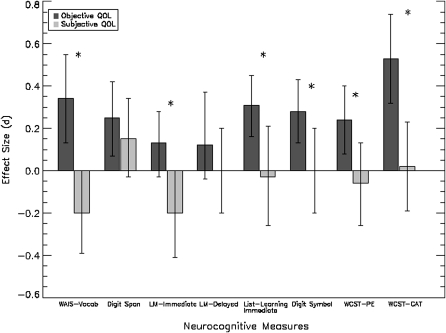
Quality of life (QOL) has been recognized as a crucial domain of outcome in schizophrenia treatment, and yet its determinants are not well understood. Recent meta-analyses suggest that symptoms have only a modest relationship to QOL (Eack SM, Newhill CE. Psychiatric symptoms and quality of life in schizophrenia: a meta-analysis. Schizophr Bull. 2007;33:1225-1237). Individuals with schizophrenia show 1-2 SD deficits on measures of elementary neurocognition, and links between these deficits and objective measures of community functioning (eg, employment and independent living) are well established. While objective measures of community functioning and measures of QOL would appear to be closely related, studies investigating the ability of neurocognitive variables to predict QOL in individuals with schizophrenia have yielded conflicting results. One potential explanation for opposing findings in the schizophrenia literature is the interchangeable use of objective and subjective indices of QOL. This study used quantitative methods of meta-analysis to clarify the relationship between neurocognitive determinants of objective QOL (ie, observable, clinician-rated) and subjective QOL (ie, patient satisfaction) separately in individuals with schizophrenia. A total of 20 studies (10 objective and 10 subjective) consisting of 1615 clients were aggregated from relevant databases. Weighted effect size analysis revealed that there were small-moderate relationships (d ≤ 0.55) between crystallized verbal ability, working memory verbal list learning, processing speed, and executive function and objective indices of QOL. In contrast, results revealed either nonsignificant or inverse relationships for the vast majority of neurocognitive measures and measures of subjective QOL. Moderating variables and implications for future research and treatment development are discussed.
Figures
References
-
- Awad AG, Voruganti LP. Intervention research in psychosis: issues related to the assessment of quality of life. Schizophr Bull. 2000;26:557–564. - PubMed
-
- Lehman AF. Measures of quality of life among persons with severe and persistent mental disorders. Soc Psychiatry Psychiatr Epidemiol. 1996;31(2):78–88. - PubMed
-
- Gold J, Harvey PD. Cognitive deficits in schizophrenia. The Psychiatr Clin North Am. 1993;16:295–312. - PubMed
-
- Heinrichs RW, Zakzanis KK. Neurocognitive deficit in schizophrenia: a quantitative review of the evidence. Neuropsychology. 1998;12:426–445. - PubMed
Publication types
MeSH terms
Grants and funding
LinkOut - more resources
Full Text Sources
Medical
