


Dispositional optimism predicts placebo analgesia
- PMID: 20627818
- PMCID: PMC2956003
- DOI: 10.1016/j.jpain.2010.02.014
Dispositional optimism predicts placebo analgesia
Abstract
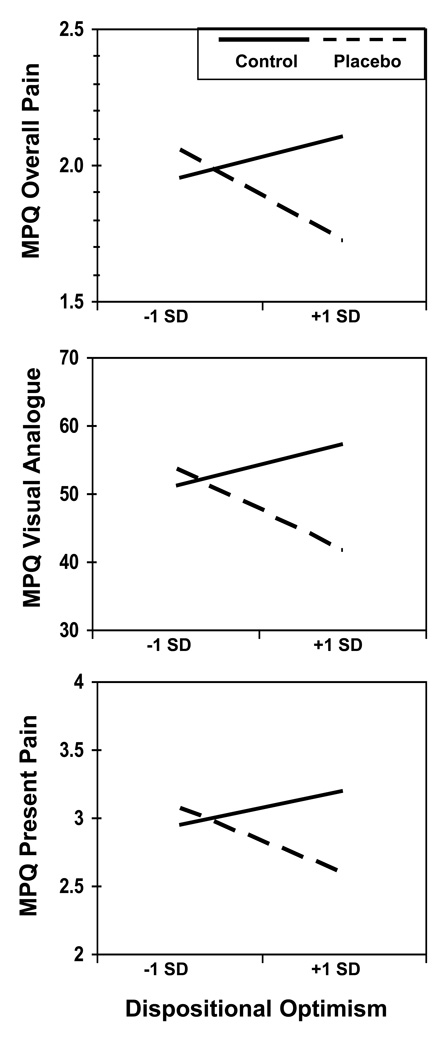
Based on prior research identifying dispositional optimism as a predictor of placebo responding, the present study tested the hypothesis that individuals high in optimism would be more likely to respond to a placebo analgesic. Optimists and pessimists were randomly assigned to a placebo expectation condition or a no expectation condition before a cold pressor task. Blood pressure and heart rate were recorded before and during the cold pressor task, and participant ratings of pain and expectations were obtained immediately after the task. Analysis of the expectation manipulation revealed that the placebo instruction was successful in altering participant expectancy during the cold pressor. Supporting the main hypothesis, dispositional optimism was associated with lower pain ratings in the placebo condition but not in the control condition. Because dispositional optimism can alter placebo responding to laboratory pain, future studies should examine the potential role that this individual difference factor may play in patient responsivity to pharmacological and nonpharmacological treatments for clinical pain.
Perspective: This study examined the possibility that individual differences can predict placebo analgesia. Participants were randomly assigned to receive either a placebo expectation or no expectation before a cold pressor task. Dispositional optimism was related to less cold pressor pain in the placebo condition as compared with the control condition.
Copyright © 2010 American Pain Society. Published by Elsevier Inc. All rights reserved.
Figures
References
-
- Abele AE, Gendolla GHE. Dispositional optimism predicts the recall of personally relevant information. Pers Individ Dif. 2007;43:1125–1135.
-
- Affleck G, Tennen H, Zautra A, Urrows S, Abeles M, Karoly P. Women’s pursuit of personal goals in daily life with Fibromyalgia: A value-expectancy analysis. J Pers Soc Psychol. 2001;69:587–596. - PubMed
-
- Aiken LS, West SG. Multiple regression: Testing and interpreting interactions. Newbury Park: Sage; 1991.
-
- Aspinwall LG, Richter L, Hoffman RR. Understanding how optimism works: An examination of optimists’ adaptive moderation of belief and behavior. In: Chang EC, editor. Optimism and pessimism: Implications for theory, research, and practice; Washington D.C: American Psychological Association; 2001. pp. 217–238.
Publication types
MeSH terms
Grants and funding
LinkOut - more resources
Full Text Sources
Medical
