


Finding and sharing: new approaches to registries of databases and services for the biomedical sciences
- PMID: 20627863
- PMCID: PMC2911849
- DOI: 10.1093/database/baq014
Finding and sharing: new approaches to registries of databases and services for the biomedical sciences
Abstract
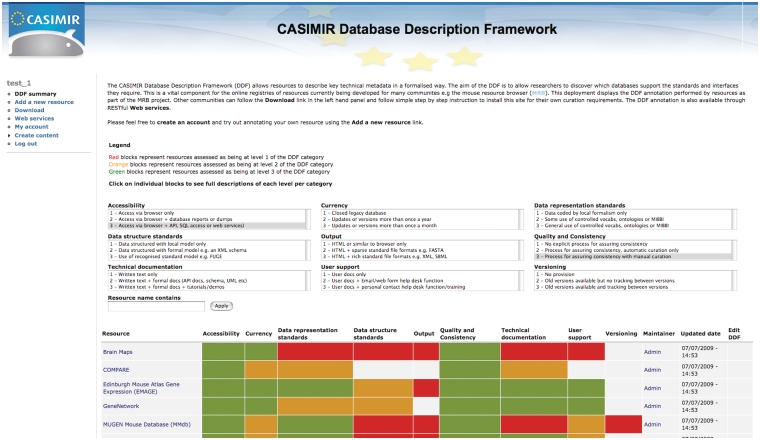
The recent explosion of biological data and the concomitant proliferation of distributed databases make it challenging for biologists and bioinformaticians to discover the best data resources for their needs, and the most efficient way to access and use them. Despite a rapid acceleration in uptake of syntactic and semantic standards for interoperability, it is still difficult for users to find which databases support the standards and interfaces that they need. To solve these problems, several groups are developing registries of databases that capture key metadata describing the biological scope, utility, accessibility, ease-of-use and existence of web services allowing interoperability between resources. Here, we describe some of these initiatives including a novel formalism, the Database Description Framework, for describing database operations and functionality and encouraging good database practise. We expect such approaches will result in improved discovery, uptake and utilization of data resources. Database URL: http://www.casimir.org.uk/casimir_ddf.
Figures
References
-
- Hancock JM, Schofield PN, Chandras C, et al. CASIMIR: Coordination and Sustainability of International Mouse Informatics Resources. Proceedings of the 8th IEEE International Conference on Bioinformatics and Bioengineering. 2008 doi:10.1109/BIBE.2008.4696712.
Publication types
MeSH terms
Grants and funding
LinkOut - more resources
Full Text Sources
