. 2010 Aug;133(Pt 8):2475-88.
doi: 10.1093/brain/awq159. Epub 2010 Jul 13.

Triptan-induced enhancement of neuronal nitric oxide synthase in trigeminal ganglion dural afferents underlies increased responsiveness to potential migraine triggers

Affiliations

Triptan-induced enhancement of neuronal nitric oxide synthase in trigeminal ganglion dural afferents underlies increased responsiveness to potential migraine triggers

Milena De Felice et al. Brain. 2010 Aug.

Abstract

Migraine is a common neurological disorder often treated with triptans. Triptan overuse can lead to increased frequency of headache in some patients, a phenomenon termed medication overuse headache. Previous preclinical studies have demonstrated that repeated or sustained triptan administration for several days can elicit persistent neural adaptations in trigeminal ganglion cells innervating the dura, prominently characterized by increased labelling of neuronal profiles for calcitonin gene related peptide. Additionally, triptan administration elicited a behavioural syndrome of enhanced sensitivity to surrogate triggers of migraine that was maintained for weeks following discontinuation of drug, a phenomenon termed 'triptan-induced latent sensitization'. Here, we demonstrate that triptan administration elicits a long-lasting increase in identified rat trigeminal dural afferents labelled for neuronal nitric oxide synthase in the trigeminal ganglion. Cutaneous allodynia observed during the period of triptan administration was reversed by NXN-323, a selective inhibitor of neuronal nitric oxide synthase. Additionally, neuronal nitric oxide synthase inhibition prevented environmental stress-induced hypersensitivity in the post-triptan administration period. Co-administration of NXN-323 with sumatriptan over several days prevented the expression of allodynia and enhanced sensitivity to stress observed following latent sensitization, but not the triptan-induced increased labelling of neuronal nitric oxide synthase in dural afferents. Triptan administration thus promotes increased expression of neuronal nitric oxide synthase in dural afferents, which is critical for enhanced sensitivity to environmental stress. These data provide a biological basis for increased frequency of headache following triptans and highlight the potential clinical utility of neuronal nitric oxide synthase inhibition in preventing or treating medication overuse headache.


Figures
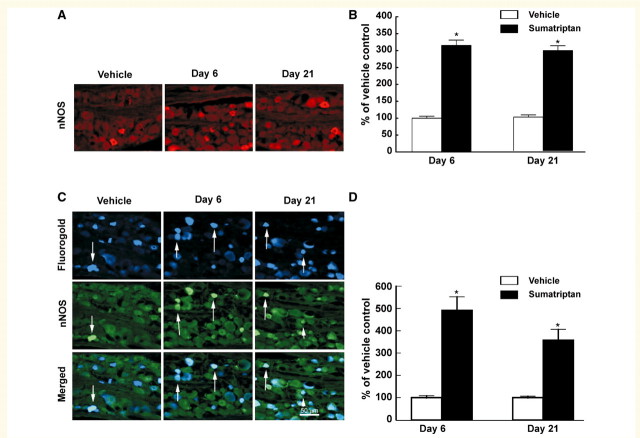
Figure 1
Figure 1
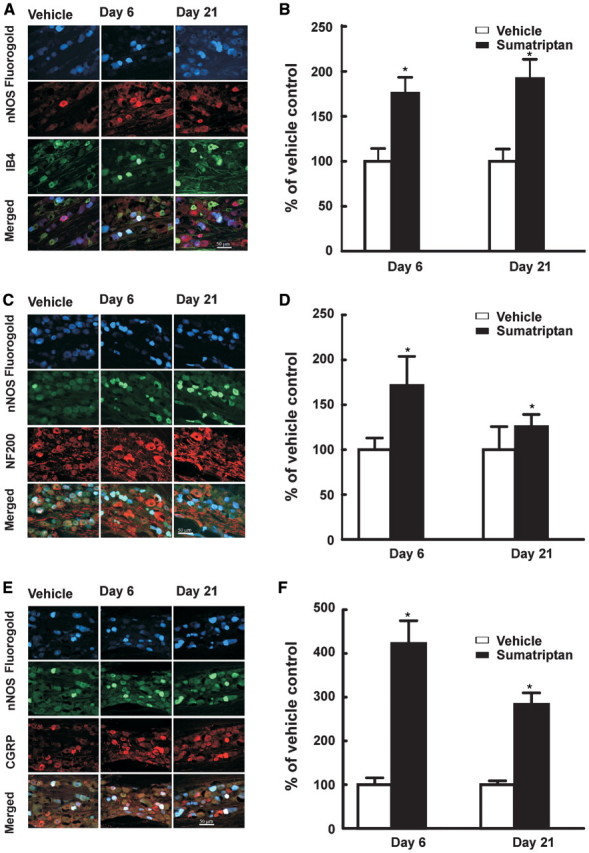
Sustained infusion of sumatriptan (0.6 mg/kg/day, s.c.) for 6 days promoted increased and persistent expression of neuronal NOS (nNOS) in the trigeminal ganglia of rats. Immunofluorescence labelling neuronal NOS in the trigeminal ganglion is shown for sections obtained 6 and 21 days after vehicle or sumatriptan pump was implanted (A). Sumatriptan exposure resulted in a significant (P < 0.05) increase in numbers of neuronal NOS-labelled profiles in the trigeminal ganglia, relative to vehicle-infused animals, at both Day 6 and 21 (B). Additionally, dural afferents were identified by application of Fluorogold to the dura and profiles expressing labelling for neuronal NOS (C) were evaluated in the trigeminal ganglia 6 and 21 days after sumatriptan exposure. The relative proportion of profiles obtained from sumatriptan-treated animals and expressing both the retrograde label and label for neuronal NOS in the trigeminal ganglia showed a significant and persistent (Day 6 and Day 21) increase relative to vehicle-infused animals (D). Asterisk indicates P < 0.05 relative to vehicle.
Figure 2
Figure 2
Sustained infusion of sumatriptan lead to an increased expression of neuronal NOS (nNOS) in normally ‘peptide-poor’ unmyelinated fibres and in myelinated fibres. Dural afferents were identified by administration of Fluorogold to the dura 4 days prior to collecting trigeminal tissue for immunofluorescent imaging. Trigeminal ganglion sections were obtained from rats 6 and 21 days after initiation of sumatriptan infusion (0.6 mg/kg/day, s.c.) and labelled for neuronal NOS. The sections were also labelled for reactivity to IB4 (A, B) or NF200 (C, D). The proportion of retrogradely-labelled profiles also showing label for neuronal NOS and for either IB4 or NF200 were determined relative to that shown by sections obtained from saline-treated rats. Sumatriptan infusion resulted in significant (P < 0.05) increase in retrogradely-labelled trigeminal profiles expressing label for neuronal NOS and either IB4 (B) or NF200 (D) 6 and 21 days after initiation of infusion. In dural afferents of the trigeminal ganglia, exposure to sumatriptan increased the co-expression of neuronal NOS with CGRP in retrogradely-labelled trigeminal profiles. After retrolabelling the dural afferent of the trigeminal ganglia, sections were prepared for fluorescent staining to visualize CGRP and neuronal NOS at Day 6 and 21 after sumatriptan exposure (E). The numbers of profiles expressing neuronal NOS and CGRP were counted (F). Sumatriptan exposure induced a marked significant (P < 0.05) increase in co-expression, relative to vehicle-infused animals, 6 and 21 days after sumatriptan pump implantation. Asterisk indicates P < 0.05 relative to vehicle.
Figure 3
Figure 3
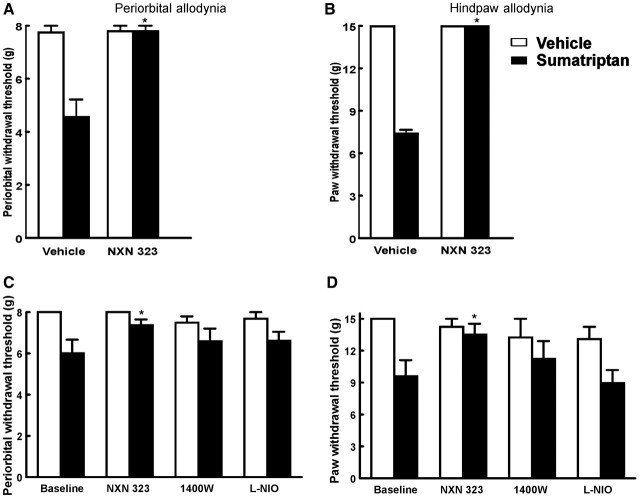
The effects of triptan exposure are mediated by neuronal NOS, and not inducible NOS or endothelial NOS. Rats infused with sumatriptan for 6 days were challenged with a single bolus injection of NXN-323 (A, B), which significantly (P < 0.05) elevated withdrawal thresholds, indicating a reversal of triptan-induced allodynia. Asterisk indicates P < 0.05 relative to vehicle. Additionally, co-infusion of sumatriptan (0.6 mg/kg/day, s.c.) with selective inhibitors of neuronal NOS (NXN-323), inducible NOS (1400W) or endothelial NOS [(l-iminoethyl) ornithine] resulted in significant (P < 0.05) reduction in tactile allodynia of the periorbital area (C) or hindpaws (D) with NXN-323. Neither 1400W nor (l-iminoethyl) ornithine prevented the development of tactile allodynia in rats infused with sumatriptan.
Figure 4
Figure 4
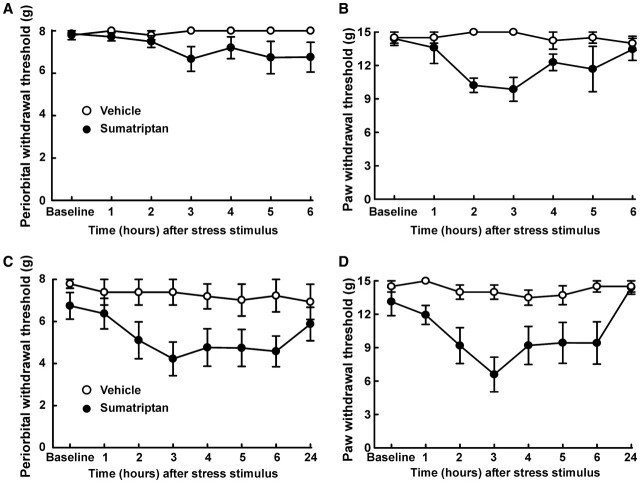
Sumatriptan-induced latent sensitization. Twenty days after pump implant, sumatriptan-exposed rats showed sensitivity to environmental stress. On Day 20, rats were exposed to bright light for 1 h, which caused a significant (P < 0.05) reduction in periorbital (A) or hind paw (B) thresholds in sumatriptan-exposed rats. More over on Day 21 a second exposure to bright light produced an even more robust facial (C) and hind paw (D) allodynia in sumatriptan pre-exposed animals. Two-factor ANOVA indicated significant (P < 0.05) differences in periorbital and hindpaw withdrawal thresholds between the vehicle-treated and sumatriptan-treated groups on both days.
Figure 5
Figure 5
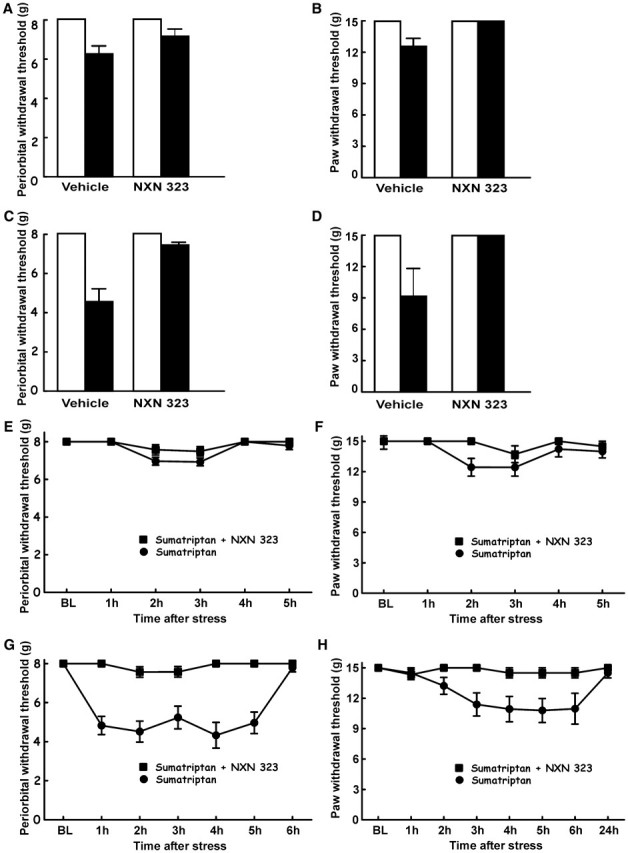
Stress-induced allodynia is blocked by selective neuronal NOS inhibitor. (A–D) Rats received sumatriptan infusion and were challenged on Days 20 and 21 with a single injection of NXN-323 prior to exposure to the bright light environmental stressor. NXN-323 blocked the expression of periorbital (A: Day 20, C: Day 21) and hind paw (B: Day 20, D: Day 21) tactile allodynia in sumatriptan-exposed rats. Two-factor ANOVA indicated significant (P50.05) differences in periorbital and hind paw withdrawal thresholds between the groups receiving vehicle and that receiving NXN-323 on both days. (E–H) On Days 20 and 21 after pump implantation, rats were exposed to bright light for 1 h, which caused a significant reduction in periorbital or hind paw thresholds in sumatriptan-exposed rats. However, co-infusion of sumatriptan and NXN-323 prevented the expression of periorbital (E: Day 20, G: Day 21) or hind paw (F: Day 20, H: Day 21) allodynia.
Figure 6
Figure 6
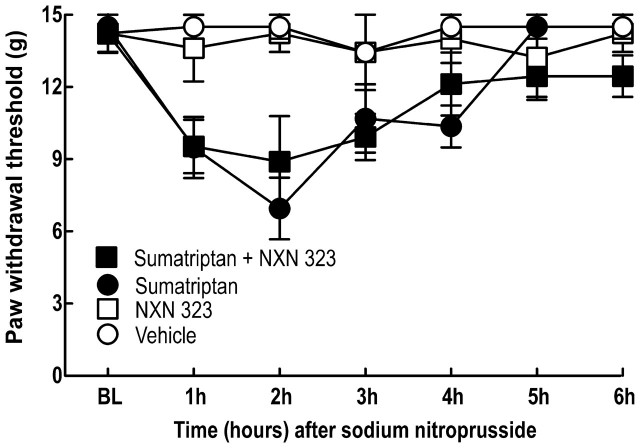
Sumatriptan-induced latent sensitization. Rats were pre-exposed to sumatriptan infusion and co-infusion of vehicle or NXN-323 for 6 days. The rats were challenged with sodium nitroprusside, which produced significant (P < 0.05) reductions in paw withdrawal thresholds in both vehicle-exposed and NXN-323-treated rats that also received sumatriptan infusion. Two-factor ANOVA indicated no significant (P > 0.05) differences withdrawal thresholds between the sumatriptan-infused groups receiving vehicle and that receiving NXN-323.

References

    1. Afridi SK, Kaube H, Goadsby PJ. Glyceryl trinitrate triggers premonitory symptoms in migraineurs. Pain. 2004;110:675–80. - PubMed
    1. Akerman S, Williamson DJ, Kaube H, Goadsby PJ. Nitric oxide synthase inhibitors can antagonize neurogenic and calcitonin gene-related peptide induced dilation of dural meningeal vessels. Br J Pharmacol. 2002;137:62–8. - PMC - PubMed
    1. Arulmani U, Maassenvandenbrink A, Villalon CM, Saxena PR. Calcitonin gene-related peptide and its role in migraine pathophysiology. Eur J Pharmacol. 2004;500:315–30. - PubMed
    1. Ayzenberg I, Obermann M, Nyhuis P, Gastpar M, Limmroth V, Diener HC, et al. Central sensitization of the trigeminal and somatic nociceptive systems in medication overuse headache mainly involves cerebral supraspinal structures. Cephalalgia. 2006;26:1106–14. - PubMed
    1. Bahra A, Walsh M, Menon S, Goadsby PJ. Does chronic daily headache arise de novo in association with regular use of analgesics? Headache. 2003;43:179–90. - PubMed

Publication types

MeSH terms