


Is it possible to improve residents breaking bad news skills? A randomised study assessing the efficacy of a communication skills training program
- PMID: 20628395
- PMCID: PMC2906741
- DOI: 10.1038/sj.bjc.6605749
Is it possible to improve residents breaking bad news skills? A randomised study assessing the efficacy of a communication skills training program
Abstract
Background: This study aims to assess the efficacy of a 40-h training programme designed to teach residents the communication skills needed to break the bad news.
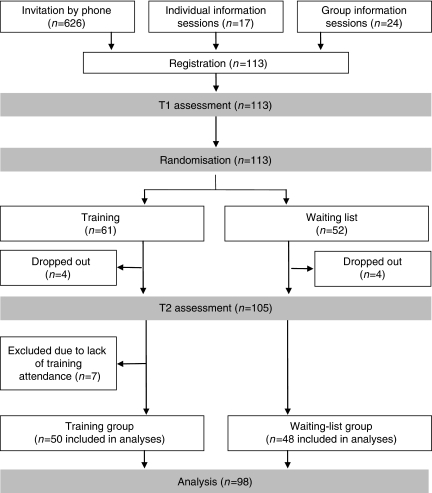
Methods: Residents were randomly assigned to the training programme or to a waiting list. A simulated patient breaking bad news (BBN) consultation was audiotaped at baseline and after training in the training group and 8 months after baseline in the waiting-list group. Transcripts were analysed by tagging the used communication skills with a content analysis software (LaComm) and by tagging the phases of bad news delivery: pre-delivery, delivery and post-delivery. Training effects were tested with generalised estimating equation (GEE) and multivariate analysis of variance (MANOVA).
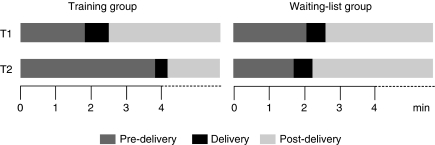
Results: The trained residents (n=50) used effective communication skills more often than the untrained residents (n=48): more open questions (relative rate (RR)=5.79; P<0.001), open directive questions (RR=1.71; P=0.003) and empathy (RR=4.50; P=0.017) and less information transmission (RR=0.72; P=0.001). The pre-delivery phase was longer for the trained (1 min 53 s at baseline and 3 min 55 s after training) compared with the untrained residents (2 min 7 s at baseline and 1 min 46 s at second assessment time; P<0.001).
Conclusion: This study shows the efficacy of training programme designed to improve residents' BBN skills. The way residents break bad news may thus be improved.
Conflict of interest statement
The authors declare no conflict of interest.
Figures
References
-
- Alexander SC, Keitz SA, Sloane R, Tulsky JA (2006) A controlled trial of a short course to improve residents' communication with patients at the end of life. Acad Med 81(11): 1008–1012 - PubMed
-
- Back AL, Arnold RM, Baile WF, Fryer-Edwards KA, Alexander SC, Barley GE, Gooley TA, Tulsky JA (2007) Efficacy of communication skills training for giving bad news and discussing transitions to palliative care. Arch Intern Med 167(5): 453–460 - PubMed
-
- Baile WF, Buckman R, Lenzi R, Glober G, ABeale E, Kudelka AP (2000) SPIKES-a six-step protocol for delivering bad news: application to the patient with cancer. Oncologist 5(4): 302–311 - PubMed
-
- Booth C, Maguire P (1991) Development of a Rating System to Assess Interaction Between Cancer Patients and Health Professionals. Report to Cancer Research Campaign: London
-
- Bragard I, Razavi D, Marchal S, Merckaert I, Delvaux N, Libert Y, Reynaert C, Boniver J, Klastersky J, Scalliet P, Etienne AM (2006) Teaching communication and stress management skills to junior physicians dealing with cancer patients: a Belgian Interuniversity Curriculum. Support Care Cancer 14(5): 454–461 - PubMed
Publication types
MeSH terms
LinkOut - more resources
Full Text Sources
Medical
Research Materials
