


Evaluation of candidate stromal epithelial cross-talk genes identifies association between risk of serous ovarian cancer and TERT, a cancer susceptibility "hot-spot"
- PMID: 20628624
- PMCID: PMC2900295
- DOI: 10.1371/journal.pgen.1001016
Evaluation of candidate stromal epithelial cross-talk genes identifies association between risk of serous ovarian cancer and TERT, a cancer susceptibility "hot-spot"
Abstract
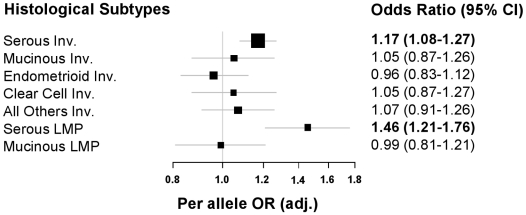
We hypothesized that variants in genes expressed as a consequence of interactions between ovarian cancer cells and the host micro-environment could contribute to cancer susceptibility. We therefore used a two-stage approach to evaluate common single nucleotide polymorphisms (SNPs) in 173 genes involved in stromal epithelial interactions in the Ovarian Cancer Association Consortium (OCAC). In the discovery stage, cases with epithelial ovarian cancer (n=675) and controls (n=1,162) were genotyped at 1,536 SNPs using an Illumina GoldenGate assay. Based on Positive Predictive Value estimates, three SNPs-PODXL rs1013368, ITGA6 rs13027811, and MMP3 rs522616-were selected for replication using TaqMan genotyping in up to 3,059 serous invasive cases and 8,905 controls from 16 OCAC case-control studies. An additional 18 SNPs with Pper-allele<0.05 in the discovery stage were selected for replication in a subset of five OCAC studies (n=1,233 serous invasive cases; n=3,364 controls). The discovery stage associations in PODXL, ITGA6, and MMP3 were attenuated in the larger replication set (adj. Pper-allele>or=0.5). However genotypes at TERT rs7726159 were associated with ovarian cancer risk in the smaller, five-study replication study (Pper-allele=0.03). Combined analysis of the discovery and replication sets for this TERT SNP showed an increased risk of serous ovarian cancer among non-Hispanic whites [adj. ORper-allele 1.14 (1.04-1.24) p=0.003]. Our study adds to the growing evidence that, like the 8q24 locus, the telomerase reverse transcriptase locus at 5p15.33, is a general cancer susceptibility locus.
Conflict of interest statement
The authors have declared that no competing interests exist.
Figures

References
-
- Parkin DM, Bray F, Ferlay J, Pisani P. Global cancer statistics, 2002. CA Cancer J Clin. 2005;55:74–108. - PubMed
-
- Wenham RM, Lancaster JM, Berchuck A. Molecular aspects of ovarian cancer. Best Pract Res Clin Obstet Gynaecol. 2002;16:483–497. - PubMed
-
- Whittemore AS. Characteristics relating to ovarian cancer risk: implications for prevention and detection. Gynecol Oncol. 1994;55:S15–19. - PubMed
-
- Pharoah PD, Ponder BA. The genetics of ovarian cancer. Best Pract Res Clin Obstet Gynaecol. 2002;16:449–468. - PubMed
-
- Boyd J, Rubin SC. Hereditary ovarian cancer: molecular genetics and clinical implications. Gynecol Oncol. 1997;64:196–206. - PubMed
Publication types
MeSH terms
Substances
Grants and funding
- R01CA095023/CA/NCI NIH HHS/United States
- R01 CA087538/CA/NCI NIH HHS/United States
- R01 CA095023/CA/NCI NIH HHS/United States
- R01CA54419/CA/NCI NIH HHS/United States
- R01 CA058860/CA/NCI NIH HHS/United States
- R01CA112523/CA/NCI NIH HHS/United States
- P50 CA105009/CA/NCI NIH HHS/United States
- A10119/CRUK_/Cancer Research UK/United Kingdom
- U01 CA058860/CA/NCI NIH HHS/United States
- 10119/CRUK_/Cancer Research UK/United Kingdom
- CA-58860/CA/NCI NIH HHS/United States
- R01 CA112523/CA/NCI NIH HHS/United States
- A10124/CRUK_/Cancer Research UK/United Kingdom
- 10124/CRUK_/Cancer Research UK/United Kingdom
- R01 CA87538/CA/NCI NIH HHS/United States
- R01 CA058598/CA/NCI NIH HHS/United States
- R01-CA122443/CA/NCI NIH HHS/United States
- K07 CA092044/CA/NCI NIH HHS/United States
- 11021/CRUK_/Cancer Research UK/United Kingdom
- G0801875/MRC_/Medical Research Council/United Kingdom
- R01 CA054419/CA/NCI NIH HHS/United States
- R01 CA122443/CA/NCI NIH HHS/United States
- CA-92044/CA/NCI NIH HHS/United States
- P50CA105009/CA/NCI NIH HHS/United States
LinkOut - more resources
Full Text Sources
Other Literature Sources
Medical
Molecular Biology Databases
Miscellaneous
