


Sleep assessments in healthy school-aged children using actigraphy: concordance with polysomnography
- PMID: 20629939
- PMCID: PMC3040287
- DOI: 10.1111/j.1365-2869.2010.00857.x
Sleep assessments in healthy school-aged children using actigraphy: concordance with polysomnography
Abstract
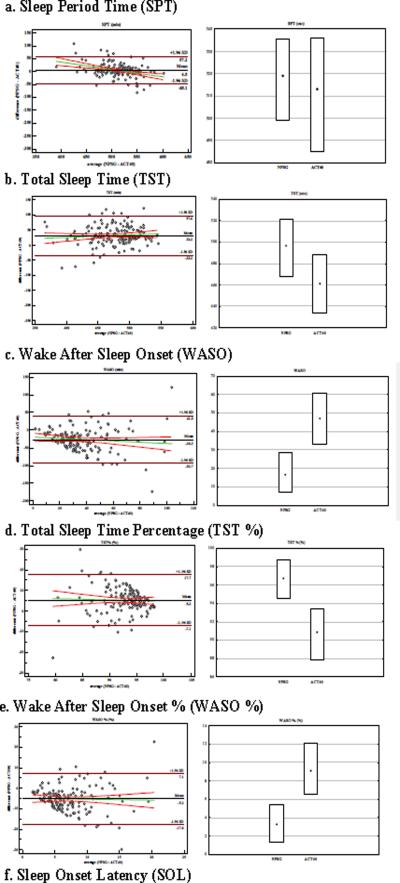
Actigraphic (ACT) recordings are used widely in schoolchildren as a less intrusive and more extended approach to evaluation of sleep problems. However, critical assessment of the validity and reliability of ACT against overnight polysomnography (NPSG) are unavailable. Thus, we explored the degree of concordance between NPSG and ACT in school-aged children to delineate potential ACT boundaries when interpreting pediatric sleep. Non-dominant wrist ACT was recorded simultaneously with NPSG in 149 healthy school-aged children (aged 4.1-8.8 years, 41.7% boys, 80.4% Caucasian) recruited from the community. Analyses were limited to the Actiware (MiniMitter-64) calculated parameters originating from 1-min epoch sampling and medium sensitivity threshold value of 40; i.e. sleep period time (SPT), total sleep time (TST) and wake after sleep onset (WASO). SPT was not significantly different between ACT and NPSG. However, ACT underestimated TST significantly by 32.2±33.4 min and overestimated WASO by 26.3±34.4 min. The decreased precision of ACT was also evident from moderate to small concordance correlation coefficients (0.47 for TST and 0.09 for WASO). ACT in school-aged children provides reliable assessment of sleep quantity, but is relatively inaccurate during determination of sleep quality. Thus, caution is advocated in drawing definitive conclusions from ACT during evaluation of the sleep-disturbed child.
© 2010 European Sleep Research Society.
Figures
References
-
- Acebo C, Lebourgeois MK. Actigraphy. Respir. Care Clin. N. Am. 2006;12:23–30. viii. - PubMed
-
- Ancoli-Israel S, Cole R, Alessi C, Chambers M, Moorcroft W, Pollak CP. The role of actigraphy in the study of sleep and circadian rhythms. Sleep. 2003;26:342–92. - PubMed
-
- Aronen ET, Fjallberg M, Paavonen EJ, Soininen M. Day length associates with activity level in children living at 60 degrees north. Child Psychiatry Hum. Dev. 2002;32:217–26. - PubMed
-
- Aronen ET, Paavonen EJ, Soininen M, Fjallberg M. Associations of age and gender with activity and sleep. Acta Paediatrica, International Journal of Paediatrics. 2001;90:222–24. - PubMed
-
- Cole RJ, Kripke DF, Gruen W, Mullaney DJ, Gillin JC. Automatic sleep/wake identification from wrist activity. Sleep. 1992;15:461–9. - PubMed
Publication types
MeSH terms
Grants and funding
LinkOut - more resources
Full Text Sources
