


Hereditary combined deficiency of the vitamin K-dependent clotting factors
- PMID: 20630065
- PMCID: PMC2913942
- DOI: 10.1186/1750-1172-5-21
Hereditary combined deficiency of the vitamin K-dependent clotting factors
Abstract
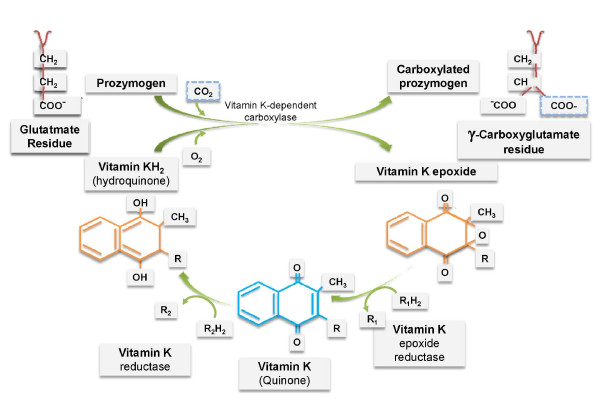
Hereditary combined vitamin K-dependent clotting factors deficiency (VKCFD) is a rare congenital bleeding disorder resulting from variably decreased levels of coagulation factors II, VII, IX and X as well as natural anticoagulants protein C, protein S and protein Z. The spectrum of bleeding symptoms ranges from mild to severe with onset in the neonatal period in severe cases. The bleeding symptoms are often life-threatening, occur both spontaneously and in a surgical setting, and usually involve the skin and mucosae. A range of non-haemostatic symptoms are often present, including developmental and skeletal anomalies. VKCFD is an autosomal recessive disorder caused by mutations in the genes of either gamma-glutamyl carboxylase or vitamin K2,3-epoxide reductase complex. These two proteins are necessary for gamma-carboxylation, a post-synthetic modification that allows coagulation proteins to display their proper function. The developmental and skeletal anomalies seen in VKCFD are the result of defective gamma-carboxylation of a number of non-haemostatic proteins. Diagnostic differentiation from other conditions, both congenital and acquired, is mandatory and genotype analysis is needed to confirm the defect. Vitamin K administration is the mainstay of therapy in VKCFD, with plasma supplementation during surgery or severe bleeding episodes. In addition, prothrombin complex concentrates and combination therapy with recombinant activated FVII and vitamin K supplementation may constitute alternative treatment options. The overall prognosis is good and with the availability of several effective therapeutic options, VKCFD has only a small impact on the quality of life of affected patients.
References
-
- Soff GA, Levin J. Familial multiple coagulation factor deficiencies. I. Review of the literature: differentiation of single hereditary disorders associated with multiple factor deficiencies from coincidental concurrence of single factor deficiency states. Semin Thromb Hemost. 1981;7:112–148. doi: 10.1055/s-2007-1005073. - DOI - PubMed
-
- Soff GA, Levin J, Bell WR. Familial multiple coagulation factor deficiencies. II. Combined factor VIII, IX, and XI deficiency and combined factor IX and XI deficiency: two previously uncharacterized familial multiple factor deficiency syndromes. Semin Thromb Hemost. 1981;7:149–169. doi: 10.1055/s-2007-1005074. - DOI - PubMed
-
- Soute BAM, Ulrich MMW, Watson ADJ, Maddison JE, Ebberink RHM, Vermeer C. Congenital deficiency of all vitamin K-dependent blood coagulation factors due to a defective vitamin K-dependent carboxylase in Devon Rex cats. Thromb Haemost. 1992;68:521–525. - PubMed
-
- Oldenburg J, von Brederlow B, Fregin A, Rost S, Wolz W, Eberl W, Eber S, Lenz E, Schwaab R, Brackmann HH, Effenberger W, Harbrecht U, Schurgers LJ, Vermeer C, Muller CR. Congenital deficiency of vitamin K dependent coagulation factors in two families presents as a genetic defect of the vitamin K-epoxide-reductase-complex. Thromb Haemost. 2000;84:937–941. - PubMed
Publication types
MeSH terms
Substances
LinkOut - more resources
Full Text Sources
