


Responding to inequities: gorillas try to maintain their competitive advantage during play fights
- PMID: 20630892
- PMCID: PMC3030874
- DOI: 10.1098/rsbl.2010.0482
Responding to inequities: gorillas try to maintain their competitive advantage during play fights
Abstract
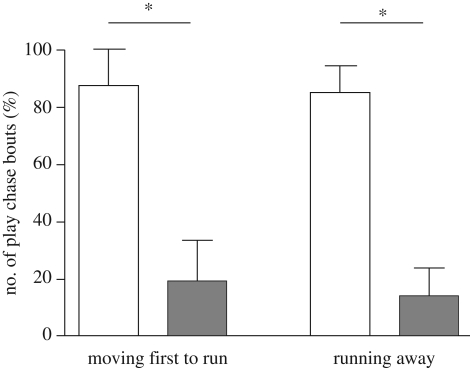
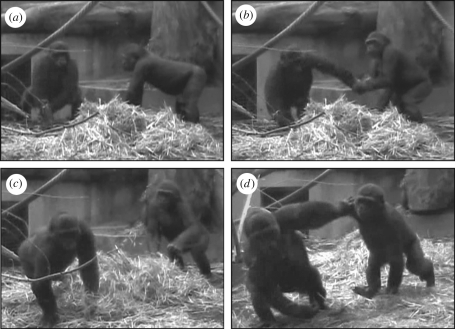
Humans respond to unfair situations in various ways. Experimental research has revealed that non-human species also respond to unequal situations in the form of inequity aversions when they have the disadvantage. The current study focused on play fights in gorillas to explore for the first time, to our knowledge, if/how non-human species respond to inequities in natural social settings. Hitting causes a naturally occurring inequity among individuals and here it was specifically assessed how the hitters and their partners engaged in play chases that followed the hitting. The results of this work showed that the hitters significantly more often moved first to run away immediately after the encounter than their partners. These findings provide evidence that non-human species respond to inequities by trying to maintain their competitive advantages. We conclude that non-human primates, like humans, may show different responses to inequities and that they may modify them depending on if they have the advantage or the disadvantage.
Figures
References
-
- Fehr E., Schmidt K. M. 1999. A theory of fairness, competition, and cooperation. Q. J. Econ. 114, 817–86810.1162/003355399556151 (doi:10.1162/003355399556151) - DOI - DOI
-
- Henrich J., Boyd R., Bowles S., Camerer C., Fehr E., Gintis H., McElreath R. 2001. In search of Homo economicus: behavioral experiments in 15 small-scale societies. Am. Econ. Rev. 91, 73–7810.1257/aer.91.2.73 (doi:10.1.1.23.2064) - DOI - DOI
-
- Brosnan S. F., Schiff H., de Waal F. B. M. 2005. Tolerance for inequity increases with social closeness in chimpanzees. Proc. R. Soc. B 272, 253–25810.1098/rspb.2004.2947 (doi:10.1098/rspb.2004.2947) - DOI - DOI - PMC - PubMed
-
- Brosnan S. F., de Waal F. B. M. 2003. Monkeys reject unequal pay. Nature 425, 297–29910.1038/nature01963 (doi:10.1038/nature01963) - DOI - DOI - PubMed
-
- Range F., Horn L., Viranyi Z., Huber L. 2008. The absence of reward induces inequity aversion in dogs. Proc. Natl Acad. Sci. USA 106, 340–34510.1073/pnas.0810957105 (doi:10.1073/pnas.0810957105) - DOI - DOI - PMC - PubMed
Publication types
MeSH terms
LinkOut - more resources
Full Text Sources
