


Liver x receptor signaling pathways and atherosclerosis
- PMID: 20631351
- PMCID: PMC2919217
- DOI: 10.1161/ATVBAHA.109.191197
Liver x receptor signaling pathways and atherosclerosis
Abstract
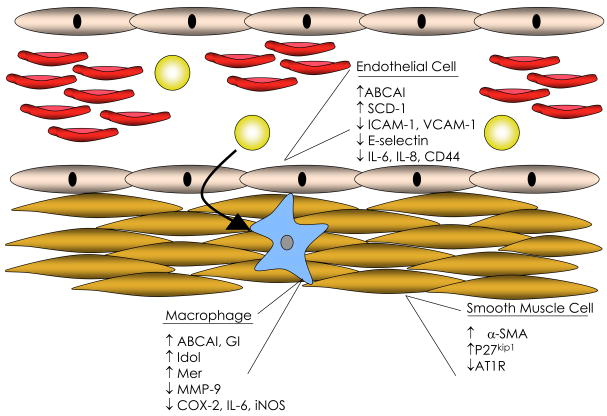
First discovered as orphan receptors, liver X receptors (LXRs) were subsequently identified as the nuclear receptor target of the cholesterol metabolites, oxysterols. There are 2 LXR receptors encoded by distinct genes: LXRalpha is most highly expressed in the liver, adipose, kidney, adrenal tissues, and macrophages and LXRbeta is ubiquitously expressed. Despite differential tissue distribution, these isoforms have 78% homology in their ligand-binding domain and appear to respond to the same endogenous ligands. Work over the past 10 years has shown that the LXR pathway regulates lipid metabolism and inflammation via both the induction and repression of target genes. Given the importance of cholesterol regulation and inflammation in the development of cardiovascular disease, it is not surprising that activation of the LXR pathway attenuates various mechanisms underlying atherosclerotic plaque development. In this brief review, we will discuss the impact of the LXR pathway on both cholesterol metabolism and atherosclerosis.
Figures
References
-
- Janowski BA, Willy PJ, Devi TR, Falck JR, Mangelsdorf DJ. An oxysterol signalling pathway mediated by the nuclear receptor LXR alpha. Nature. 1996;383:728–731. - PubMed
-
- Joseph SB, McKilligin E, Pei L, Watson MA, Collins AR, Laffitte BA, Chen M, Noh G, Goodman J, Hagger GN, Tran J, Tippin TK, Wang X, Lusis AJ, Hsueh WA, Law RE, Collins JL, Willson TM, Tontonoz P. Synthetic LXR ligand inhibits the development of atherosclerosis in mice. Proc Natl Acad Sci U S A. 2002;99:7604–7609. - PMC - PubMed
-
- Levin N, Bischoff ED, Daige CL, Thomas D, Vu CT, Heyman RA, Tangirala RK, Schulman IG. Macrophage liver X receptor is required for antiatherogenic activity of LXR agonists. Arterioscler Thromb Vasc Biol. 2005;25:135–142. - PubMed
Publication types
MeSH terms
Substances
Grants and funding
LinkOut - more resources
Full Text Sources
Other Literature Sources
Medical
Molecular Biology Databases
Miscellaneous
