


Impact of human leukocyte antigen mismatching on outcomes of liver transplantation: a meta-analysis
- PMID: 20632452
- PMCID: PMC2904896
- DOI: 10.3748/wjg.v16.i27.3457
Impact of human leukocyte antigen mismatching on outcomes of liver transplantation: a meta-analysis
Abstract
Aim: To assess the effect of human leukocyte antigen (HLA) mismatching on liver graft outcome and acute rejection from a meta-analysis of available cohort studies.
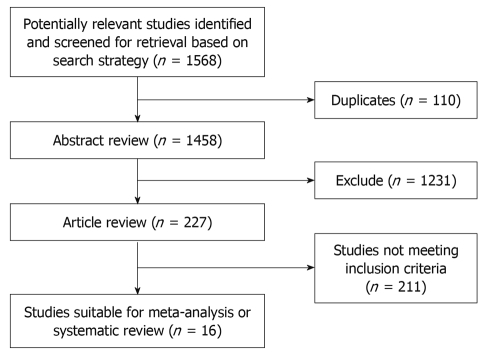
Methods: Articles in PubMed/MEDLINE, EMBASE and the Cochrane database from January 1970 to June 2009, including non-English literature identified in these databases, were searched. Only studies comparing HLA or sub-phenotype matching with mismatching were extracted. The percentage of graft survival was extracted by "Engauge Digitizer" from survival curves if the raw data were not displayed. A meta-analysis was performed when at least 3 studies provided data.
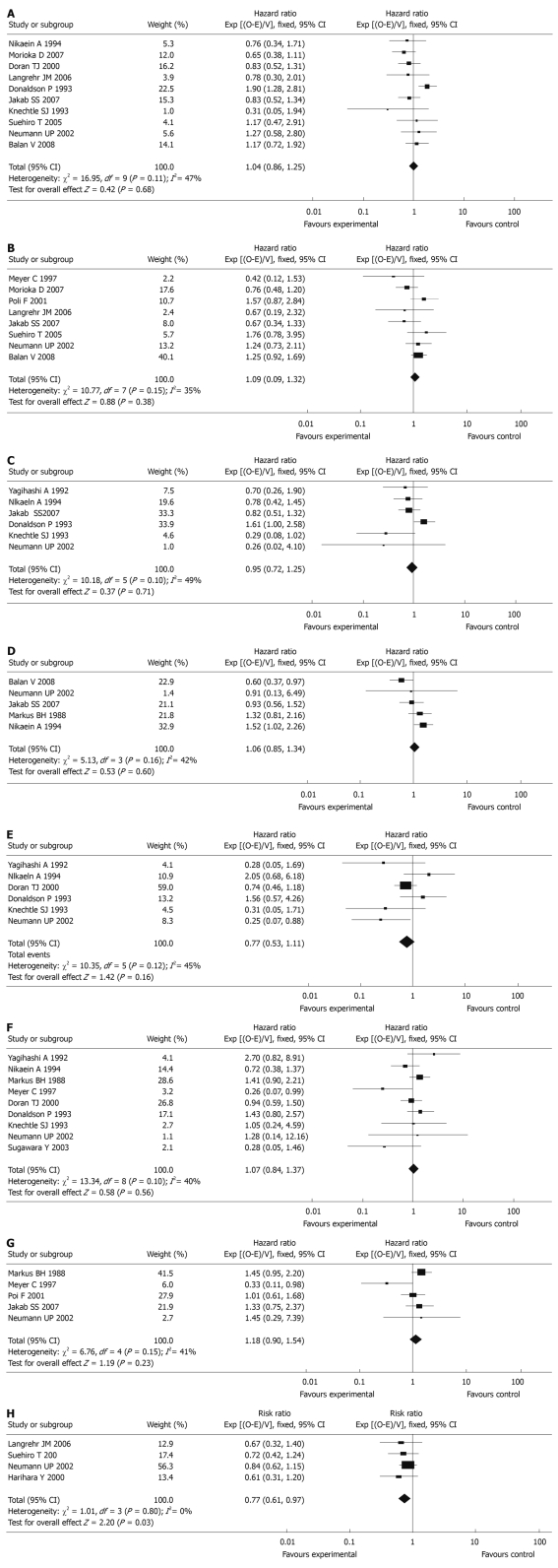
Results: Sixteen studies met the inclusion criteria. A lower number of HLA mismatches (0-2 vs 3-6) did reduce the incidence of acute rejection (relative risk: 0.77, P = 0.03). The degree of HLA mismatching (0-2 vs 3-6) had no significant effect on 1-year [hazard ratio (HR): 1.04, P = 0.68] and 5-year (HR: 1.09, P = 0.38) graft survival. In sub-phenotype analysis, the degree of HLA-A, B and DR mismatching (0 vs 1-2) had no significant effect on 1-year and 5-year graft survival, either. The HRs and P-values were 0.95, 0.71 (HLA-A, 1-year); 1.06, 0.60 (HLA-A, 5-year); 0.77, 0.16 (HLA-B, 1-year); 1.07, 0.56 (HLA-DR, 1-year); 1.18, 0.23 (HLA-DR, 5-year), respectively.
Conclusion: The results of this systematic review imply that good HLA compatibility can reduce the incidence of acute rejection in spite of having no influence on graft outcomes. To obtain a short recovery time and minimize rejection post transplantation, HLA matching studies should be considered before the operation.
Figures
References
-
- Opelz G. Success rate and impact of HLA matching on kidney graft survival in highly immunized recipients. Collaborative Transplant Study. Transpl Int. 1992;5 Suppl 1:S601–S603. - PubMed
-
- Lee PC, Zhu L, Terasaki PI, Everly MJ. HLA-specific antibodies developed in the first year posttransplant are predictive of chronic rejection and renal graft loss. Transplantation. 2009;88:568–574. - PubMed
-
- Meng HL, Jin XB, Li XT, Wang HW, Lü JJ. Impact of human leukocyte antigen matching and recipients’ panel reactive antibodies on two-year outcome in presensitized renal allograft recipients. Chin Med J (Engl) 2009;122:420–426. - PubMed
-
- Kaczmarek I, Deutsch MA, Rohrer ME, Beiras-Fernandez A, Groetzner J, Daebritz S, Schmoeckel M, Spannagl M, Meiser B, Reichart B. HLA-DR matching improves survival after heart transplantation: is it time to change allocation policies? J Heart Lung Transplant. 2006;25:1057–1062. - PubMed
-
- Wong JY, Tait B, Levvey B, Griffiths A, Esmore DS, Snell GI, Williams TJ, Kotsimbos TC. Epstein-Barr virus primary mismatching and HLA matching: key risk factors for post lung transplant lymphoproliferative disease. Transplantation. 2004;78:205–210. - PubMed
Publication types
MeSH terms
Substances
LinkOut - more resources
Full Text Sources
Medical
Research Materials
Miscellaneous
