


Complex regional pain syndrome: what's in a name?
- PMID: 20634146
- PMCID: PMC4850066
- DOI: 10.1016/j.jpain.2010.06.001
Complex regional pain syndrome: what's in a name?
Abstract
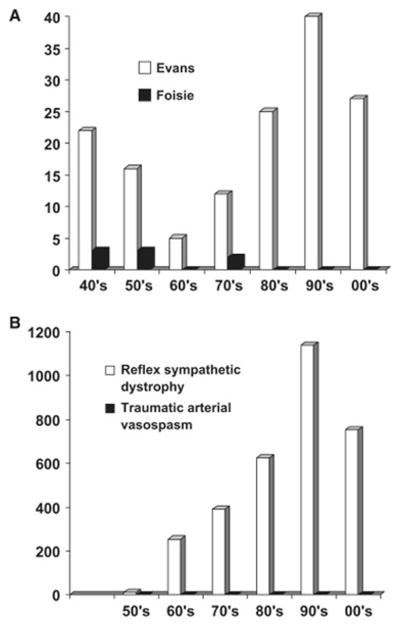
Within a 2-year period in the 1940s, 2 Boston physicians published dramatically opposing views on the underlying nature of a syndrome now known as complex regional pain syndrome (CRPS). Evans suggested, in several papers in 1946-1947, that sympathetic reflexes maintain pain and dystrophy in affected limbs. Foisie, in 1947, suggested arterial vasospasms were key in the etiology of this pain syndrome. Evans' hypothesis established the nomenclature for this syndrome for 60 years, and his term, "reflex sympathetic dystrophy," guided clinical treatment and research activities over the same period. Foisie's proposed nomenclature was unrecognized, and had virtually no impact on the field. Recent evidence suggests that Evans' contribution to the field may have in fact led clinicians and researchers astray all those years. This focus article on CRPS compares recent observations with these 2 earlier theories and asks the question-what if we had adopted Foisie's nomenclature from the beginning?
Perspective: This article discusses 2 opposing historical views on the etiology of what is now known as CRPS, and how they affected nomenclature, research, and clinical therapy in subsequent decades. This focus article may help researchers and clinicians realize the importance of syndrome names, and how they may inadvertently misdirect research and treatment.
Copyright © 2011 American Pain Society. Published by Elsevier Inc. All rights reserved.
Figures
References
-
- AbuRahma AF, Robinson PA, Powell M, Bastug D, Boland JP. Sympathectomy for reflex sympathetic dystrophy: Factors affecting outcome. Ann Vasc Surg. 1994;8:372–379. - PubMed
-
- Ackerman WE, Munir MA, Zhang J-M. Assessment of laser Doppler imaging for the diagnosis of complex regional pain syndrome I. J Neuropathic Pain Symp Pal. 2005;1:13–20.
-
- Albrecht PJ, Hines S, Eisenberg E, Pud D, Finlay DR, Connolly MK, Paré M, Davar G, Rice FL. Pathologic alterations of cutaneous innervations and vasculature in affected limbs from patients with complex regional pain syndrome. Pain. 2006;120:244–266. - PubMed
-
- Allen G, Galer BS, Schwartz L. Epidemiology of complex regional pain syndrome: A retrospective chart review of 134 patients. Pain. 1999;80:539–544. - PubMed
-
- Amadio PC. Vitamin C reduced the incidence of reflex sympathetic dystrophy after wrist fracture. J Bone Joint Surg Am. 2000;82:873. - PubMed
Publication types
MeSH terms
Grants and funding
LinkOut - more resources
Full Text Sources
Other Literature Sources
Medical
